
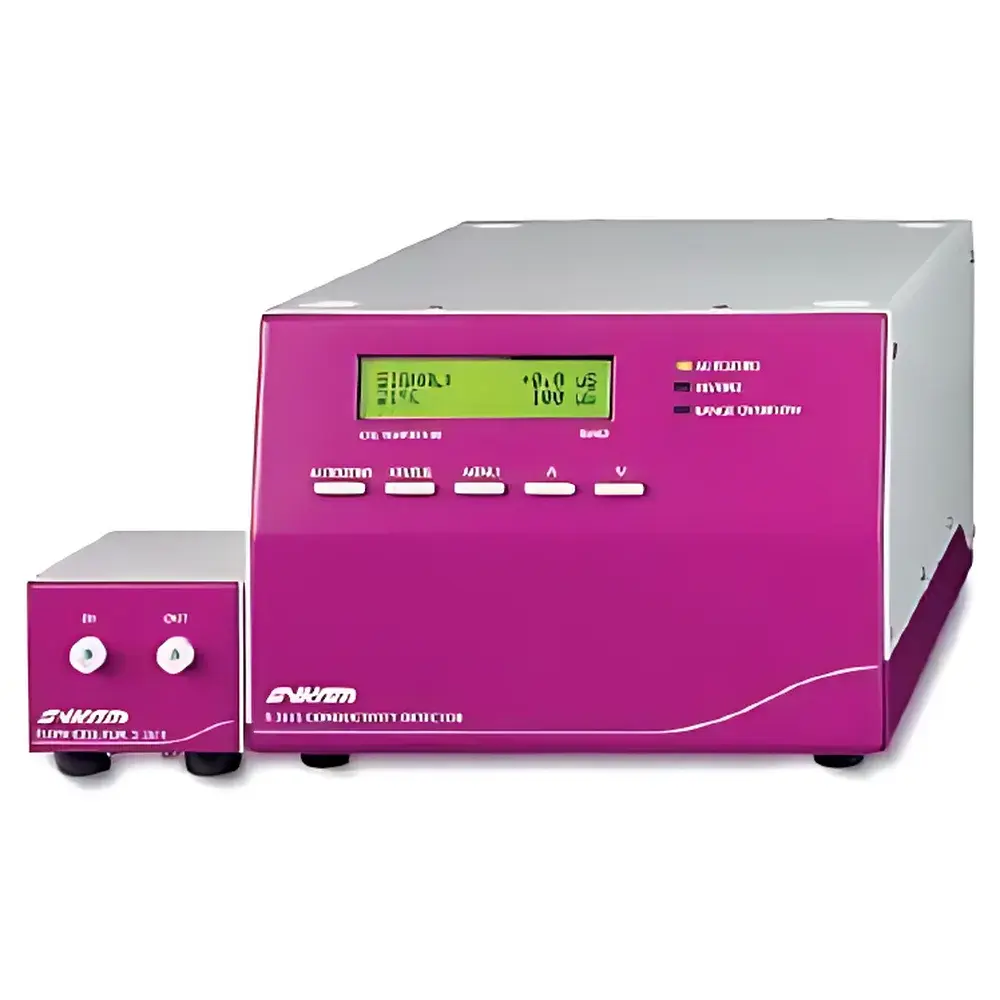
Sykam S-3115 Conductivity Detector
| Brand | Sykam |
|---|---|
| Origin | Germany |
| Model | S-3115 |
| Detection Principle | Bipolar Pulsed Electrode Conductivity Measurement |
| Measuring Range | 0.05–10,000 µS |
| Rise Time | 0–10 s |
| Cell Volume | 0.2 µL |
| Temperature Control Range | Ambient to 85 °C |
| Temperature Stability | ±0.01 °C |
| Signal Offset Adjustment | 0–20% of full scale |
| Digital Signal Smoothing | Enabled |
| Auto-zero Function | Supported |
| External Control Interface | Analog (0–10 V) and RS232 |
| Dimensions | 330 × 220 × 160 mm |
| Weight | ~8 kg |
Overview
The Sykam S-3115 Conductivity Detector is a high-precision, temperature-stabilized electrochemical detection system engineered for integration into ion chromatography (IC) and capillary electrophoresis (CE) platforms. It operates on the principle of bipolar pulsed electrode conductivity measurement — a technique that eliminates electrode polarization effects and enables stable, drift-free detection of ionic species in aqueous eluents. Designed and manufactured in Germany under strict quality control standards, the S-3115 delivers exceptional baseline stability and reproducibility across extended run times, making it suitable for routine quantitative analysis in regulated environments including pharmaceutical QC, environmental monitoring, and food safety laboratories.
Key Features
- Ultra-low dead-volume flow cell (0.2 µL) minimizes band broadening and preserves chromatographic resolution, especially critical for capillary- and microbore-column applications.
- Integrated thermostatic control with ±0.01 °C stability over ambient to 85 °C ensures consistent conductivity response independent of ambient fluctuations or eluent viscosity changes.
- Wide dynamic detection range (0.05–10,000 µS) accommodates both trace-level anion/cation quantification and high-concentration standard calibration without manual range switching.
- Digital signal smoothing algorithm reduces high-frequency noise while preserving true peak shape and retention time fidelity — configurable via front-panel interface or remote command.
- Auto-zero function compensates for background conductivity drift during gradient elution or mobile phase composition changes, enhancing long-term method robustness.
- Flexible external control architecture supports analog voltage input (0–10 V) for real-time gain/offset adjustment and bidirectional RS232 communication for full parameter configuration, data logging, and synchronization with chromatography data systems (CDS).
Sample Compatibility & Compliance
The S-3115 is compatible with common IC eluents including carbonate/bicarbonate, methanesulfonic acid (MSA), and potassium hydroxide (KOH) gradients. Its chemically resistant stainless-steel and PEEK-wetted components ensure compatibility with aggressive eluents and suppressor-regenerated streams. The detector conforms to ISO 9001 manufacturing protocols and supports GLP/GMP-compliant workflows through audit-trail-capable software interfaces. When integrated with validated CDS platforms, it meets requirements for data integrity under FDA 21 CFR Part 11 when used with appropriate electronic signature and access control configurations.
Software & Data Management
The S-3115 does not include embedded software but is fully interoperable with industry-standard chromatography data systems (e.g., Chromeleon, Empower, OpenLab CDS) via RS232 or analog output. All operational parameters—including temperature setpoint, signal offset (0–20% full scale), smoothing factor, and auto-zero trigger conditions—are remotely configurable and recallable as method-associated settings. Raw analog output (±1 V full scale) is digitized at ≥16-bit resolution by connected DAQ hardware, ensuring high-fidelity peak integration and low-noise quantitation. Firmware updates are delivered via serial interface and include version-locked calibration checksums for traceability.
Applications
- Quantitative determination of inorganic anions (F⁻, Cl⁻, NO₂⁻, Br⁻, NO₃⁻, PO₄³⁻, SO₄²⁻) and cations (Li⁺, Na⁺, NH₄⁺, K⁺, Mg²⁺, Ca²⁺) in drinking water, wastewater, and soil extracts per EPA Methods 300.0, 300.1, and ISO 10304 series.
- Analysis of organic acids (acetate, formate, oxalate) and amines in bioprocess monitoring and fermentation broth characterization.
- Trace chloride and sulfate detection in high-purity pharmaceutical excipients and active pharmaceutical ingredients (APIs), aligned with USP and EP 2.2.38.
- Ion profiling in battery electrolyte formulations and semiconductor-grade ultrapure water (UPW) testing.
FAQ
What is the minimum detectable conductivity change supported by the S-3115?
The detector’s effective resolution depends on system noise floor and data acquisition rate; under typical IC conditions (1 Hz sampling, optimized smoothing), it reliably resolves changes ≥0.02 µS.
Can the S-3115 be used with suppressed and non-suppressed ion chromatography systems?
Yes — its wide linear range and low-noise design support both suppressed-mode (low-background conductivity) and non-suppressed (high-background) configurations.
Is the temperature-controlled flow cell compatible with organic solvent-containing eluents?
The standard cell is rated for aqueous and ≤15% (v/v) miscible organic modifiers (e.g., methanol, acetonitrile); extended solvent compatibility requires optional PTFE-sealed cell variants.
Does the detector provide digital output natively, or only analog?
Native output is analog (±1 V); digital data acquisition requires external ADC hardware or CDS with built-in digitization — no onboard Ethernet or USB interface is provided.
How is calibration traceability maintained for regulatory submissions?
Calibration is performed using NIST-traceable KCl standard solutions; instrument logs store date/time-stamped calibration events, operator ID (if entered), and measured response values — exportable as CSV for audit review.
Related Products





