
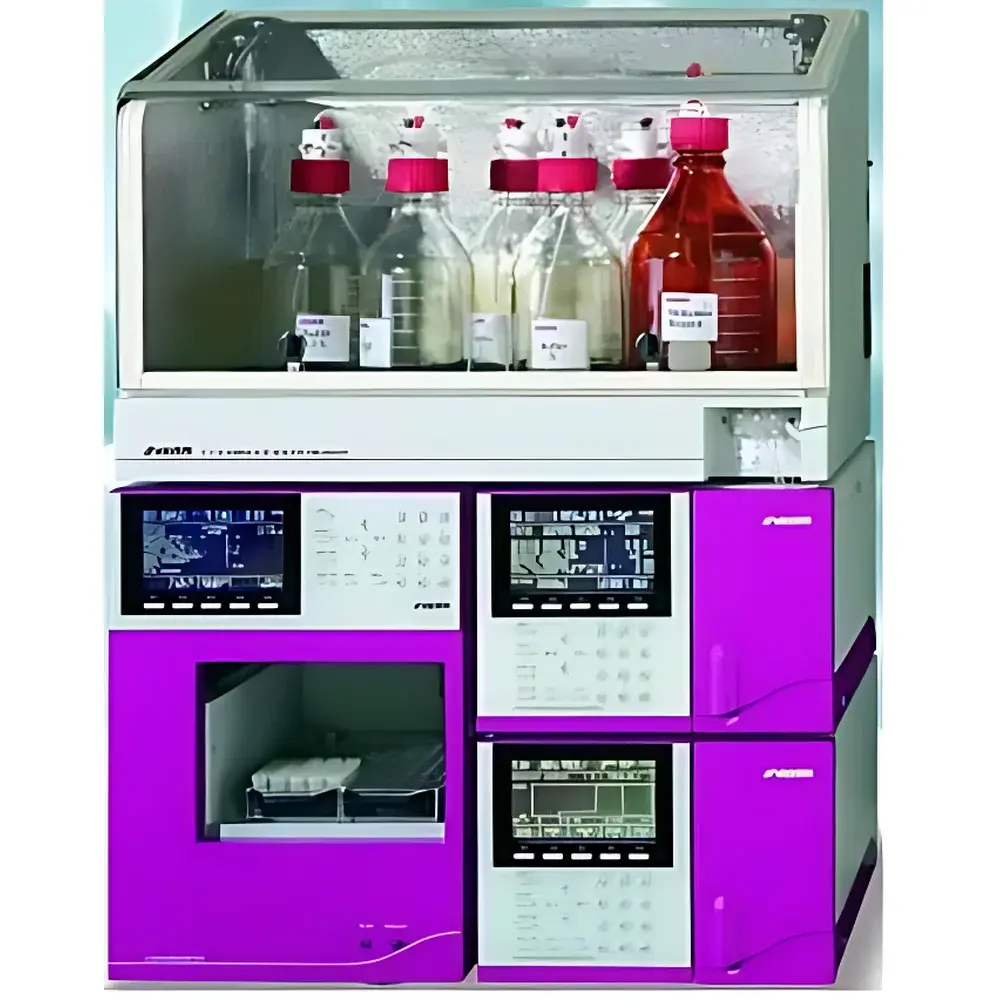
Sykam S433D Fully Automated Amino Acid Analyzer
| Brand | Sykam |
|---|---|
| Origin | Germany |
| Model | S433D |
| Instrument Type | Post-Column Derivatization System |
| Pump Flow Rate | 0–9.999 mL/min |
| Maximum Pump Pressure | 40 MPa |
| Autosampler Injection Volume | 0–500 µL |
| Autosampler Temperature Control | +5 °C to 70 °C (electronic thermostating) |
| Post-Column Reactor Temperature Range | Ambient to 180 °C |
| Detection Wavelengths | 570 nm and 440 nm |
| Flow Cell Volume | 8 µL |
Overview
The Sykam S433D Fully Automated Amino Acid Analyzer is a high-precision, post-column derivatization (PCD) HPLC-based system engineered for quantitative and qualitative analysis of both hydrolyzed and free amino acids in complex biological, food, pharmaceutical, and clinical matrices. It operates on the principle of ion-exchange chromatography coupled with ortho-phthalaldehyde (OPA) and ninhydrin derivatization, followed by dual-wavelength photometric detection at 570 nm (primary amines) and 440 nm (secondary amines, e.g., proline). Unlike conventional step-gradient systems requiring four to six eluents for comprehensive profiling, the S433D implements a proprietary quaternary gradient mixing architecture—enabling full hydrolyzed amino acid analysis with only two buffer solutions and complete free amino acid separation using just three. This design reduces reagent consumption, minimizes manual intervention, and enhances method flexibility without hardware modification.
Key Features
- Quaternary gradient pump system with precise low-flow control (0–9.999 mL/min) and high-pressure capability (up to 40 MPa), ensuring stable baseline and reproducible retention times across extended runs.
- Autosampler with programmable injection volume (0–500 µL) and independent electronic temperature control (+5 °C to 70 °C), supporting both chilled sample storage and thermally stabilized injections for improved precision.
- High-temperature post-column reactor (ambient to 180 °C) optimized for rapid, complete derivatization kinetics—critical for resolving late-eluting and structurally similar amino acids (e.g., leucine/isoleucine, valine/threonine).
- PEEK-packed separation column featuring 7 µm resin with 10% cross-linking—engineered to balance resolution, backpressure, and robustness against particulate-laden samples; validated for ≥6,000–8,000 injections under routine operation.
- Optical detection module with fixed-wavelength photometers at 570 nm and 440 nm, integrated fused-silica flow cell (8 µL volume), and interference-filter-based optical path—delivering long-term wavelength stability, vibration resistance, and zero-maintenance performance.
- Entire fluidic path constructed from inert PEEK, PFA, and PTFE components—including PFA reaction coil—to eliminate metal-induced adsorption, catalytic degradation, or peak tailing, particularly for sulfur-containing and basic amino acids.
Sample Compatibility & Compliance
The S433D accommodates a broad range of sample types—including tissue hydrolysates, serum/plasma, urine, fermentation broths, dairy products, and plant extracts—following standardized sample preparation protocols (e.g., acid hydrolysis, deproteinization, filtration). Its design conforms to internationally recognized analytical validation frameworks, including ISO/IEC 17025 requirements for testing laboratories and alignment with USP , AOAC Official Methods®, and ASTM D6580 for amino acid quantification. The system supports GLP-compliant operation when paired with audit-trail-enabled software (optional 21 CFR Part 11 compliance package available), making it suitable for regulated environments such as pharmaceutical QC, clinical diagnostics, and nutritional labeling verification.
Software & Data Management
Controlled via Sykam’s proprietary ChromStar® software, the S433D provides intuitive method development tools, real-time chromatogram visualization, peak integration with customizable baselines and thresholds, and automated calibration curve generation using internal standard or external standard modes. Data files are stored in vendor-neutral formats (e.g., ASCII .txt, CSV) for seamless integration into LIMS or third-party statistical platforms. All instrument events—including valve actuations, temperature setpoints, pressure logs, and derivatization timing—are timestamped and recorded for full traceability. Optional software modules enable method transfer validation reports, system suitability assessment (e.g., resolution, tailing factor, RSD), and electronic signature support per FDA 21 CFR Part 11.
Applications
- Quantitative profiling of essential and non-essential amino acids in infant formula and dietary supplements per Codex Alimentarius standards.
- Stability-indicating assays for biopharmaceuticals, including monitoring deamidation and oxidation products in monoclonal antibodies.
- Clinical research applications: plasma amino acid screening for inborn errors of metabolism (e.g., phenylketonuria, maple syrup urine disease).
- Food authenticity testing—detection of adulteration in honey, whey protein isolates, and soy-based products via amino acid fingerprinting.
- Process monitoring in microbial fermentation: real-time tracking of intracellular amino acid pools during fed-batch cultivation.
FAQ
What derivatization chemistry does the S433D use?
It employs sequential OPA (for primary amines) and ninhydrin (for secondary amines and residual primary amines) post-column derivatization under precisely controlled temperature and residence time conditions.
Can the system analyze D-amino acids?
Yes—when coupled with chiral pre-column derivatization (e.g., using o-phthaldialdehyde and N-acetyl-L-cysteine) or enzymatic pretreatment, the S433D can resolve D/L enantiomers with appropriate method adaptation.
Is column regeneration supported?
The PEEK-packed column is designed for regeneration using manufacturer-recommended wash protocols (e.g., NaOH flushes); however, routine maintenance focuses on preventive replacement based on pressure rise and resolution loss rather than aggressive cleaning cycles.
Does the system support unattended overnight operation?
Yes—the autosampler accommodates up to 120 vials, and the integrated system self-monitoring (including pressure limits, temperature deviations, and reagent level sensors) enables fully automated batch processing with alarm-triggered shutdown or pause functionality.
How is method transfer handled between instruments?
ChromStar® includes built-in method portability features, allowing export/import of gradient profiles, detector settings, and integration parameters; retention time alignment is facilitated through internal standard referencing and dwell volume compensation algorithms.






