
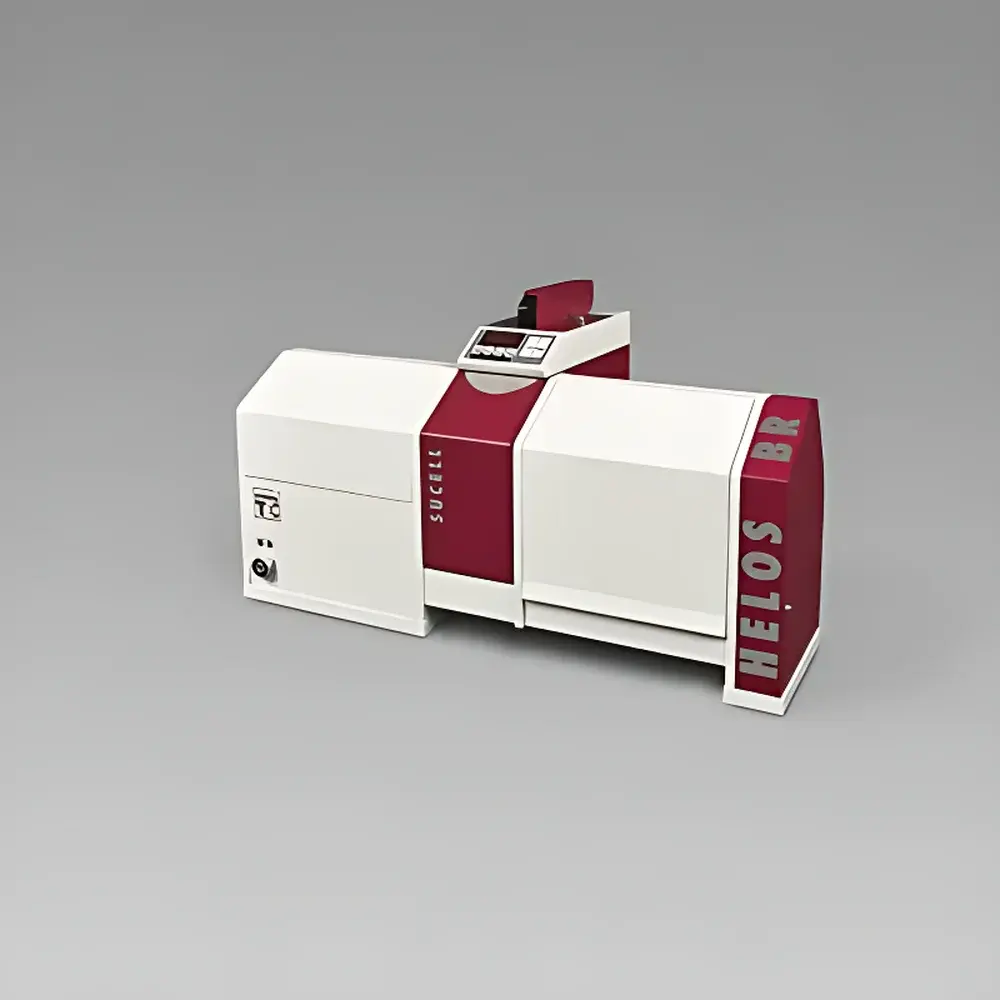
Sympatec HELOS/SUCELL Wet-Dispersion Laser Diffraction Particle Size Analyzer
| Brand | Sympatec |
|---|---|
| Origin | Germany |
| Manufacturer | Sympatec GmbH |
| Instrument Type | Laboratory Laser Particle Size Analyzer |
| Dispersion Method | Wet Dispersion |
| Measurement Range | 0.1–875 µm |
| Repeatability | <0.04% |
| Measurement Time | ≤10 s |
| Optical Theory | Fraunhofer and Mie |
| Maximum Obscuration | 50% |
| Disperser Volume | 400 mL |
| Ultrasonic Power | 60 W (adjustable) |
| Circulation Pump | Adjustable Peristaltic Pump |
| Optional Accessory | SVA Micro-Dispersion Unit (50 mL) |
Overview
The Sympatec HELOS/SUCELL is a high-precision, laboratory-grade laser diffraction particle size analyzer engineered for robust and traceable wet dispersion analysis of suspensions and emulsions. It operates on the physical principle of laser light scattering—where particles in a dispersed phase deflect incident monochromatic laser light at angles inversely proportional to their size—enabling quantitative determination of particle size distribution (PSD) from 0.1 µm to 875 µm. Compliant with ISO 13320:2020 (“Particle size analysis — Laser diffraction methods”), the system integrates the HELOS optical sensor unit with the SUCELL fully automated wet dispersion module into a single, closed-loop fluidic architecture. This configuration ensures minimal operator intervention, eliminates cross-contamination between runs, and maintains consistent hydrodynamic conditions critical for reproducible measurement outcomes in regulated environments.
Key Features
- ISO 13320-compliant optical design with dual-theory data processing (Fraunhofer approximation for coarse particles; Mie theory with user-defined refractive index for fine or optically complex materials)
- Integrated SUCELL dispersion module featuring a 400 mL dispersing chamber with level-controlled automatic sample introduction and discharge
- Onboard 60 W ultrasonic generator with continuously adjustable power output, enabling optimization of de-agglomeration without thermal degradation or cavitation-induced particle damage
- Combined mechanical stirring (variable speed) and peristaltic circulation pump (flow rate programmable), ensuring homogeneous suspension prior to measurement
- Full automation via SOP-driven software: from initial dispersion conditioning to final PSD report generation in under 10 seconds per analysis cycle
- Optional SVA (Small Volume Adapter) module supporting analysis of as little as 50 mL sample volume—ideal for high-value pharmaceutical actives, clinical trial formulations, or limited-batch R&D samples
Sample Compatibility & Compliance
The HELOS/SUCELL accommodates aqueous and organic-based suspensions, colloidal dispersions, polymer emulsions, nanosuspensions, and biopharmaceutical formulations. Its closed-loop fluid path prevents aerosol release and supports GLP/GMP-aligned workflows. The system meets requirements for analytical instrument qualification (AIQ) and is compatible with 21 CFR Part 11-compliant electronic records and signatures when deployed with validated software configurations. Built-in obscuration monitoring (up to 50%) enables real-time feedback on sample concentration, ensuring measurements remain within the optimal dynamic range for scattering signal integrity. All hardware components contacting the sample stream are chemically resistant (e.g., PTFE, borosilicate glass, stainless steel 316), facilitating cleaning validation and multi-product use in shared lab environments.
Software & Data Management
WINDOX 7 software provides a secure, audit-trail-enabled platform for method development, execution, and reporting. It supports role-based user access control, electronic signature capture, and full metadata logging—including instrument parameters, dispersion settings, raw scattering patterns, and post-processing selections. Data export conforms to ASTM E2918 and ISO/IEC 17025 documentation standards. Batch processing, statistical trend analysis across multiple runs, and customizable PDF/CSV report templates streamline QA/QC documentation. Software validation packages—including IQ/OQ protocols and UAT test scripts—are available upon request for regulated pharmaceutical and medical device manufacturing sites.
Applications
- Pharmaceutical development: API crystallization monitoring, nanoemulsion stability assessment, inhalation aerosol characterization
- Materials science: Ceramics slurry homogeneity verification, battery cathode/anode suspension consistency, pigment dispersion quality control
- Food & beverage: Fat globule sizing in dairy emulsions, starch granule swelling behavior, protein aggregate quantification
- Chemical industry: Catalyst particle distribution profiling, polymer latex batch release testing, agrochemical suspension formulation optimization
- Academic & contract research: Method transfer studies, inter-laboratory comparison programs, reference material certification support
FAQ
What dispersion theories does the HELOS/SUCELL support?
The system supports both Fraunhofer diffraction approximation (for particles >~2 µm or low-refractive-index contrast systems) and Mie scattering theory (requiring input of real and imaginary refractive indices for accurate sub-micron analysis).
Can the system handle highly viscous or temperature-sensitive samples?
Yes—the peristaltic pump and modular flow path allow integration of external thermostatted baths or low-shear pumping accessories; viscosity limits depend on selected tubing and flow rate calibration.
Is the SVA adapter compatible with all HELOS optical units?
The 50 mL SVA is designed exclusively for HELOS/KR and HELOS/SUCELL configurations and requires firmware version ≥7.3.0 and WINDOX 7.4 or later.
How is data integrity ensured during long-term operation?
All measurement events are timestamped, digitally signed, and stored with immutable audit trails. Raw scattering data (.wdf files) are retained alongside processed reports, satisfying ALCOA+ principles for regulatory submissions.
Does Sympatec provide installation qualification (IQ) documentation?
Yes—factory-issued IQ checklists, calibration certificates traceable to NIST standards, and optical alignment verification reports are supplied with each system shipment.



