
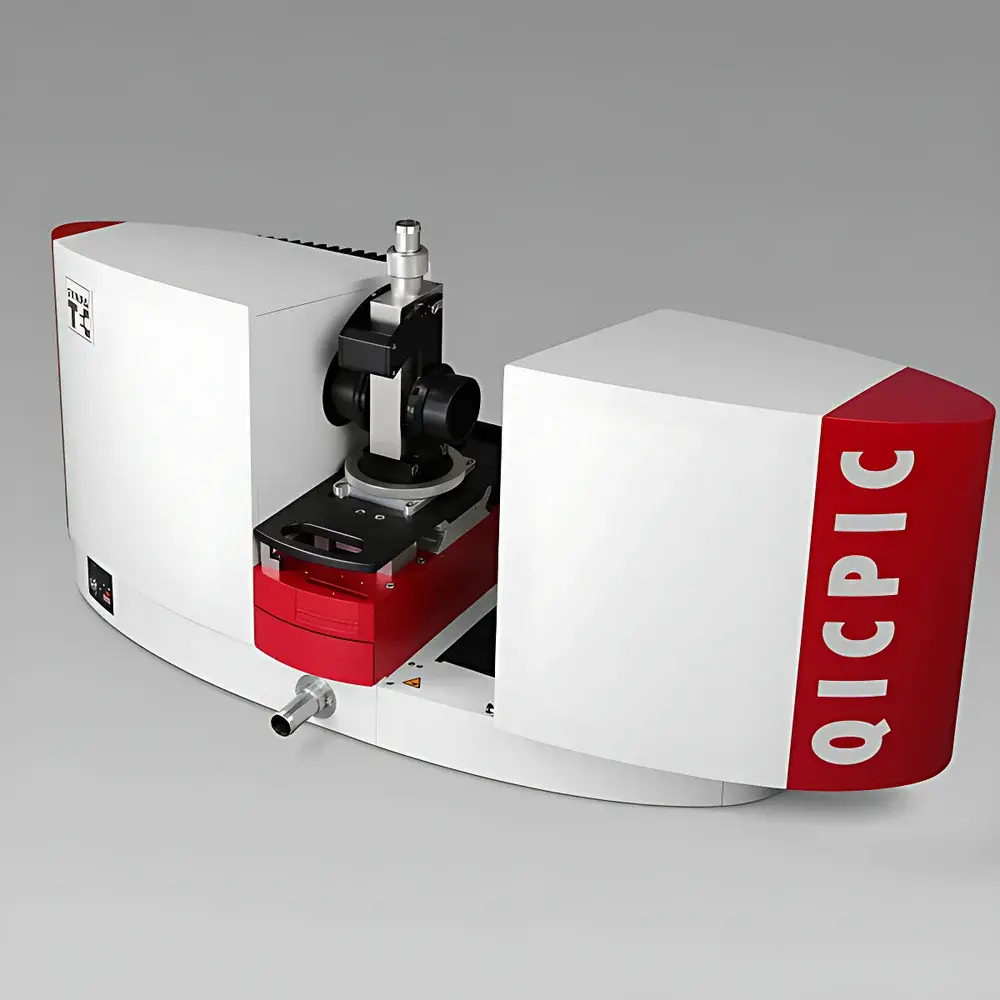
SYMPATEC QICPIC & FLOWCELL Wet-Dispersion Dynamic Image Analysis System
| Brand | SYMPATEC |
|---|---|
| Origin | Germany |
| Manufacturer | SYMPATEC GmbH |
| Type | Imported Industrial-Grade Dynamic Image Analyzer |
| Model | QICPIC & FLOWCELL |
| Optical Configuration | Dual-lens imaging system |
| Measurement Range | 11–16,000 µm |
| Dispersion Method | Wet dispersion via external recirculation |
| Image Resolution | 4.2 MP (high-fidelity monochrome CMOS sensors) |
| Measured Parameters | Chord length, Feret diameters (max/min/mean), fiber length & diameter, equivalent circular diameter (ECD), sphericity, aspect ratio (width-to-length), convexity, flatness, elongation, LEFI/DIFI/VBFD indices, projected area diameter (PED) |
Overview
The SYMPATEC QICPIC & FLOWCELL is a high-throughput, wet-dispersion dynamic image analysis system engineered for statistically robust characterization of coarse and fragile particulate systems in industrial R&D and process environments. Operating on the principle of pulsed backlight illumination and real-time high-speed imaging, the instrument captures silhouette images of individual particles as they flow—singly and non-overlapping—through a precisely defined optical measurement zone. Two synchronized, telecentric lenses with calibrated magnification provide orthogonal or complementary field-of-view coverage, enabling multi-angle morphological assessment without mechanical repositioning. Unlike static image analysis or laser diffraction, QICPIC resolves true 2D projection geometry—including edge definition, concavity, and anisotropy—making it uniquely suited for irregular, fibrous, flaky, or agglomerate-prone materials where shape-dependent functionality (e.g., flowability, dissolution rate, packing density) governs performance.
Key Features
- Dual-lens optical architecture with independent focus and magnification control, supporting simultaneous acquisition of primary and auxiliary particle views for enhanced morphological confidence.
- FLOWCELL wet dispersion module: configurable channel widths (10 mm or 20 mm), compatible with externally dispersed slurries; supports volumetric flow rates up to 20 L/min and total sample volumes exceeding 20 L per analysis sequence.
- High-pulse LED backlight (≥10 kHz repetition rate) ensures motion-free silhouettes of fast-moving particles—even at elevated flow velocities—minimizing streaking artifacts and preserving edge fidelity.
- Real-time image capture at ≥500 fps (full-frame), enabling analysis of >10 million particles per measurement run with sub-millisecond exposure timing.
- Calibrated pixel-to-length conversion traceable to NIST-traceable standards; all geometric parameters computed directly from binary particle masks using ISO 9276-6 and ASTM E2457–22 compliant algorithms.
- Rugged, IP54-rated enclosure designed for integration into pilot-scale or production-line environments, including cleanroom-compatible variants (ISO Class 7/8).
Sample Compatibility & Compliance
The QICPIC & FLOWCELL accommodates suspensions of coarse, friable, or shear-sensitive particles—including fruit pulp aggregates, tobacco lamellae, pharmaceutical granules, food-grade starch fragments, and mineral ores—without requiring sonication or surfactant addition that may alter native morphology. Its wet-flow design eliminates static settling bias and enables representative sampling from heterogeneous slurries. The system complies with ISO 13322-2:2020 (Dynamic image analysis — Part 2: Calibration and verification), supports audit-ready data export per FDA 21 CFR Part 11 requirements (including electronic signatures, user access logs, and immutable result archives), and meets GLP/GMP documentation standards for regulated industries. Optional IQ/OQ/PQ validation packages are available for pharmaceutical and food safety-critical applications.
Software & Data Management
Operating on WINDOX 7 software platform, the system delivers integrated acquisition, segmentation, feature extraction, statistical reporting, and visualization tools. Particle images are stored in a searchable database with metadata tagging (time stamp, flow rate, dilution factor, operator ID). Users define custom filters—e.g., “sphericity 5” —to isolate subpopulations for targeted review, video reconstruction, or export to third-party modeling tools (e.g., DEM simulation inputs). Reports include cumulative/differential distributions for each parameter, scatter plots (e.g., sphericity vs. ECD), and overlay comparisons across batches or process stages. All raw images, processed masks, and intermediate calculation files are retained in hierarchical folder structures with SHA-256 checksum integrity verification.
Applications
- Food science: Quantifying pulp fragment size/shape distribution in juice concentrates, evaluating cell wall integrity in plant-based dairy alternatives, monitoring grinding efficiency in cereal processing.
- Pharmaceutical development: Assessing granule morphology impact on tablet compaction behavior, characterizing fiber content in excipient blends, verifying homogeneity of multiparticulate dosage forms.
- Tobacco manufacturing: Measuring lamina shreds’ aspect ratio and surface roughness to predict burn rate and ash stability.
- Agrochemical formulation: Monitoring crystalline active ingredient morphology during wet milling and spray drying to ensure consistent suspension stability and droplet formation.
- Mineral processing: Classifying coarse tailings fractions by convexity and angularity to optimize dewatering and transport rheology.
FAQ
How does QICPIC differ from laser diffraction for coarse particle analysis?
Laser diffraction assumes spherical equivalence and reports only volume-weighted equivalent spherical diameter; QICPIC provides true 2D projections and shape descriptors critical for non-spherical systems where functional performance depends on orientation and geometry.
Can the system analyze transparent or semi-transparent particles?
Yes—using optimized backlight intensity and contrast enhancement algorithms, QICPIC reliably segments low-contrast particles such as sugar crystals, gelatin beads, or cellulose fibers without staining or coating.
Is method transfer possible between dry and wet dispersion modes?
While QICPIC is configured here for wet dispersion via FLOWCELL, SYMPATEC offers parallel dry-dispersion modules (e.g., GRADIS); cross-mode correlation requires empirical calibration due to inherent differences in particle orientation and agglomeration state.
What regulatory documentation is provided for GMP environments?
Standard delivery includes full IQ/OQ documentation, electronic signature capability, audit trail configuration, and 21 CFR Part 11 compliance mode enabled by default.
How is measurement repeatability ensured across operators and laboratories?
WINDOX implements standardized SOP templates, automated calibration routines (using traceable glass microspheres), and inter-laboratory round-robin validation protocols aligned with ISO/IEC 17043 guidelines.



