
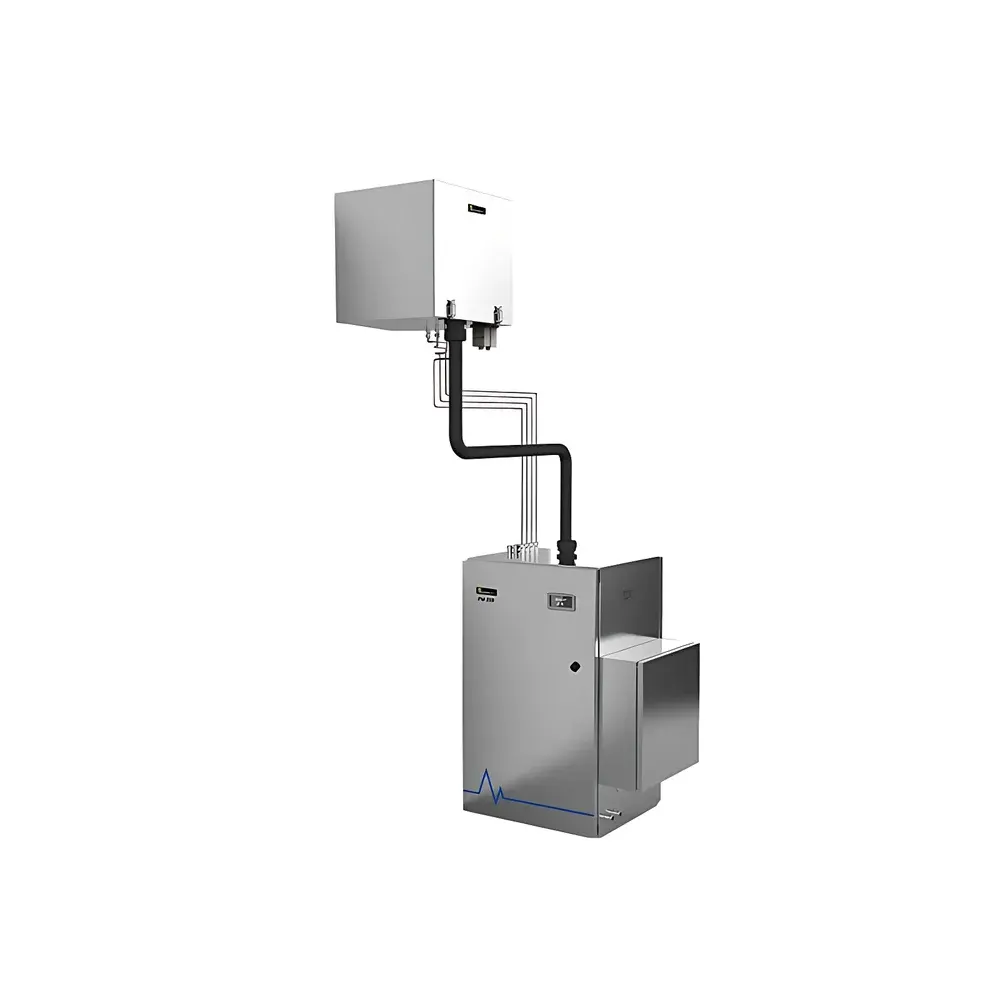
Synspec PM-200 Online Particulate Matter Monitoring System
| Origin | Netherlands |
|---|---|
| Manufacturer Type | Authorized Distributor |
| Origin Category | Imported |
| Model | PM-200 |
| Pricing | Upon Request |
| Measurement Principle | Beta-Ray Absorption with Complementary Optical Scattering |
| Measured Parameter | Total Suspended Particulate Mass Concentration (PM) |
| Detection Limit | 0.1 mg/m³ (100 µg/m³) |
| Compliance | Designed to meet EU Directive 75/76/EEC requirements and EPA Method 5 for isokinetic sampling |
Overview
The Synspec PM-200 Online Particulate Matter Monitoring System is a high-integrity, extractive-type continuous emission monitoring (CEM) instrument engineered for accurate, long-term quantification of low-concentration particulate matter in challenging flue gas environments—particularly those characterized by high relative humidity, condensable vapors, and adhesive or hygroscopic dusts. Developed by Synspec B.V., a Dutch subsidiary of Focused Photonics Inc. (Hangzhou), the PM-200 integrates dual physical measurement principles: beta-ray attenuation (β-ray absorption) as the primary gravimetric reference method, augmented by real-time optical scattering for dynamic signal compensation and process insight. This hybrid architecture ensures metrological traceability while mitigating interference from particle morphology, refractive index, color, or size distribution—factors that commonly compromise single-principle optical or electrostatic sensors. The system operates on an extractive dilution sampling principle, where hot, wet flue gas is drawn through a temperature-controlled, isokinetic probe, diluted with clean, dry air at a precisely controlled ratio, and delivered to the measurement chamber under stable thermal and flow conditions. This design eliminates condensation-related artifacts and enables reliable operation downstream of wet flue gas desulfurization (WFGD) and wet electrostatic precipitators (WESPs)—critical locations where traditional in-situ opacity meters or direct-impaction monitors exhibit significant drift or fouling.
Key Features
- Extractive dilution sampling architecture with integrated isokinetic probe compliant with U.S. EPA Method 5 design criteria
- Dual-sensor measurement core: certified beta-ray absorption detector (primary mass measurement) coupled with calibrated forward-scatter photometer (supportive signal correlation and diagnostic feedback)
- Onboard calibration membrane system enabling automated daily zero/span verification and long-term baseline stability assessment
- Active dilution ratio monitoring and periodic validation protocol to ensure consistent sample conditioning across operational cycles
- Heated sampling line and probe maintained above dew point to prevent water condensation and particle loss during transport
- Embedded diagnostics engine supporting fault detection, root-cause identification, and autonomous recovery from common field anomalies (e.g., filter clogging, flow deviation, temperature excursion)
- Robust mechanical housing rated IP65 for outdoor installation; designed for continuous operation in industrial ambient conditions (−20 °C to +50 °C)
Sample Compatibility & Compliance
The PM-200 is validated for use in coal-fired power plant stacks post-WFGD and post-WESP, as well as in cement kilns, waste incinerators, and metallurgical furnaces where flue gas contains sub-micron aerosols, sulfate-rich condensates, and sticky fly ash fractions. Its dilution-based approach renders it insensitive to relative humidity fluctuations up to 100 % RH and tolerant of transient liquid carryover. Regulatory alignment includes structural conformity with Council Directive 75/76/EEC on continuous monitoring of emissions from large combustion plants, and functional equivalence to EN 13284-1:2017 (determination of low-range dust mass concentration). While not pre-certified for U.S. PS-11 or MCERTS, its isokinetic sampling geometry, documented uncertainty budget (<±5 % RSD at 1 mg/m³), and audit-ready data logging support qualification under site-specific QA/QC protocols aligned with ISO/IEC 17025 and EPA 40 CFR Part 60 Appendix B performance specifications.
Software & Data Management
The embedded firmware runs on a Linux-based real-time OS and communicates via Modbus TCP/IP, Profibus DP, or optional 4–20 mA analog outputs. Configuration, calibration history, alarm logs, and raw sensor time-series are accessible through a web-hosted HMI interface requiring no client-side software installation. All measurement events—including automatic calibrations, maintenance alerts, and flow deviations—are timestamped and stored with full audit trail capability. Data export supports CSV and XML formats compatible with central CEMS databases (e.g., Siemens Desigo, Honeywell Experion, or custom SCADA integrations). Software architecture complies with ALCOA+ principles for data integrity: attributable, legible, contemporaneous, original, accurate, complete, consistent, enduring, and available—enabling readiness for GLP/GMP audits and FDA 21 CFR Part 11-compliant electronic record implementation when deployed with validated identity management and digital signature modules.
Applications
- Continuous compliance monitoring of PM emissions from coal-fired boilers equipped with wet FGD and WESP systems
- Performance verification of particulate control devices (e.g., fabric filters, ESPs, WESPs) in thermal power generation and co-generation facilities
- Stack testing and long-term trend analysis in municipal solid waste and hazardous waste incineration plants
- Process optimization and emission inventory reporting for cement clinker production lines and lime kilns
- Research-grade particulate characterization in pilot-scale carbon capture and storage (CCS) test loops where low-concentration, high-humidity aerosol behavior must be quantified
FAQ
Does the PM-200 require periodic filter replacement? How often?
Yes—the system uses a quartz fiber filter tape that advances automatically after each measurement cycle; typical tape life exceeds 30 days under standard operating conditions (1 mg/m³ average load), with end-of-tape alerts generated via the HMI.
Is the dilution ratio adjustable in the field?
No—the dilution ratio is factory-set and fixed per application configuration (e.g., 1:10 or 1:20); however, the system continuously monitors actual dilution airflow and triggers alarms if deviation exceeds ±2 % of setpoint.
Can the PM-200 be integrated into existing CEMS infrastructure?
Yes—it supports standard industrial communication protocols (Modbus TCP/IP, Profibus DP, 4–20 mA) and provides configurable data tags for seamless integration with third-party DCS or CEMS data acquisition systems.
What maintenance intervals are recommended for routine operation?
Quarterly inspection of probe heating elements and dilution air filters; semi-annual verification of beta source activity and optical scatter gain coefficients using NIST-traceable reference standards.
Is remote firmware update supported?
Yes—secure OTA (over-the-air) updates are enabled via HTTPS-authenticated connections, with rollback capability and SHA-256 integrity verification prior to installation.







