
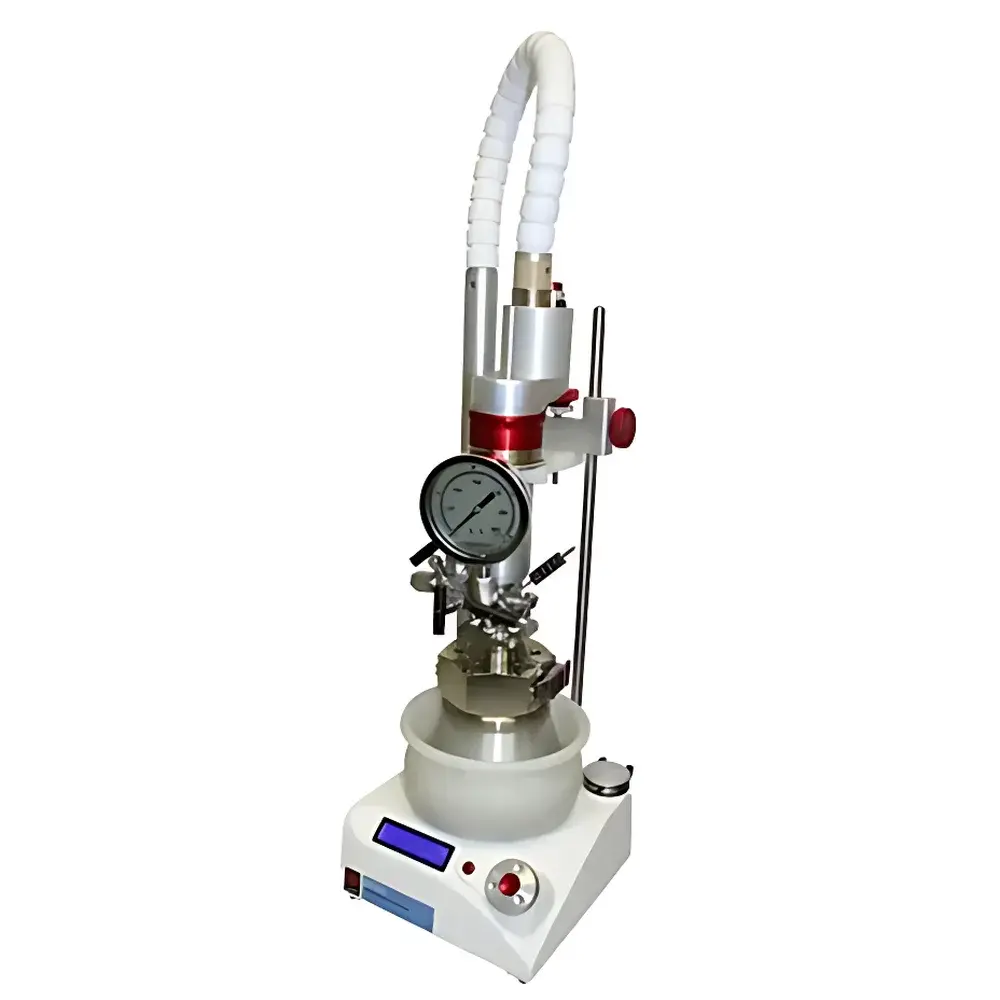
Syrris Atlas High-Temperature & High-Pressure Reactor System
| Brand | Syrris |
|---|---|
| Origin | United Kingdom |
| Model | Atlas-Sodium |
| Vessel Capacities | 100 mL, 160 mL, 300 mL, 450 mL |
| Construction Material | Stainless Steel 316 (standard), optional Hastelloy or Titanium |
| Maximum Operating Pressure | 200 bar |
| Maximum Temperature | 250 °C |
| Vacuum Capability | 10 mbar |
| Stirring | Mechanical up to 800 rpm, Magnetic up to 1200 rpm |
| Gas Selection | Up to 3 gases via front-panel or PC software control |
| Pressure Control | Automated setpoint regulation with venting logic |
| Data Logging | Real-time recording of temperature, pressure, stirring speed, gas selection, and timing events |
| Safety Certification | PED 2014/68/EU and ASME BPVC Section VIII compliant |
| Optional Extensions | Custom configurations up to 350 °C, 60 bar, 10 L capacity |
Overview
The Syrris Atlas High-Temperature & High-Pressure Reactor System is an engineered platform for controlled chemical synthesis under extreme thermodynamic conditions. Based on a modular, pressure-rated architecture, the Atlas-Sodium configuration integrates precision thermal management, dynamic pressure regulation, and multi-mode agitation within a single, compact footprint. Its core measurement and control paradigm relies on closed-loop feedback from calibrated transducers—temperature (Pt100 RTD), pressure (piezoresistive sensor), and rotational speed (Hall-effect encoder)—enabling reproducible execution of reactions governed by Arrhenius kinetics, phase-equilibrium constraints, or gas-liquid mass transfer limitations. Designed explicitly for laboratory-scale process development, the system supports reaction screening, catalyst evaluation, hydrogenation, oxidation, hydrothermal synthesis, and supercritical fluid chemistry—particularly where stoichiometric gas dosing, pressure-dependent selectivity, or exothermicity management are critical.
Key Features
- Modular reactor core compatible with interchangeable vessels: 100 mL, 160 mL, 300 mL, and 450 mL stainless steel 316 vessels (Hastelloy C-276 and titanium available as options for corrosive or halogenated media)
- Dual-mode agitation: High-torque mechanical stirring (0–800 rpm, torque-sensing enabled) and magnetic stirring (0–1200 rpm), both independently controllable and loggable
- Thermal control via integrated heating plate or dry-block bath, delivering stable operation from ambient to 250 °C with ±1 °C accuracy over full range
- Automated pressure management: real-time regulation to user-defined setpoints (0–200 bar), with programmable venting sequences and overpressure relief via certified rupture discs
- Gas selection module supporting three independent gas lines (e.g., N₂, H₂, O₂, CO, syngas); switching occurs pneumatically under software or front-panel command with sub-second response
- Integrated vacuum capability down to 10 mbar for degassing, solvent removal, or inert atmosphere establishment prior to pressurization
- PED 2014/68/EU and ASME BPVC Section VIII Div. 1 certified construction ensures compliance with European and North American pressure equipment directives
Sample Compatibility & Compliance
The Atlas-Sodium accommodates heterogeneous, homogeneous, and multiphase reaction systems—including slurries, viscous melts, and gas-saturated liquids—without compromising seal integrity or thermal uniformity. All wetted parts conform to ISO 8502-3 and ASTM G31 standards for corrosion resistance verification. Vessel design adheres to EN 13445-3 Annex C for fatigue assessment under cyclic pressure loading. The system meets GLP data integrity requirements per FDA 21 CFR Part 11 when operated with Syrris’s validated Atlas software (audit trail, electronic signatures, and immutable raw data export). It is routinely deployed in pharmaceutical process R&D (ICH Q5, Q7), fine chemical manufacturing (REACH-compliant documentation), and academic catalysis studies requiring traceable reaction parameter histories.
Software & Data Management
Atlas Control Software (v5.x, Windows-based) provides deterministic sequencing of temperature ramps, pressure profiles, gas switching events, and agitation schedules. All sensor inputs—including torque feedback, heat flow (via optional calorimetry add-on), and mass-flow rates—are time-stamped at ≥1 Hz resolution and stored in HDF5 format for post-processing in MATLAB, Python, or industry-standard analytics platforms. The software supports method templates, batch-level metadata tagging, and automated report generation (PDF/CSV) compliant with internal SOPs. Raw data files include cryptographic hashes for integrity verification, satisfying ALCOA+ principles (Attributable, Legible, Contemporaneous, Original, Accurate, Complete, Consistent, Enduring, Available).
Applications
- Catalytic hydrogenation under controlled H₂ partial pressure (0.1–100 bar) with inline sampling capability
- High-temperature hydrothermal synthesis of metal oxides and MOFs at 180–250 °C and 50–150 bar
- Oxidation reactions using O₂ or air with precise oxygen concentration modulation and explosion-limit monitoring
- Supercritical CO₂-assisted polymerization and extraction workflows
- Reaction calorimetry via heat-flow or power-compensation modes for thermodynamic profiling (ΔHᵣ, adiabatic temperature rise)
- Accelerated stability testing of APIs under elevated temperature/pressure stress conditions per ICH Q1A(R3)
FAQ
What safety certifications apply to the Atlas-Sodium system?
The system carries PED 2014/68/EU conformity marking and ASME BPVC Section VIII Div. 1 certification for pressure containment. All rupture discs, pressure transducers, and electrical components are CE-marked and UL-recognized.
Can the system perform quantitative gas dosing based on mass flow?
Yes—when equipped with optional thermal mass flow controllers (MFCs), the Atlas software executes stoichiometric gas addition by mass, volume, or partial pressure, with real-time correction for temperature and compressibility deviations.
Is remote operation supported?
The system operates over Ethernet with full TCP/IP command interface (SCPI-compatible), enabling integration into centralized lab automation frameworks (e.g., LabVantage, STARLIMS) and unattended overnight runs with email/SMS alerting on deviation events.
What materials are available for vessels handling HF or hot chlorides?
Hastelloy C-276 and titanium Grade 2 vessels are standard options for halide-rich or strongly acidic environments; custom linings (e.g., PFA, quartz) are available upon engineering review.
How is calibration traceability maintained?
Temperature and pressure sensors ship with UKAS-accredited calibration certificates (ISO/IEC 17025), and the system supports user-executed periodic verification using NIST-traceable reference standards.



