
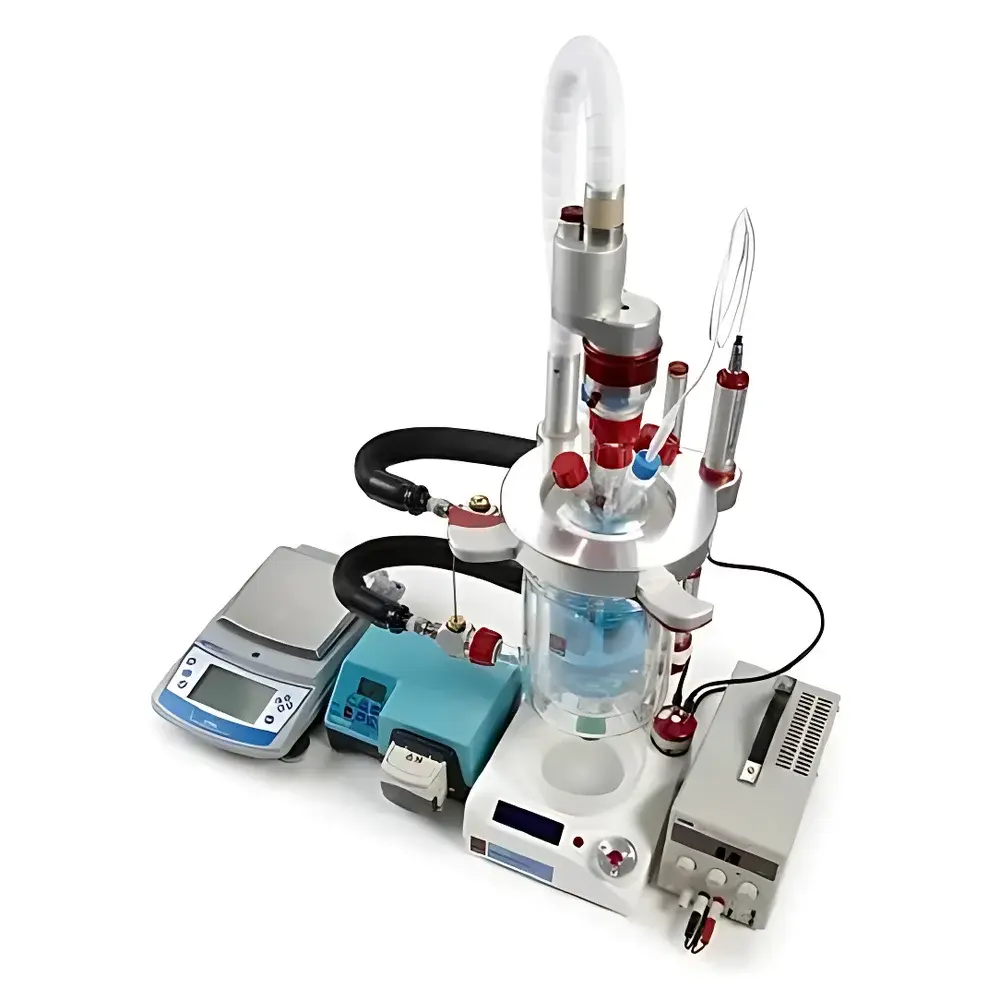
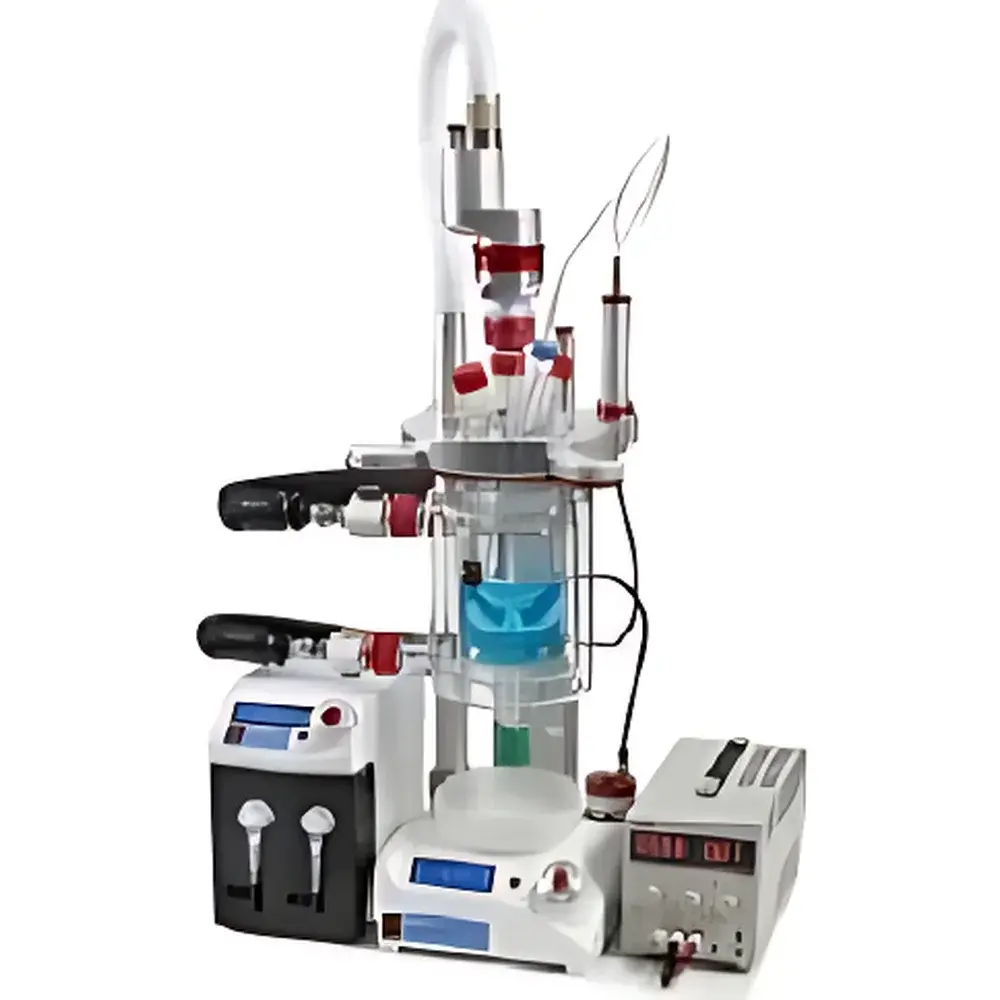
Syrris Atlas Potassium Reaction Calorimeter
| Brand | Syrris |
|---|---|
| Origin | United Kingdom |
| Model | Potassium-02 |
| Vessel Volume | 250 mL – 2 L |
| Construction Material | Borosilicate Glass |
| Operating Pressure | Low-pressure (vacuum to slight overpressure) |
| Vacuum Level | 50 mbar |
| Temperature Range | −40 °C to 200 °C |
| Temperature Accuracy | ±0.1 °C (dependent on external circulator performance) |
| Max PCC Power | 50 W |
| Max HFC Power Density | 100 W/L |
| Thermal Sensitivity | <0.1 W/kg |
| Mechanical Stirring | 0–800 rpm |
| Magnetic Stirring | 0–1200 rpm |
| Gas Inlet/Outlet Ports | Yes (inert gas compatible) |
Overview
The Syrris Atlas Potassium Reaction Calorimeter is an engineered platform for precise, real-time measurement of heat flow and enthalpy changes during chemical reactions under controlled laboratory conditions. It operates on two complementary calorimetric principles: Heat Flow Calorimetry (HFC), which quantifies thermal exchange between the reaction mixture and a thermostatted jacket via temperature differentials across a calibrated thermal resistance; and Power Compensation Calorimetry (PCC), where electrical power is dynamically supplied to maintain isothermal conditions—directly yielding reaction enthalpy without empirical calibration. Designed for process safety assessment and quality-by-design (QbD) implementation, the system supports scalable reaction evaluation from early-stage screening to kilolab development. Its vacuum-jacketed glass reactor architecture enables simultaneous control of temperature, pressure, atmosphere, and mass transfer—critical for exothermic hazard analysis, crystallization kinetics, and catalytic reaction optimization.
Key Features
- Fully automated operation: integrated PID-controlled temperature regulation, motorized dosing, and programmable stirring—enabling unattended overnight experiments.
- High-fidelity thermal control: triple-walled glass reactor with vacuum insulation, coupled with high-resolution RTD sensors and external recirculating chiller integration (−40 °C to 200 °C range).
- Dual-mode calorimetry: seamless switching between HFC and PCC within the same hardware and software environment—eliminating method-specific instrumentation constraints.
- Rapid reactor interchangeability: tool-free mounting mechanism allows full reactor replacement in under 60 seconds, minimizing downtime between experiments.
- Modular feed and monitoring expansion: standardized ports support optional gravimetric dosing (balance-integrated), syringe pumps, peristaltic pumps, and in-line analytical probes.
- Robust mechanical agitation: variable-speed overhead stirrer (0–800 rpm) ensures homogeneous mixing for viscous or heterogeneous systems—essential for reproducible solid formation and particle size distribution control.
Sample Compatibility & Compliance
The Atlas Potassium accommodates a broad spectrum of chemistries—including organometallic catalysis, nitration, hydrogenation, polymerization, and crystallization—within its borosilicate glass vessel (250 mL to 2 L). Its low-pressure rating (up to slight overpressure) and 50 mbar vacuum capability support solvent removal, inert-atmosphere handling (N₂, Ar), and moisture-sensitive transformations. The system complies with fundamental design expectations for GLP-compliant laboratories: full audit trail logging, user-access controls, electronic signatures (via optional 21 CFR Part 11–compliant software configuration), and traceable calibration records. While not certified to ISO 11358 or ASTM E698 by default, raw thermal data output formats are compatible with third-party validation protocols required for regulatory submissions (e.g., ICH Q5, Q7, Q11).
Software & Data Management
Atlas Calorimetry Software provides a guided, wizard-driven interface for experiment setup, real-time visualization of heat flow, temperature, and dosing profiles, and automated curve generation (dQ/dt, Q(t), ΔH). All parameters—including setpoints, actuator states, sensor readings, and timestamps—are logged at ≥1 Hz resolution in proprietary .atx binary format, exportable to CSV, Excel, or MATLAB-compatible structures. Reporting Software enables batch comparison, baseline correction, peak integration, and customizable report generation aligned with internal SOPs or client deliverables. Data integrity safeguards include write-once storage options, encrypted backups, and configurable retention policies—supporting long-term archival requirements under ALCOA+ principles.
Applications
- Reaction hazard assessment: determination of adiabatic temperature rise (ΔTad), time-to-maximum-rate (TMRad), and criticality classification per CCPS guidelines.
- Crystallization process understanding: coupling with optional in-line turbidity or ATR-FTIR probes to correlate heat evolution with nucleation onset, polymorphic transition, or agglomeration events.
- pH-controlled reactions: integration with auto-titrators and pH electrodes for exotherm mapping during neutralization or enzymatic hydrolysis.
- Scale-up thermodynamics: direct translation of lab-scale calorimetric data to pilot-plant cooling capacity requirements using heat balance modeling.
- Quality attribute linkage: correlation of thermal signatures with final product attributes (e.g., residual solvent, crystal form, assay purity) in pharmaceutical development.
FAQ
What calorimetric methods does the Atlas Potassium support?
It supports both Heat Flow Calorimetry (HFC) and Power Compensation Calorimetry (PCC) within a single instrument platform and unified software interface.
Can the system operate under inert or vacuum conditions?
Yes—it features gas inlet/outlet ports rated for inert gas purging and achieves a base vacuum level of 50 mbar using standard lab vacuum sources.
Is the software compliant with FDA 21 CFR Part 11?
The base software includes audit trail and user management functions; full Part 11 compliance requires optional validation package and site-specific configuration.
What is the minimum detectable heat flow sensitivity?
Thermal sensitivity is specified as <0.1 W/kg under optimized conditions—dependent on vessel size, thermal mass, and experimental duration.
How is temperature accuracy maintained across the operating range?
Accuracy of ±0.1 °C is achieved through high-stability RTDs, vacuum-jacketed thermal isolation, and synchronization with externally validated circulation baths.
Related Products



