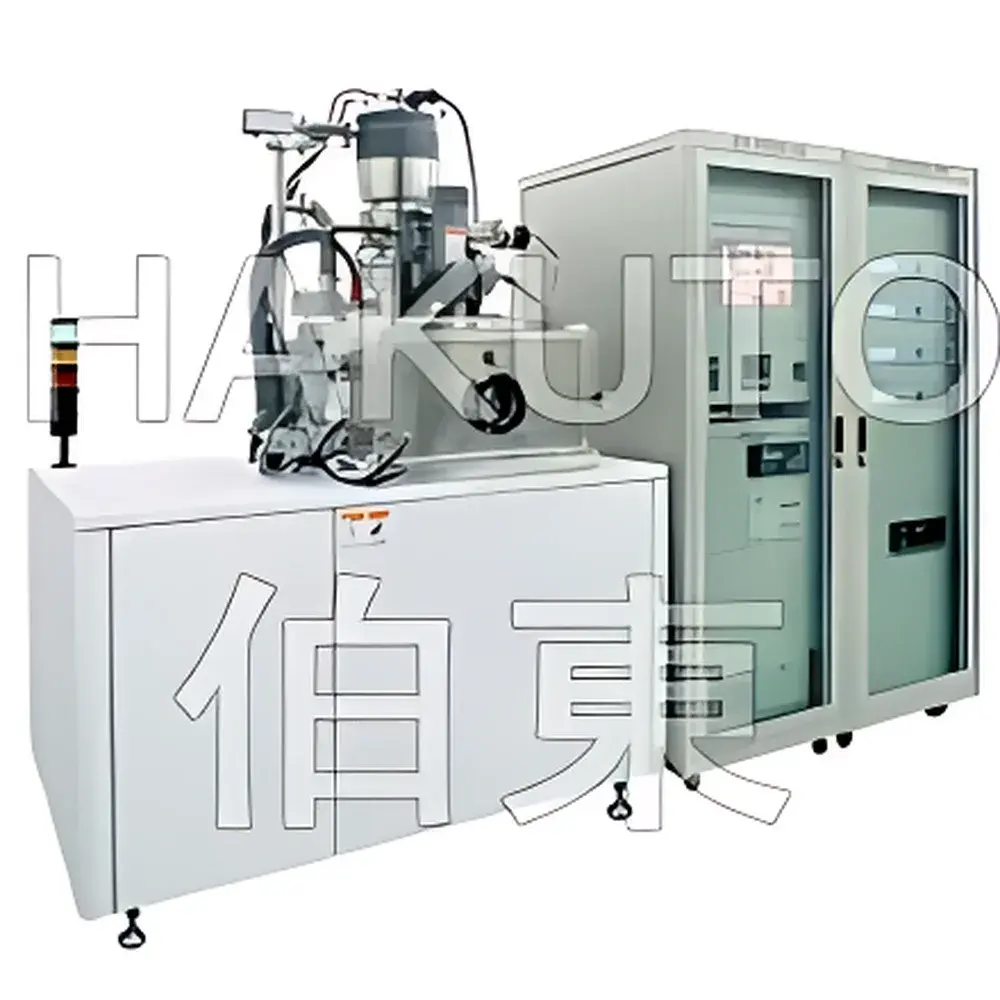
Syskey Multilayer Magnetron Sputtering System for 12-inch Wafers
| Brand | Syskey |
|---|---|
| Origin | Taiwan |
| Equipment Type | Magnetron Sputter Deposition System |
| Substrate Size | Up to 300 mm (12-inch) |
| Base Pressure | ≤1×10⁻⁸ Torr |
| Substrate Temperature Range | Ambient to 600 °C |
| Thickness Uniformity | ±3% (across 300 mm wafer) |
| Sputter Sources | Up to 6 configurable magnetron cathodes (RF/DC/pulsed DC) |
| Gas Lines | Up to 4 mass flow controllers (Ar, N₂, O₂) |
| Substrate Motion | Planetary rotation + independent rotation |
| Optional Integration | KRI ion source, load-lock, RGA/OES ports, RF bias, film thickness monitor |
Overview
The Syskey Multilayer Magnetron Sputtering System is an ultra-high-vacuum (UHV) physical vapor deposition (PVD) platform engineered for precise, reproducible fabrication of complex multilayer thin-film architectures. Operating on the principle of magnetron-enhanced plasma confinement, the system utilizes crossed electric and magnetic fields to sustain high-density argon plasma near rotating or stationary sputter targets—enabling efficient atom ejection with minimal substrate heating and low defect density. Designed for research and pilot-scale production in semiconductor process development, photovoltaic device engineering, and advanced functional material synthesis, this system supports sequential layer deposition (with shutter-controlled source isolation) and co-sputtering modes under tightly regulated gas chemistry, pressure (1×10⁻⁸ Torr base), and thermal environment (substrate heating up to 600 °C). Its modular architecture accommodates integration with auxiliary tools—including KRI broad-beam ion sources for pre-deposition cleaning or post-deposition ion-assisted densification—ensuring compatibility with demanding applications such as superconducting NbTiN stacks, transparent conductive oxides (TCOs), and high-k dielectric multilayers.
Key Features
- UHV-compatible stainless-steel chamber sealed with all-metal ConFlat (CF) flanges, rated for bake-out at 150 °C to achieve and maintain ≤1×10⁻⁸ Torr base pressure
- Configurable array of up to six independently controlled magnetron sputter sources—supporting DC, pulsed DC, and RF power supplies for conductive, semiconductive, and insulating targets (e.g., Al₂O₃, Si₃N₄, ITO)
- Planetary substrate stage with simultaneous revolution (orbital motion) and independent rotation—optimized for uniformity across 300 mm wafers (±3% thickness variation)
- Adjustable target-to-substrate distance (75–150 mm range) with motorized shutters for each source, enabling precise layer sequencing without breaking vacuum
- Integrated 4-channel MFC gas delivery system (Ar, N₂, O₂) with digital pressure regulation via Baratron capacitance manometer and full-range cold cathode gauge
- Substrate heating capability from ambient to 600 °C using embedded resistive heaters with closed-loop PID control and thermocouple feedback
- Optional RF bias (up to 300 W, 13.56 MHz) for ion energy modulation during growth; optional KRI 100-series ion source for in-situ surface activation or ion beam etching
Sample Compatibility & Compliance
The system accommodates rigid planar substrates up to 300 mm in diameter—including silicon wafers, fused silica, sapphire, and ceramic carriers—with mechanical clamping and thermal contact optimization for uniform heating. It supports deposition of metallic (Ti, Nb, Pd), compound (NbTiN, TiN, AlN), and dielectric (SiO₂, Al₂O₃, Si₃N₄) films with stoichiometric control enabled by reactive sputtering protocols. All vacuum components comply with ISO 10100 cleanroom compatibility standards; electrical subsystems meet CE and UL 61010-1 safety requirements. The control architecture supports audit-ready data logging aligned with GLP and GMP principles, including timestamped parameter records, recipe versioning, and user-access logs—facilitating FDA 21 CFR Part 11 compliance when paired with validated software configurations.
Software & Data Management
Operation is managed via a real-time Windows-based control interface with deterministic I/O response (<10 ms cycle time) and dual redundancy for critical interlocks (vacuum, cooling, power). Process recipes—including power ramp profiles, gas flow sequences, shutter timing, and temperature ramps—are stored with full revision history and digital signature authentication. Raw sensor data (pressure, temperature, power, MFC setpoints) are logged at 1 Hz resolution to encrypted SQLite databases with automatic daily backup to network storage. Export formats include CSV, HDF5, and ASTM E1395-compliant XML for integration with enterprise MES or LIMS platforms. Optional OPC UA server enables seamless connectivity to factory automation systems.
Applications
- Semiconductor R&D: Fabrication of seed layers, barrier stacks (e.g., Ta/TaN), and metallization schemes for advanced nodes
- Photovoltaics: Deposition of transparent conducting oxides (ITO, AZO), back-reflector multilayers, and perovskite-compatible buffer layers
- Superconducting devices: Growth of Nb-based thin films (Nb, NbN, NbTiN) for SQUIDs, qubit resonators, and Josephson junctions
- Optical coatings: High-precision quarter-wave stacks for anti-reflective, high-reflective, and edge-filter applications
- MEMS/NEMS: Stress-engineered bilayer actuators, piezoelectric AlN films, and hermetic encapsulation layers
- Academic materials science: Combinatorial library synthesis, interfacial diffusion studies, and phase-separation kinetics under controlled atmosphere
FAQ
What vacuum level is achievable, and how is it maintained?
The chamber achieves ≤1×10⁻⁸ Torr base pressure using a combination of cryogenic pumping (20 K cold panel) and turbomolecular backing, with all-metal CF seals and bake-out capability ensuring long-term UHV stability.
Can the system deposit insulating films like Al₂O₃ or SiO₂?
Yes—via RF or pulsed DC magnetron sputtering using appropriate targets and reactive gas (O₂) mixing, with real-time plasma monitoring to stabilize stoichiometry.
Is remote operation and process monitoring supported?
The system includes Ethernet-connected PLC and HMI with secure VNC access; optional telemetry modules support SNMP-based alarm forwarding and cloud-synced log aggregation.
How is film thickness monitored during deposition?
A quartz crystal microbalance (QCM) is standard; optional optical monitoring (in-situ ellipsometry or reflectance) can be integrated via dedicated viewports.
Does the system support automated batch processing?
With optional load-lock integration and robotic transfer interface, the platform supports unattended multi-wafer runs with recipe-driven sequence execution and end-point detection.
Related Products