
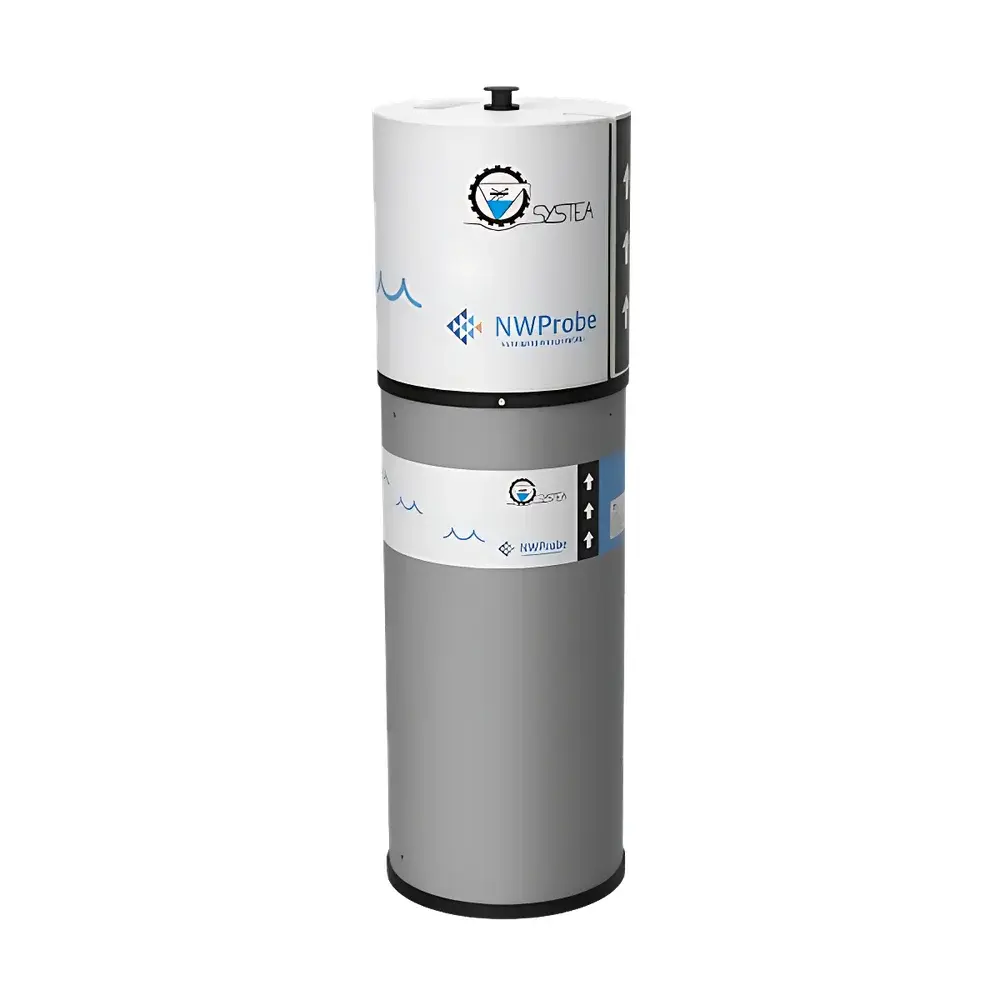
SYSTEA NWP In-situ Water Quality Analyzer
| Brand | SYSTEA |
|---|---|
| Origin | Zhejiang, China |
| Model | NWP |
| Measurement Parameters | 5-parameter simultaneous in-situ analysis (e.g., NO₃⁻-N, PO₄³⁻, NH₄⁺-N, SiO₂, CODₘₙ or configurable) |
| Detection Limit | 0.001 mg/L (for key analytes) |
| Calibration | Two-point linear calibration (R² ≥ 0.995) |
| Power Supply | 13 V DC (solar-compatible) |
| Filtration Options | Self-cleaning filter cartridges (0.1 µm or 25 µm) |
| Waste Handling | Segregated toxic/non-toxic waste and effluent lines |
| Sample Wash | Deionized water–free cleaning using ambient sample water |
| Remote Operation | Full bidirectional control & real-time status telemetry via external PC |
| Environmental Rating | IP68 submersible housing for buoy, vessel, or emergency field deployment |
| Compliance | Designed to support ISO 5667-3, ASTM D511/D512/D5429/D6508, and EPA Method 300.0/353.2 workflows |
Overview
The SYSTEA NWP In-situ Water Quality Analyzer is an autonomous, submersible multi-parameter analyzer engineered for continuous, real-time monitoring of critical water quality indicators directly in natural aquatic environments. Operating on the principle of segmented flow analysis (SFA) with micro-circulation fluidics, the NWP integrates five independent spectrophotometric or electrochemical measurement channels—each optically or electrically isolated—to enable concurrent, interference-minimized quantification of parameters such as nitrate-nitrogen (NO₃⁻-N), orthophosphate (PO₄³⁻), ammonium-nitrogen (NH₄⁺-N), silicate (SiO₂), and permanganate index (CODMn). Its in-situ architecture eliminates sample transport delays and preservation artifacts, delivering data with high temporal resolution and metrological traceability. The instrument is purpose-built for deployment in marine, estuarine, and freshwater ecosystems—particularly where regulatory compliance, early ecological anomaly detection, or rapid response to contamination events is required.
Key Features
- Five-parameter simultaneous analysis with dedicated optical/electrochemical flow cells per parameter, enabling channel-specific verification and cross-channel diagnostic validation.
- Micro-circulation SFA architecture reduces reagent consumption by >40% and achieves a detection limit of 0.001 mg/L for key nutrients—validated against certified reference materials (CRMs) traceable to NIST SRMs.
- Two-point calibration protocol with automated slope/intercept calculation yields linear correlation coefficients ≥0.995 across full operational ranges; calibration history is timestamped and stored with audit trail.
- Self-cleaning filtration system with user-selectable 0.1 µm (for phytoplankton-rich or colloidal waters) or 25 µm (for turbid coastal or riverine deployments) stainless-steel mesh cartridges.
- Dual-waste management: chemically segregated tubing paths for hazardous reagent waste (e.g., acidic molybdate, persulfate digestants) and non-hazardous sample effluent—supporting safe handling and disposal per local environmental regulations.
- Onboard fault diagnostics including air-in-line detection, low-flow alarm, sensor drift warning, and power-supply voltage monitoring; all events trigger syslog entries and optional SMS/email alerts via connected gateway.
- 13 V DC nominal input with wide-range tolerance (10–16 V), enabling direct integration with marine-grade solar charge controllers and battery banks without external regulators.
Sample Compatibility & Compliance
The NWP accommodates unfiltered or pre-filtered natural waters—including seawater, brackish estuaries, and eutrophic inland lakes—without matrix-induced signal suppression when operated within salinity ranges up to 35 ppt. Its flow path design minimizes biofouling through periodic reverse-flush cycles and UV-resistant PFA/PEEK wetted materials compliant with USP Class VI and FDA 21 CFR 177.2470. All analytical methods implemented are aligned with ISO 5667-3 (sampling techniques), ISO 15681-1/-2 (phosphate/nitrate photometry), and EPA Methods 300.0 (anions) and 353.2 (CODMn). Data integrity safeguards include electronic signatures, immutable event logs, and time-stamped calibration records—facilitating GLP-compliant reporting and regulatory submission under EU Water Framework Directive (WFD) or US Clean Water Act (CWA) monitoring programs.
Software & Data Management
The NWP communicates via RS-485 (Modbus RTU) or Ethernet (TCP/IP) to external host systems. SYSTEA’s AquaControl™ desktop software provides full remote configuration, real-time waveform visualization, method editing, and automated QC flagging (e.g., spike detection, drift trend analysis). All raw absorbance/current values, temperature-compensated results, and diagnostic metadata are logged at user-defined intervals (1 min to 24 h) and exportable in CSV, NetCDF, or EPA WQX-compliant XML. Audit trails meet FDA 21 CFR Part 11 requirements for electronic records, including operator ID, action timestamp, and before/after parameter values for every configuration change.
Applications
- Long-term ecological observatories: integrated into moored buoys or fixed-platform stations for nutrient flux modeling and HAB (harmful algal bloom) precursor tracking.
- Port and harbor environmental surveillance: continuous monitoring of antifouling biocide leachates, dredge plume dispersion, and ballast water discharge compliance.
- Emergency response: rapid-deployment units for post-spill or post-storm runoff assessment, supporting incident command systems with validated, chain-of-custody-ready data.
- Research-grade limnology/oceanography: synchronized multi-node networks for spatial gradient mapping of nitrogen speciation or silica limitation thresholds in coastal upwelling zones.
FAQ
Does the NWP require external pure water for system cleaning?
No—the NWP uses ambient sample water for all internal line rinsing cycles, eliminating dependency on deionized water supplies and reducing operational overhead in remote deployments.
Can calibration be performed in situ without removing the unit from water?
Yes—two-point calibrations may be executed remotely using onboard standard solutions injected via the integrated reagent manifold; no physical access to the submerged unit is required.
Is the NWP compatible with third-party telemetry platforms (e.g., Campbell Scientific, YSI EcoNet)?
Yes—its Modbus RTU and ASCII protocol interfaces support seamless integration with industry-standard SCADA and environmental data acquisition systems.
What maintenance intervals are recommended for offshore deployments?
Filter cartridge replacement every 30 days (0.1 µm) or 90 days (25 µm); reagent reservoir refill every 14–21 days depending on sampling frequency; full optical window inspection every 6 months.
How is data security ensured during wireless transmission?
When paired with SYSTEA-certified LTE gateways, all telemetry employs TLS 1.2 encryption and device-authenticated MQTT sessions; local storage retains 30 days of raw data even during comms outages.







