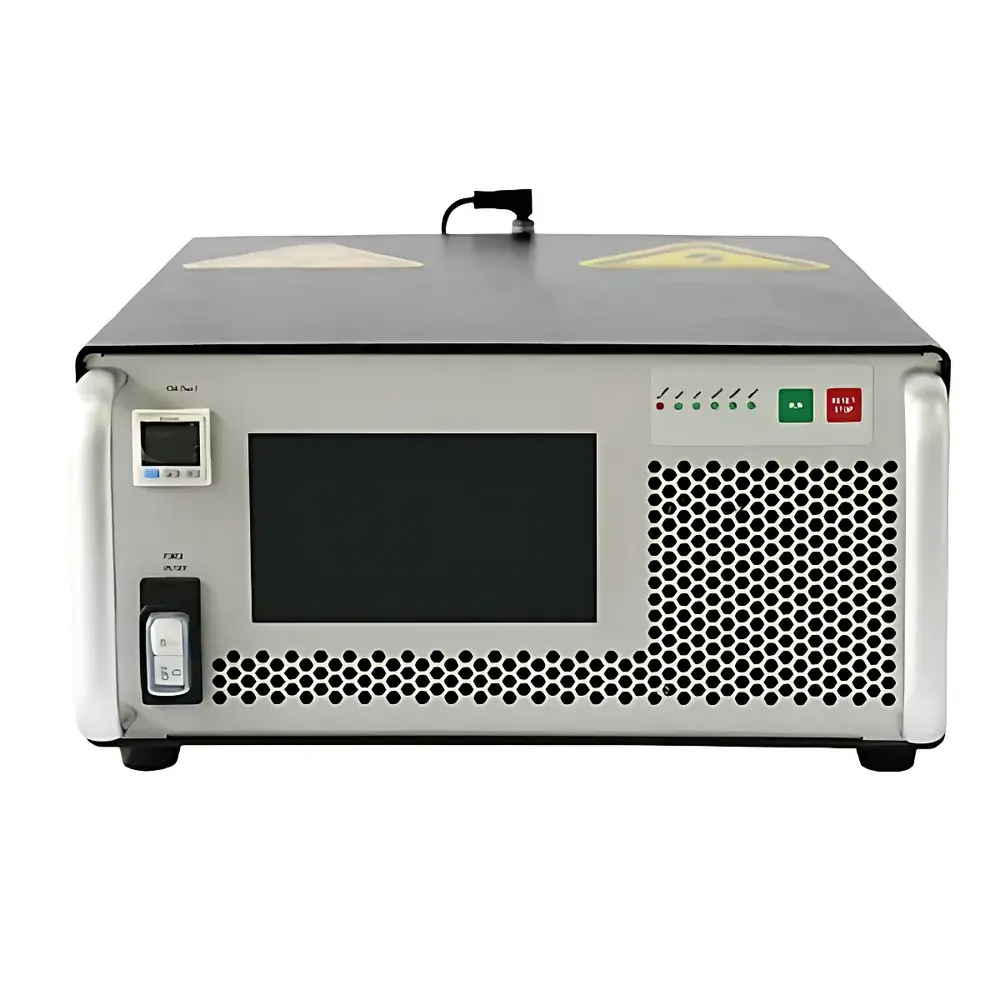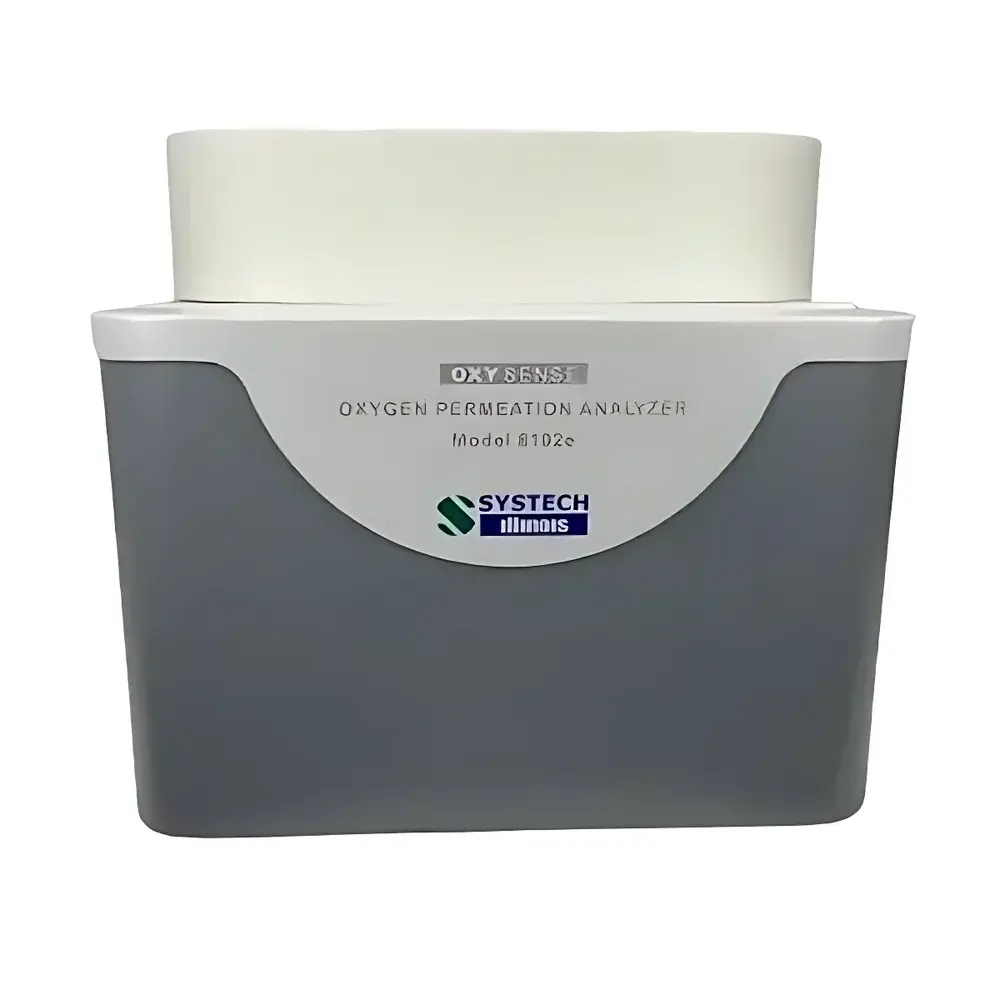
Systech Illinois 8102 Oxygen Transmission Rate Analyzer
| Brand | Systech Illinois |
|---|---|
| Origin | United Kingdom |
| Model | 8102 |
| Measurement Principle | Coulometric Sensor (Electrochemical Oxygen Detection) |
| Standards Compliance | ASTM D3985, ASTM F1307, ASTM F1927, DIN 53380-3, ISO 15105-2, JIS K 7126 |
| OTR Range | 0.05–432,000 cc/(m²·day) |
| Resolution | 0.01 cc/(m²·day) |
| Repeatability | ±0.015 cc/(m²·day) or ±1% |
| Test Chamber Temperature Range | 10–40 °C (±0.1 °C) |
| Film RH Control | 0–100% RH (dry to saturated via humidified sponge) |
| Package RH Control | Ambient or chamber-controlled |
| Sensor Technology | Long-life e-Metric® coulometric cell |
| Anti-Surge™ Protection | Yes |
| Gas Requirement | Ambient air only (no N₂/H₂ mix required) |
Overview
The Systech Illinois 8102 Oxygen Transmission Rate (OTR) Analyzer is a precision benchtop instrument engineered for quantitative determination of oxygen permeation through plastic films, laminates, foils, and rigid or flexible packaging structures. It operates on the principle of coulometric detection — a highly stable electrochemical method in which oxygen diffusing through a test specimen is quantitatively reduced at a gold cathode within a sealed sensor cell, generating a current directly proportional to the molar flux of O₂. This fundamental coulometric approach ensures traceable, absolute measurement without calibration drift, delivering high reproducibility across decades of operation. Designed for laboratories requiring regulatory-grade data integrity, the 8102 meets the metrological requirements of ASTM D3985 (for film testing), ASTM F1307 (for package testing), and ISO 15105-2, making it suitable for QC/QA validation in food, pharmaceutical, medical device, and specialty chemical packaging development.
Key Features
- e-Metric® coulometric sensor architecture with documented service life exceeding 10 years under typical use — approximately double the operational longevity of conventional zirconia or galvanic OTR sensors.
- Anti-Surge™ circuitry and pressure-compensated gas handling system prevent sensor saturation and irreversible degradation during exposure to high-O₂ environments (e.g., headspace analysis or leak-introduced air ingress).
- Computer-controlled Peltier temperature regulation (10–40 °C, ±0.1 °C stability) with independent humidity management: film specimens tested under precisely controlled RH (0–100% via integrated humidification sponge), while package tests accommodate ambient or chamber-regulated RH conditions.
- No external carrier gases required — operates exclusively on ambient air, eliminating dependency on costly and logistically complex N₂/H₂ mixtures common in paramagnetic or electrochemical alternatives.
- Wide dynamic OTR range: 0.05 to 432,000 cc/(m²·day), enabling characterization of ultra-barrier materials (e.g., SiOₓ-coated PET, AlOₓ nanolaminates) as well as highly permeable polymers (e.g., LDPE, EVA) without hardware reconfiguration.
- Resolution of 0.01 cc/(m²·day) and repeatability of ±0.015 cc/(m²·day) or ±1%, whichever is greater — validated per ASTM D3985 Annex A1 precision protocols.
Sample Compatibility & Compliance
The 8102 accommodates flat film specimens (up to 100 mm diameter) and three-dimensional packages (including pouches, blister cards, bottles, and trays) using interchangeable test fixtures. Film testing follows ASTM D3985 and ISO 15105-2 procedures, with optional RH conditioning per ASTM F1249 for hygroscopic substrates. Package testing adheres to ASTM F1307 methodology, supporting both “headspace” and “flow-through” modes depending on geometry and seal integrity. All measurement workflows are fully compliant with GLP documentation requirements and support 21 CFR Part 11–ready audit trails when paired with validated software configurations. Instrument qualification documentation (IQ/OQ/PQ templates) and standard operating procedures (SOPs) aligned with ISO/IEC 17025 are available upon request.
Software & Data Management
The included OTRSoft™ v5.x application provides full instrument control, real-time curve visualization, automated pass/fail evaluation against user-defined specification limits, and export to CSV, PDF, or XML formats. Data files include embedded metadata: operator ID, timestamp, environmental setpoints (T/RH), sensor status logs, and raw coulometric current integrals. Software supports multi-user role-based access control, electronic signatures, and configurable electronic audit trails meeting FDA 21 CFR Part 11 and EU Annex 11 expectations. Optional LIMS integration via ASTM E1384-compliant HL7 or RESTful API enables direct ingestion into enterprise quality management systems.
Applications
- Development and validation of high-barrier flexible packaging for sterile medical devices and lyophilized pharmaceuticals.
- Accelerated shelf-life modeling of oxygen-sensitive foods (e.g., roasted coffee, snack chips, infant formula) using Arrhenius-based OTR vs. temperature profiling.
- Quality conformance testing of incoming rollstock and finished pouches against internal specifications or customer contracts (e.g., ILSI, AIB, SQF).
- Root-cause analysis of packaging failures linked to O₂ ingress — including seal integrity assessment, coating uniformity verification, and substrate aging studies.
- Regulatory submission support for FDA 510(k), MDR Annex II, or Health Canada Class II device dossiers where barrier performance is a critical design input.
FAQ
Does the 8102 require calibration gases or reference standards?
No. The coulometric sensor provides absolute measurement based on Faraday’s law; routine calibration is not required. Periodic verification using certified reference films (e.g., NIST-traceable PET or aluminum foil) is recommended annually per ISO/IEC 17025.
Can the instrument test metallized or opaque films?
Yes. Unlike optical methods (e.g., fluorescence quenching), coulometric detection is insensitive to film color, opacity, or surface reflectivity — making it ideal for Al-coated, SiOₓ-deposited, or pigment-loaded substrates.
Is RH control available for package testing?
RH is managed externally for package tests — either via integration with environmental chambers (ASTM F2096-compliant) or by conditioning samples prior to insertion. The 8102 itself regulates only test chamber temperature.
What maintenance is required beyond sensor replacement?
Annual preventive maintenance includes Peltier cooler cleaning, gasket inspection, leak verification (≤1×10⁻³ cc/min), and firmware/software update validation. Sensor replacement interval is typically 8–12 years depending on cumulative O₂ exposure.
Is the 8102 compatible with automated sample changers?
Not natively. However, its RS-232 and Ethernet interfaces support third-party robotic integration via custom SCPI command scripting or OPC UA middleware in fully automated lab environments.
Related Products