
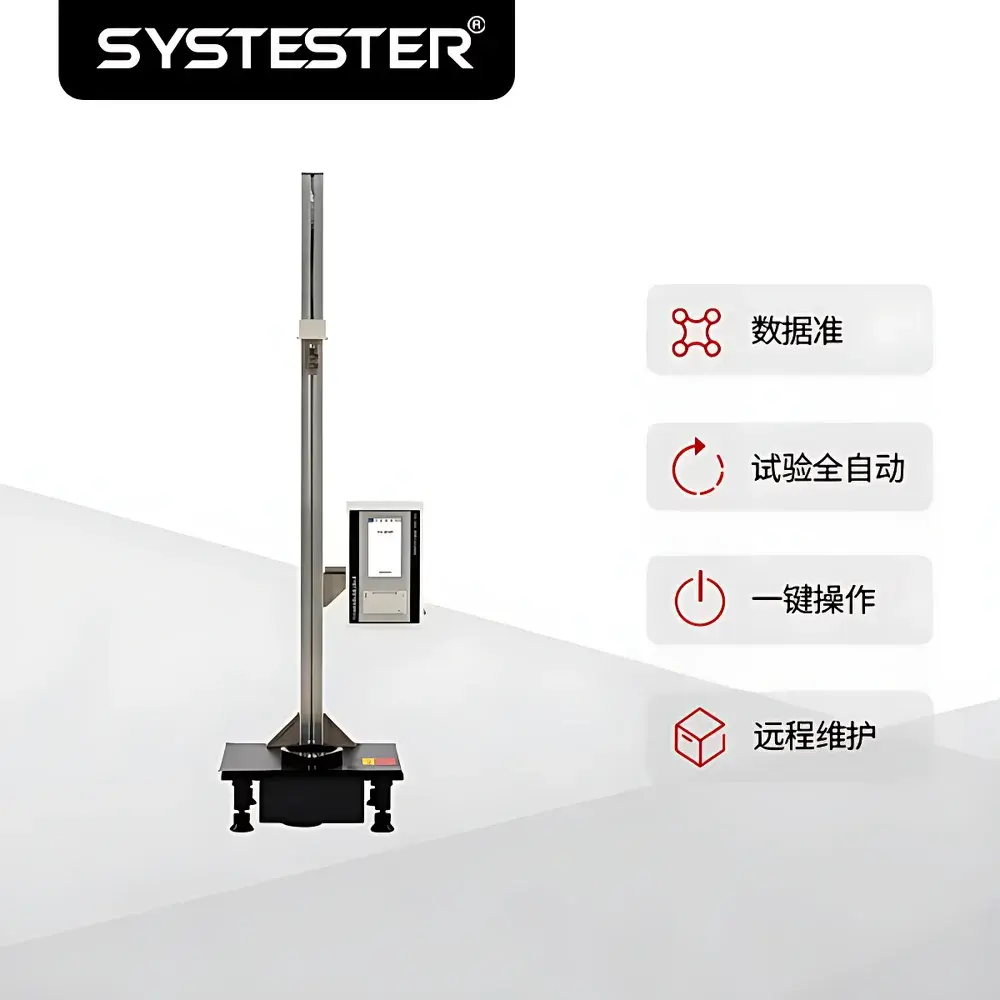
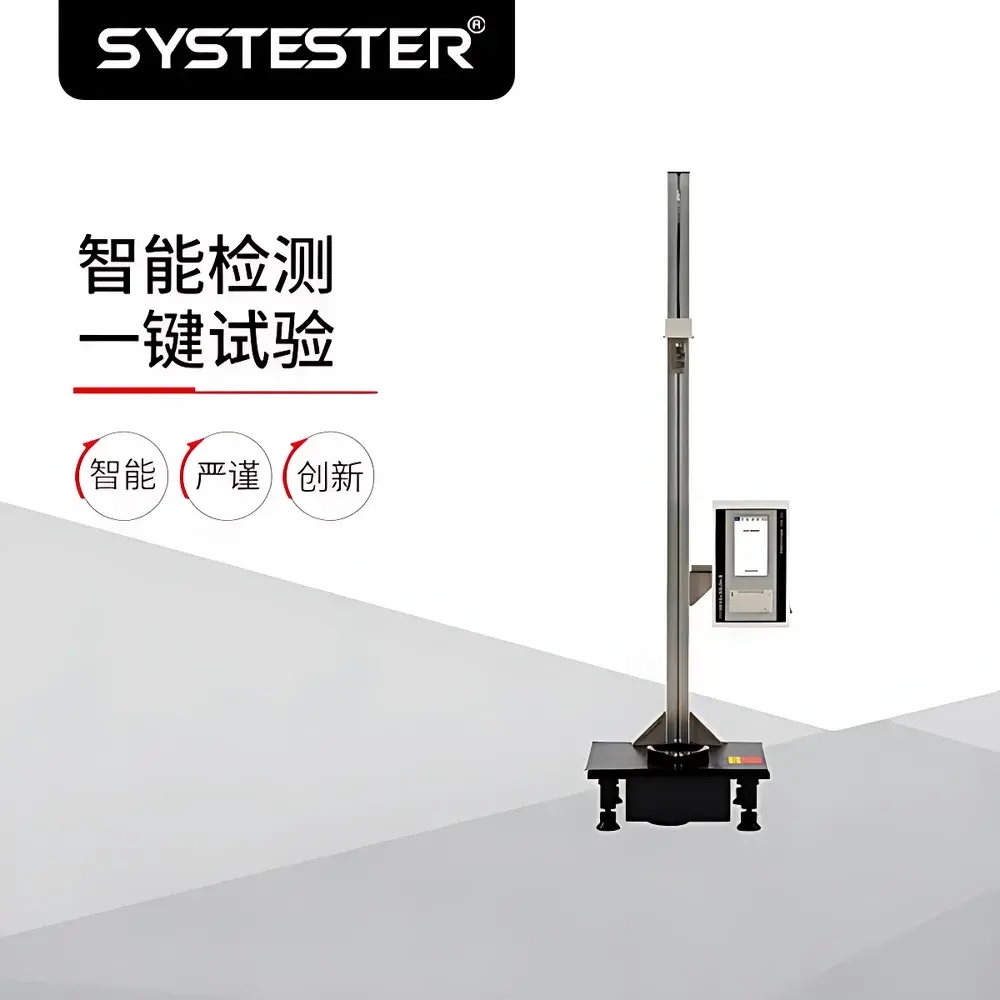
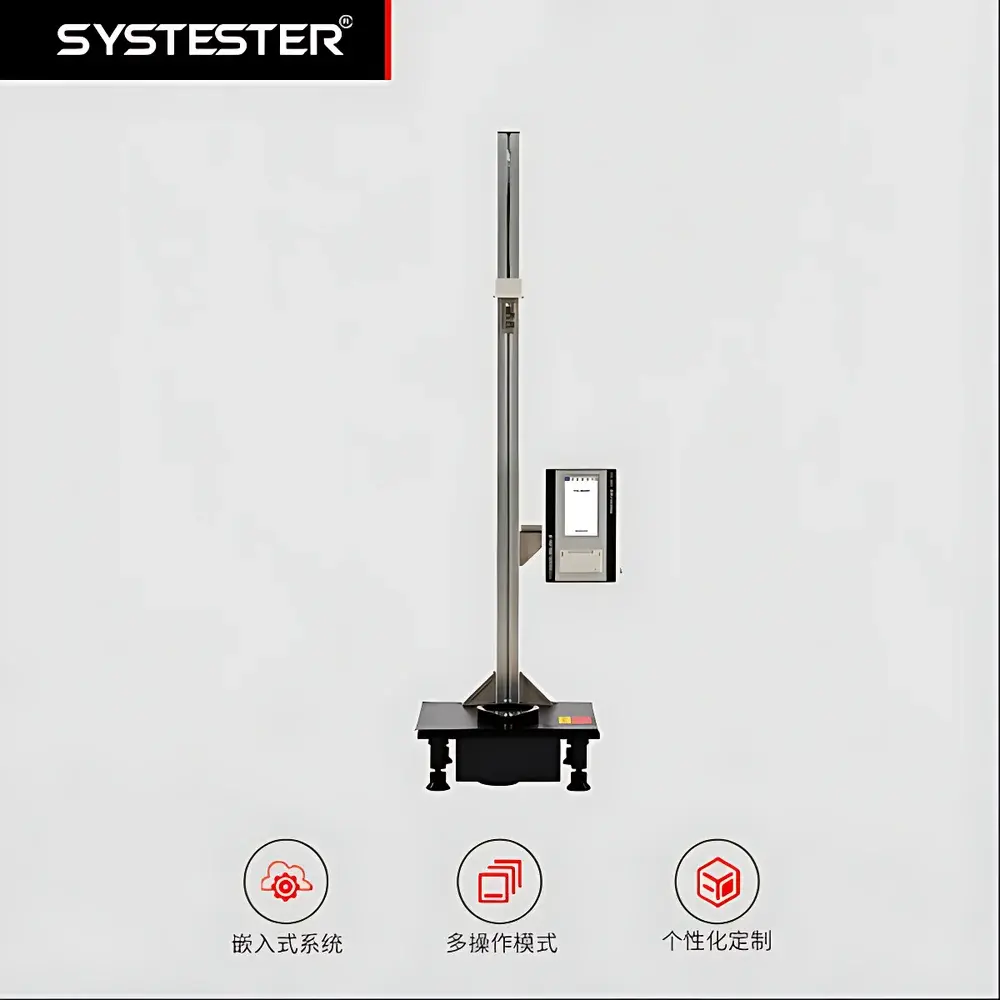
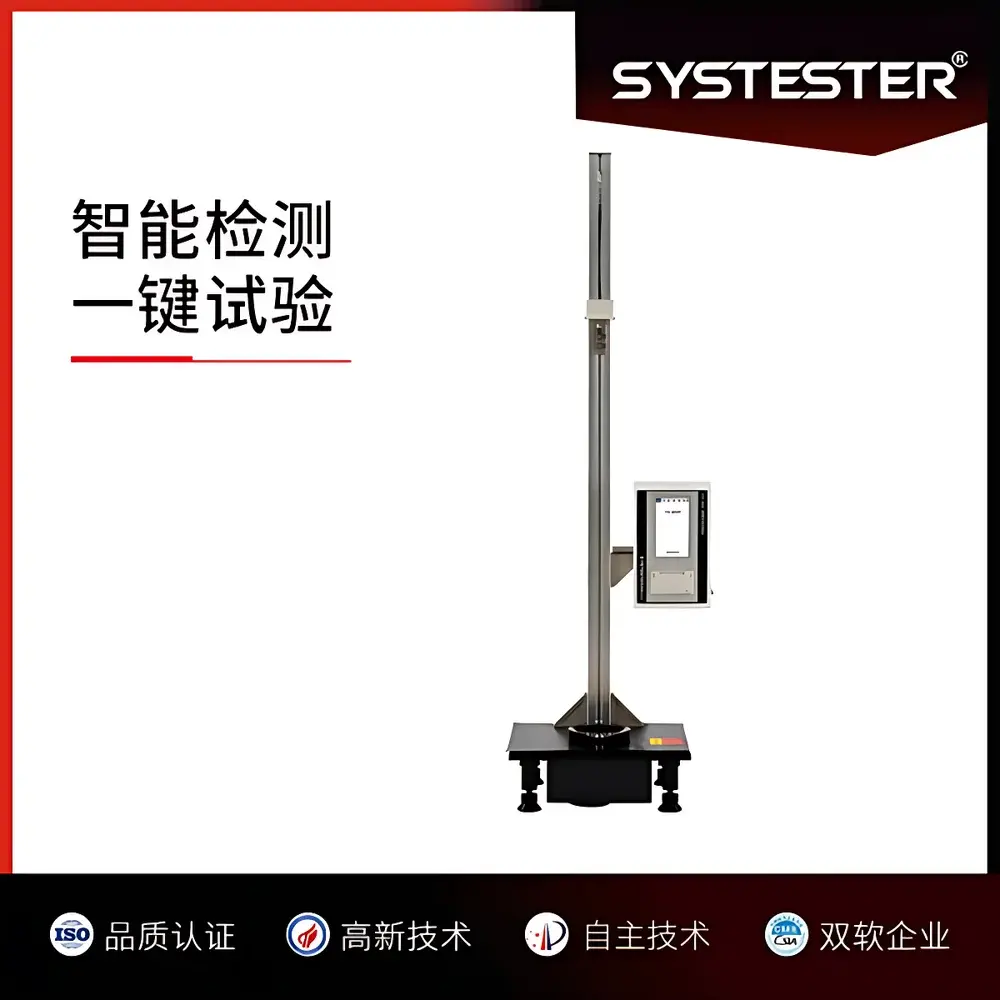
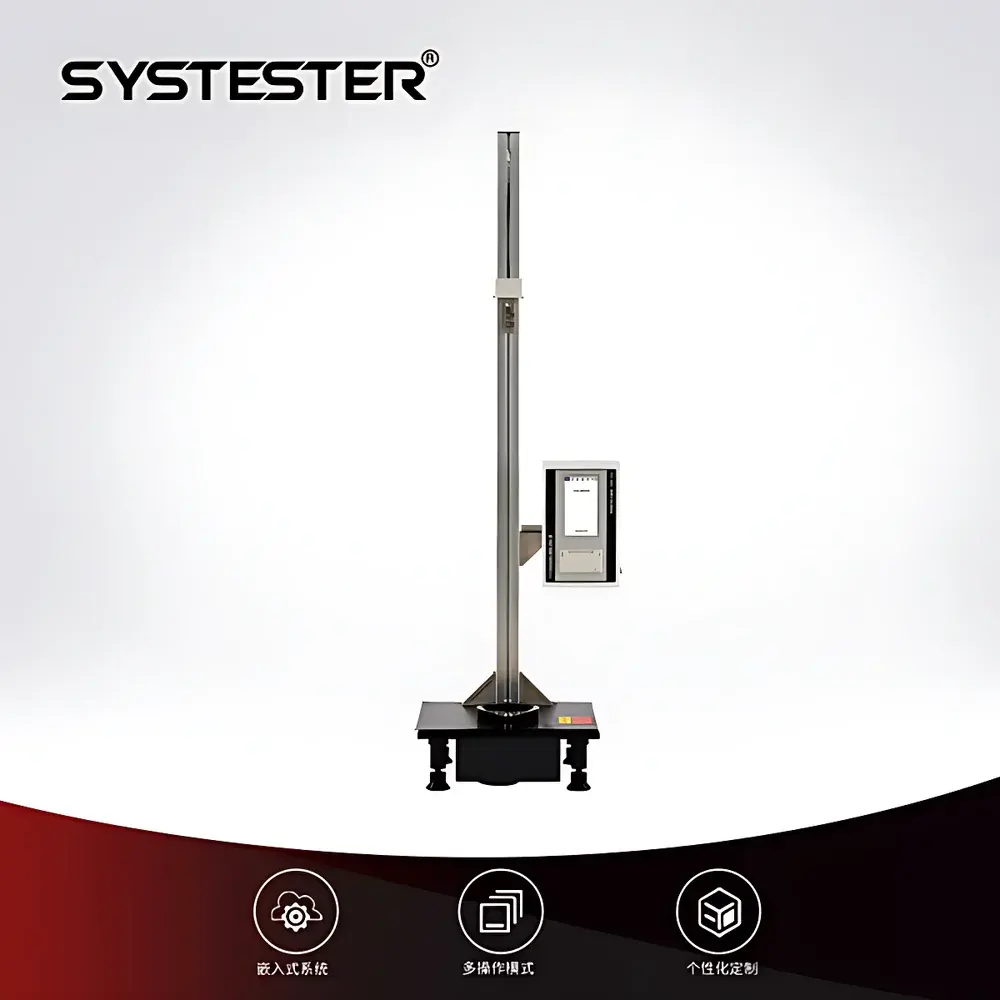
SYSTESTER DIT-ASTM D1709 Dart Impact Tester for Plastic Film and Thin Sheet Materials
| Brand | SYSTESTER |
|---|---|
| Origin | Shandong, China |
| Model | DIT-ASTM D1709 |
| Test Methods | ASTM D1709 (Method A & B), GB/T 9639, JIS K7124 |
| Mass Range | Method A: 50–2000 g |
| Method B | 300–2000 g |
| Resolution | 0.1 g (0.1 J) |
| Sample Clamping | Pneumatic, ≤1.1 MPa air supply required |
| Sample Size | >150 mm × 150 mm |
| Dimensions (A/B) | 450×450×1365 mm / 450×450×2160 mm |
| Power | AC 220 V, 50 Hz |
| Weight | 70 kg |
| Interface | Standard RS232/USB |
| Data Analysis | Built-in min/max/mean/SD calculation |
| Optional | Ball Impact Module, DSM Lab Data Management System, Safety Guard Kit |
Overview
The SYSTESTER DIT-ASTM D1709 Dart Impact Tester is an engineering-grade instrument designed to quantify the impact resistance of flexible polymeric films and thin sheets according to internationally recognized standard test methods. It operates on the principle of free-fall impact mechanics, where a calibrated dart (with defined mass and geometry) is dropped from a fixed height onto a horizontally clamped specimen. The energy imparted at failure—calculated as m·g·h—is used to determine the material’s resistance to puncture under dynamic loading conditions. This method is especially relevant for evaluating packaging integrity in food, pharmaceutical, and consumer goods industries, where film toughness directly correlates with shelf-life stability, transport durability, and seal performance. The instrument supports both Method A (lighter darts, lower heights) and Method B (heavier darts, higher drop heights), enabling precise differentiation across low-to-high impact sensitivity ranges.
Key Features
- Dual-standard compliance: Fully configured for ASTM D1709 (A & B), GB/T 9639, and JIS K7124 test protocols with seamless mode switching
- Industrial-grade 7-inch TFT capacitive touchscreen with zero-layer navigation UI—optimized for glove-compatible operation in QC labs
- Pneumatic specimen clamping system ensuring consistent 100% surface contact and eliminating edge slippage during impact
- Foot-pedal actuation for hands-free release—minimizing operator-induced variability and supporting GLP-aligned workflow practices
- Real-time display of impact event waveform, failure image capture, and immediate numerical output (mass, energy, pass/fail status)
- Onboard statistical engine computing mean, standard deviation, minimum, maximum, and coefficient of variation per test series
- Integrated thermal micro-printer for audit-trail hardcopy generation—each report includes timestamp, operator ID, test method, and environmental metadata
- Standard RS232 and USB 2.0 interfaces for bidirectional communication with LIMS or QA databases
- Modular expansion support: Optional ball impact module (for ISO 7765-1/2), full safety enclosure kit, and DSM Laboratory Data Management System integration
Sample Compatibility & Compliance
The DIT-ASTM D1709 accommodates specimens exceeding 150 mm × 150 mm, suitable for cast, blown, extruded, and laminated polymer films—including PE, PP, PET, PVC, and metallized barrier structures. Its pneumatic clamping mechanism maintains uniform pressure distribution across variable thicknesses (12–250 µm), preventing pre-stress artifacts. All mechanical and software functions are traceable to NIST-traceable mass calibration standards. The instrument meets essential requirements for ISO/IEC 17025-accredited laboratories, including documented uncertainty budgets, firmware version logging, and user-access-level controls. It supports FDA 21 CFR Part 11-compliant electronic records when paired with the optional DSM system, providing full audit trail, electronic signatures, and role-based permissions.
Software & Data Management
Firmware v3.2 includes embedded test sequence scripting, configurable pass/fail thresholds, and automatic outlier detection per ASTM E178 guidelines. Raw data—including impact time-series waveforms and frame-captured failure morphology—is stored in CSV and XML formats with ISO 8601 timestamps. When integrated with the optional DSM Lab Data Management System, users gain centralized access control, automated report generation (PDF/XLSX), trend analysis across multiple instruments, and electronic signature workflows compliant with GMP Annex 11 and EU GMP Annex 11. All data transfers utilize TLS 1.2 encryption, and local storage employs AES-256 encryption at rest.
Applications
- Quality assurance of primary packaging films in food and beverage manufacturing
- Development-stage evaluation of co-extruded barrier layers for pharmaceutical blister packaging
- Comparative assessment of aging effects (UV, heat, humidity) on impact resilience
- Supplier qualification testing against contractual impact energy specifications
- Root cause analysis of field failures linked to puncture or tear propagation
- Regulatory submission support for FDA IND/NDA filings requiring mechanical integrity data
FAQ
What standards does this instrument fully support out-of-the-box?
ASTM D1709 (Methods A and B), GB/T 9639-2002, and JIS K7124-2012 — all implemented with method-specific height/mass tables, calibration routines, and pass/fail logic.
Is compressed air supply included with the system?
No — users must provide clean, dry compressed air at ≤1.1 MPa (160 psi); a standard industrial air line with moisture trap is recommended.
Can test results be exported to Excel without optional software?
Yes — via USB flash drive or RS232 serial export; CSV files contain all raw and calculated parameters with column headers compliant with ISO/IEC 17025 reporting requirements.
Does the instrument meet requirements for GLP or GMP environments?
Yes — with optional DSM integration, it delivers full audit trail, electronic signatures, and change control logs aligned with OECD GLP Principles and FDA 21 CFR Part 11.
What maintenance is required for long-term measurement stability?
Annual verification using certified reference masses and height gauges is recommended; optical alignment check of the drop guide is performed during routine calibration per ASTM E74.
Related Products






