
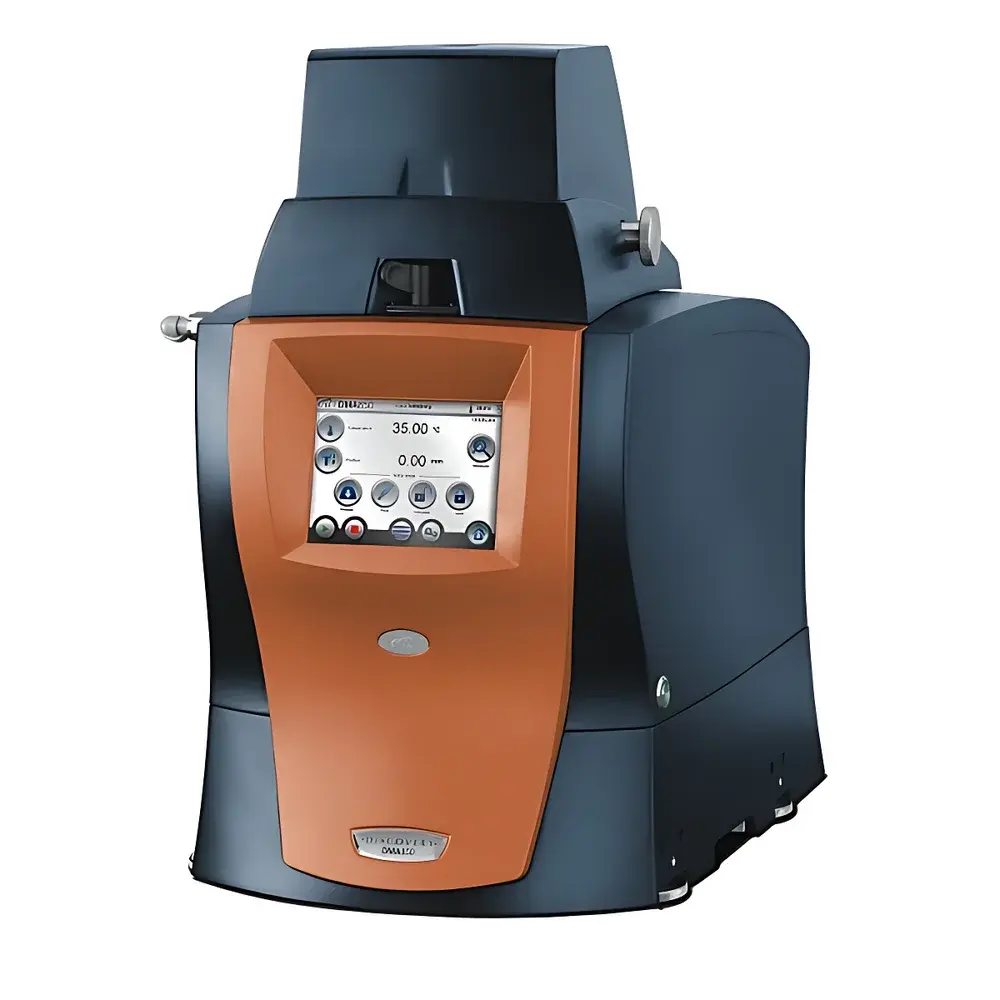
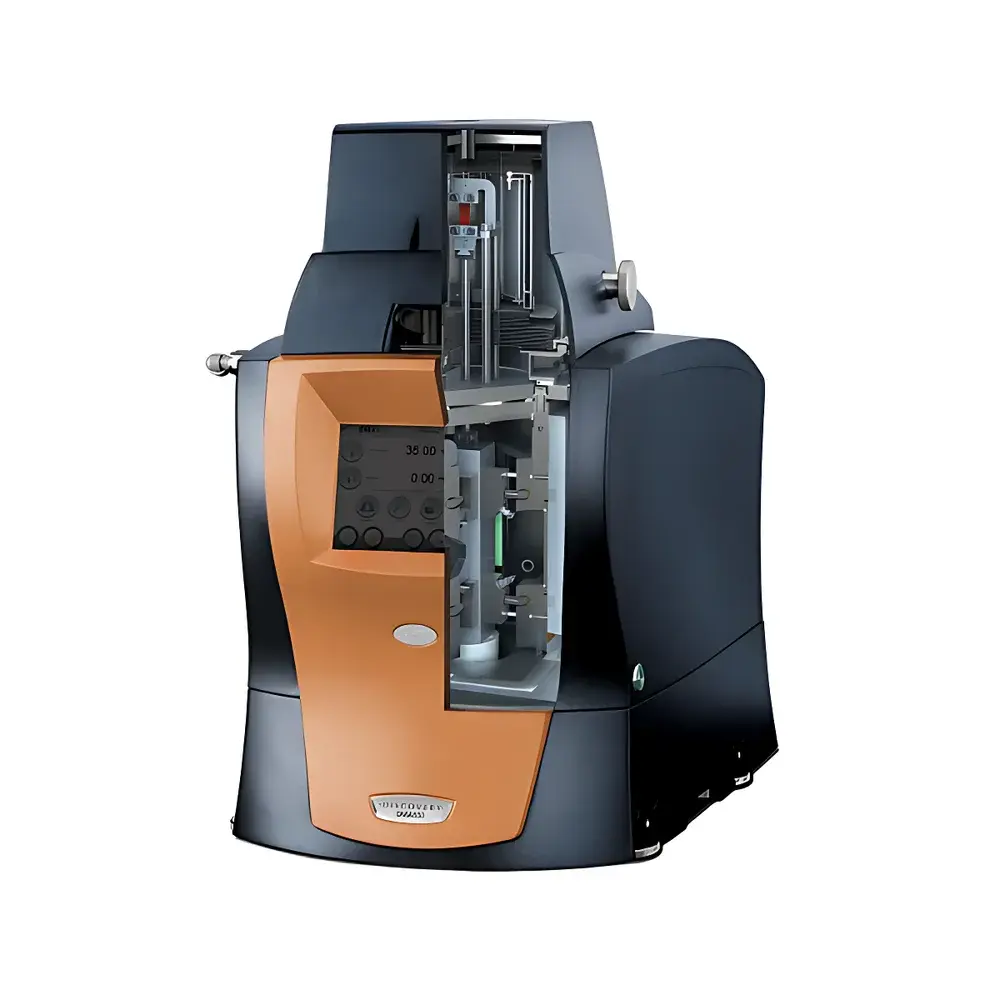
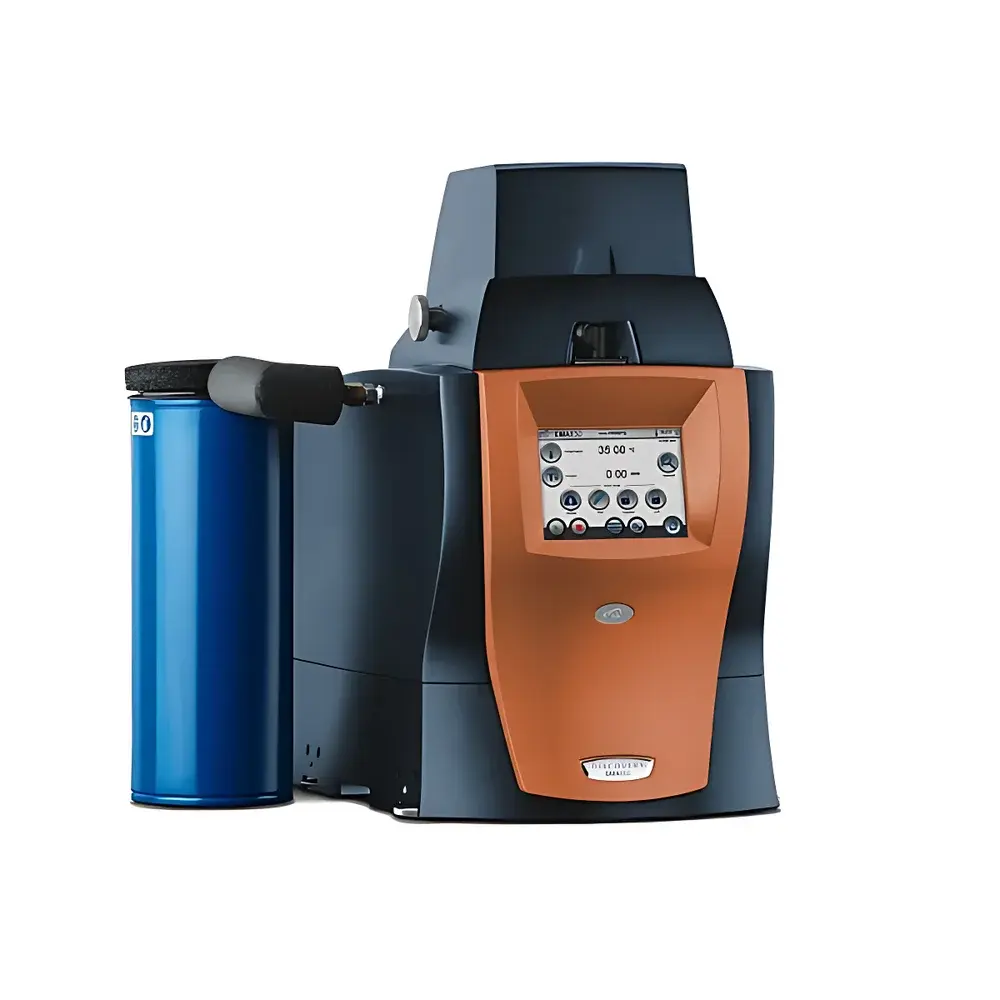
TA Instruments Discovery DMA Dynamic Mechanical Analyzer
| Brand | TA Instruments |
|---|---|
| Origin | USA |
| Model | Discovery |
| Instrument Type | Dynamic Mechanical Analyzer (DMA/DMTA) |
| Compliance | ASTM D4065, ASTM D7028, ISO 6721, ISO 11359, USP <1031> |
| Cooling Range | –100 °C to 600 °C |
| Force Range | 0.1 mN to 18 N |
| Displacement Resolution | 0.1 nm over 25 mm dynamic range |
| Environmental Options | Dual configurable environmental chambers (inert gas, humidity, vacuum) |
| Control Architecture | Non-contact voice-coil motor with continuous force control |
| Bearing System | Low-compliance air bearing |
| Strain Sensing | Direct optical encoder-based strain measurement |
| Software Platform | TRIOS v5.x with 21 CFR Part 11 compliant audit trail and GLP/GMP-ready workflows |
Overview
The TA Instruments Discovery DMA is a high-precision dynamic mechanical analyzer engineered for rigorous viscoelastic characterization of polymeric, composite, elastomeric, and biomaterial systems across broad temperature, frequency, and stress domains. Operating on the fundamental principle of forced oscillatory deformation, the instrument applies controlled sinusoidal stress or strain to a sample while simultaneously measuring the resulting in-phase (storage modulus, E′) and out-of-phase (loss modulus, E″) mechanical responses. This enables quantitative determination of material damping (tan δ), glass transition temperature (Tg), secondary relaxations (β, γ transitions), cold crystallization kinetics, cure monitoring, filler-matrix interfacial effects, and time–temperature superposition (TTS) modeling. Designed for research laboratories and quality control environments requiring traceable, reproducible thermomechanical data, the Discovery DMA integrates metrologically validated force and displacement transduction with industry-leading thermal control stability (±0.1 °C) and low thermal mass furnace architecture.
Key Features
- Non-contact voice-coil actuator delivering continuous, frictionless force control from 0.1 mN to 18 N — enabling seamless testing of ultralow-modulus hydrogels to high-stiffness carbon-fiber composites.
- Air-bearing-supported motion system with sub-nanometer mechanical compliance ensures minimal parasitic signal contribution and superior signal-to-noise ratio during low-amplitude oscillatory measurements.
- Optical encoder-based direct strain sensing with 0.1 nm resolution over 25 mm dynamic range provides true displacement fidelity without extrapolation or calibration drift.
- Intelligent Auto-Strain™ control dynamically adjusts oscillation amplitude in real time to maintain constant strain or stress conditions across variable modulus regimes — eliminating manual recalibration between samples.
- Dual independent environmental chamber options support inert gas purging (N2, Ar), controlled humidity (5–95% RH), or vacuum operation — critical for oxidation-sensitive polymers and moisture-dependent relaxation studies.
- Patented air-cooling system achieves stable operation down to –100 °C without liquid nitrogen, reducing operational cost and safety risk while maintaining thermal ramp rates up to 60 °C/min.
- Modular, high-rigidity sample fixtures (tension, bending, shear, compression) feature tool-free installation and calibrated thermal expansion compensation for dimensional accuracy across wide temperature sweeps.
Sample Compatibility & Compliance
The Discovery DMA accommodates standard geometries including rectangular bars (ASTM D4065), dual-cantilever beams (ISO 6721-4), film strips, fibers, and molded discs. Fixture interchangeability supports rapid method transfer between testing modes without hardware reconfiguration. All thermal and mechanical calibrations are NIST-traceable and documented per ISO/IEC 17025 requirements. The system complies with ASTM D4065 (standard test methods for dynamic mechanical properties of plastics), ASTM D7028 (glass transition temperatures of polymer matrix composites), ISO 6721 (determination of dynamic mechanical properties), and ISO 11359 (thermomechanical analysis). For regulated environments, TRIOS software includes 21 CFR Part 11-compliant electronic signatures, role-based access control, and immutable audit trails meeting FDA, EMA, and PMDA validation expectations.
Software & Data Management
TRIOS v5.x serves as the unified platform for experimental design, real-time monitoring, automated data reduction, and advanced modeling. Two interface modes — Guided Mode for routine QC operators and Expert Mode for researchers — provide scalable functionality without compromising analytical depth. Built-in modules include Time–Temperature Superposition (WLF and Arrhenius fitting), Cure Kinetics (model-free and model-based isoconversional analysis), and Viscoelastic Master Curve generation. Raw data files (.dma) are stored in open HDF5 format, supporting third-party scripting (Python, MATLAB) and integration into LIMS or ELN ecosystems. All instrument parameters, calibration logs, and user actions are timestamped and archived with cryptographic integrity verification.
Applications
- Quantification of Tg breadth and heterogeneity in amorphous thermoplastics and phase-separated block copolymers.
- In-process monitoring of epoxy resin cure progression via evolution of storage modulus and tan δ peak position.
- Assessment of nanofiller dispersion efficiency in rubber composites through changes in Payne effect magnitude and relaxation spectrum broadening.
- Thermomechanical stability evaluation of biomedical hydrogels under physiological temperature and hydration conditions.
- Creep recovery and stress relaxation profiling for long-term sealing performance prediction in automotive gasket materials.
- Dynamic fatigue life estimation using strain-controlled cyclic loading protocols with in-situ modulus tracking.
FAQ
What temperature range is supported without cryogenic liquids?
The integrated air-cooling system enables stable operation from –100 °C to 600 °C, eliminating dependency on liquid nitrogen for sub-ambient testing.
Is the instrument suitable for regulatory submissions?
Yes — TRIOS software supports full 21 CFR Part 11 compliance, including electronic signatures, audit trails, and secure user authentication required for FDA-regulated labs.
How is thermal calibration performed?
Certified reference materials (e.g., indium, zinc, and KCl) are used for multi-point furnace calibration; results are stored with NIST-traceable uncertainty budgets.
Can the system perform time-sweep tests at constant temperature?
Yes — isothermal frequency sweeps, stress relaxation, creep, and dynamic fatigue protocols are all natively supported with programmable dwell times and amplitude modulation.
What maintenance intervals are recommended?
Annual performance verification is advised per ISO 17025 guidelines; the furnace carries a 5-year limited warranty covering heating element, sensor, and controller subsystems.



