
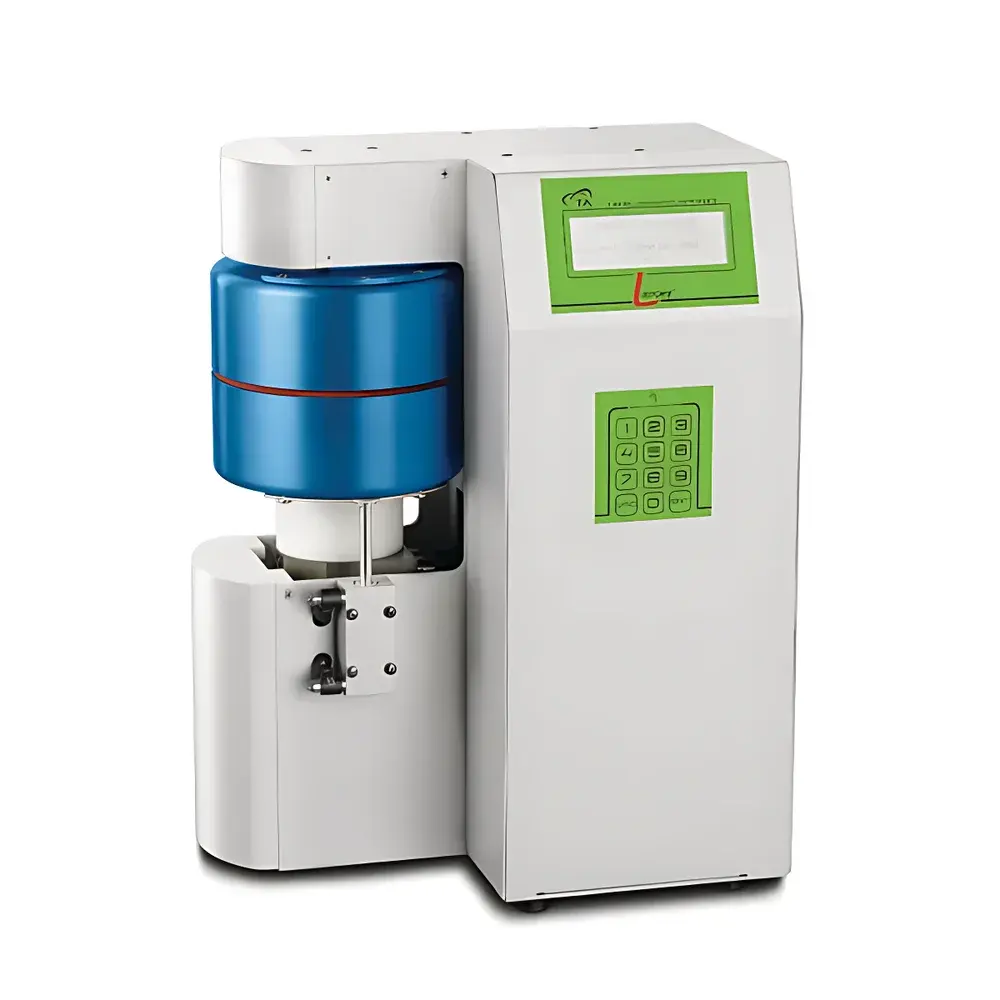
TA Instruments FOX 50 Heat Flow Meter Thermal Conductivity Analyzer
| Brand | TA Instruments |
|---|---|
| Origin | USA |
| Model | FOX 50 |
| Thermal Conductivity Range | 0.1–10 W/m·K |
| Dimensions (L×W×H) | 250×170×360 mm |
| Accuracy | ±3% |
| Temperature Range | −10°C to 110°C |
Overview
The TA Instruments FOX 50 Heat Flow Meter (HFM) Thermal Conductivity Analyzer is a precision-engineered instrument designed for steady-state measurement of thermal conductivity and thermal resistance of solid and liquid materials using the guarded hot plate principle adapted for heat flow meter methodology. Based on ASTM C518 and ISO 8301 standards, the FOX 50 employs dual symmetric heat flux sensors, calibrated reference materials (e.g., Pyrex glass), and active temperature control to deliver traceable, reproducible results in compliance with international thermal transport testing requirements. Its compact benchtop architecture integrates solid-state Peltier heating/cooling elements, enabling stable thermal gradients across sample thicknesses ranging from 5 mm to 50 mm without external chiller or heater units. The system operates under controlled environmental conditions—typically ambient air or optional purge gas—to minimize convective interference and ensure measurement fidelity for medium-conductivity materials such as polymers, ceramics, insulating foams, composites, architectural concrete, and thin-layer coatings.
Key Features
- Compact, self-contained design optimized for laboratory space efficiency and rapid setup—no external cooling water or high-voltage power supplies required.
- High-stability Peltier-based temperature control with independent hot- and cold-plate regulation, achieving ±0.1°C uniformity over the full operating range (−10°C to 110°C).
- Digital thickness measurement via optical encoder with 1 µm resolution, eliminating manual micrometer error and enabling real-time compensation during thermal equilibrium acquisition.
- Proprietary thin-film heat flux sensors with NIST-traceable calibration, delivering linear response across the 0.1–10 W/m·K range and minimizing edge-loss artifacts.
- Built-in interfacial thermal resistance correction using the double-thickness method, accounting for contact resistance between sample surfaces and sensor plates per ASTM C1113 guidelines.
- Optional liquid test cell with sealed, low-convection chamber for measuring thermal conductivity of oils, gels, and phase-change fluids under controlled shear-free conditions.
- Integrated WinTherm-50 software platform supporting automated test sequencing, multi-sample batch processing, and thermophysical property derivation including specific heat capacity (via optional DSC-coupled calibration).
Sample Compatibility & Compliance
The FOX 50 accommodates rigid, semi-rigid, and compliant flat-surfaced specimens up to 150 mm × 150 mm in planar dimension and 5–50 mm in thickness. It supports homogeneous solids (e.g., epoxy resins, alumina tiles), heterogeneous composites (e.g., fiber-reinforced plastics), porous media (e.g., aerogel blankets, mineral wool), and isotropic liquids when equipped with the fluid test module. All measurements adhere to ASTM C518 (Standard Test Method for Steady-State Thermal Transmission Properties by Means of the Heat Flow Meter Apparatus) and ISO 8301 (Thermal insulation—Determination of steady-state thermal resistance and related properties—Heat flow meter apparatus). System validation follows TA Instruments’ internal QA protocol aligned with ISO/IEC 17025 principles; calibration certificates include uncertainty budgets traceable to NIST SRMs. The instrument satisfies GLP documentation requirements through audit-ready electronic records, including full metadata logging (temperature ramp profiles, sensor drift compensation, thickness input history).
Software & Data Management
WinTherm-50 is a Windows-based application engineered for regulatory-compliant data handling. It provides full 21 CFR Part 11 functionality—including user-level access control, electronic signatures, and immutable audit trails—for laboratories operating under FDA, ISO 13485, or ICH-GCP frameworks. Raw sensor outputs (voltage, temperature, displacement) are stored in encrypted binary format with ASCII export options (CSV, TXT) for third-party analysis. The software performs automatic equilibrium detection using adaptive time-derivative thresholds, applies thickness-dependent thermal resistance corrections, and generates standardized reports with uncertainty propagation per GUM (Guide to the Expression of Uncertainty in Measurement). Optional modules enable comparative analysis against historical datasets, statistical process control (SPC) charting, and integration with LIMS via ODBC drivers.
Applications
- Quality control of thermal insulation materials in building envelope R-value certification.
- R&D evaluation of polymer matrix composites for aerospace and automotive lightweighting programs.
- Thermal interface material (TIM) screening for electronics packaging and battery thermal management systems.
- Validation of additive manufacturing build parameters affecting thermal anisotropy in printed ceramics and metals.
- Regulatory submission support for medical device packaging materials requiring thermal stability documentation per ISO 11607.
- Academic research in condensed matter physics involving phonon transport modeling in nanostructured dielectrics.
FAQ
What standards does the FOX 50 comply with for thermal conductivity measurement?
ASTM C518 and ISO 8301 are fully supported; additional alignment with EN 12664 and JIS A 1412-2 is achievable via user-defined test protocols.
Can the FOX 50 measure anisotropic materials?
Yes—when combined with directional sample mounting fixtures and orthogonal orientation testing, it enables comparative in-plane vs. through-plane analysis for layered composites and textiles.
Is calibration traceable to national metrology institutes?
All factory calibrations use NIST-traceable Pyrex reference standards; certificate of calibration includes expanded uncertainty (k=2) and measurement repeatability data.
Does the system require routine recalibration?
No—under normal operating conditions and with proper maintenance, calibration remains valid for ≥24 months; annual verification with certified reference materials is recommended.
How is sample surface contact resistance addressed?
The built-in double-thickness correction algorithm automatically computes and subtracts interfacial thermal resistance based on two sequential measurements at different sample thicknesses, per ASTM C1113 Annex A2.



