
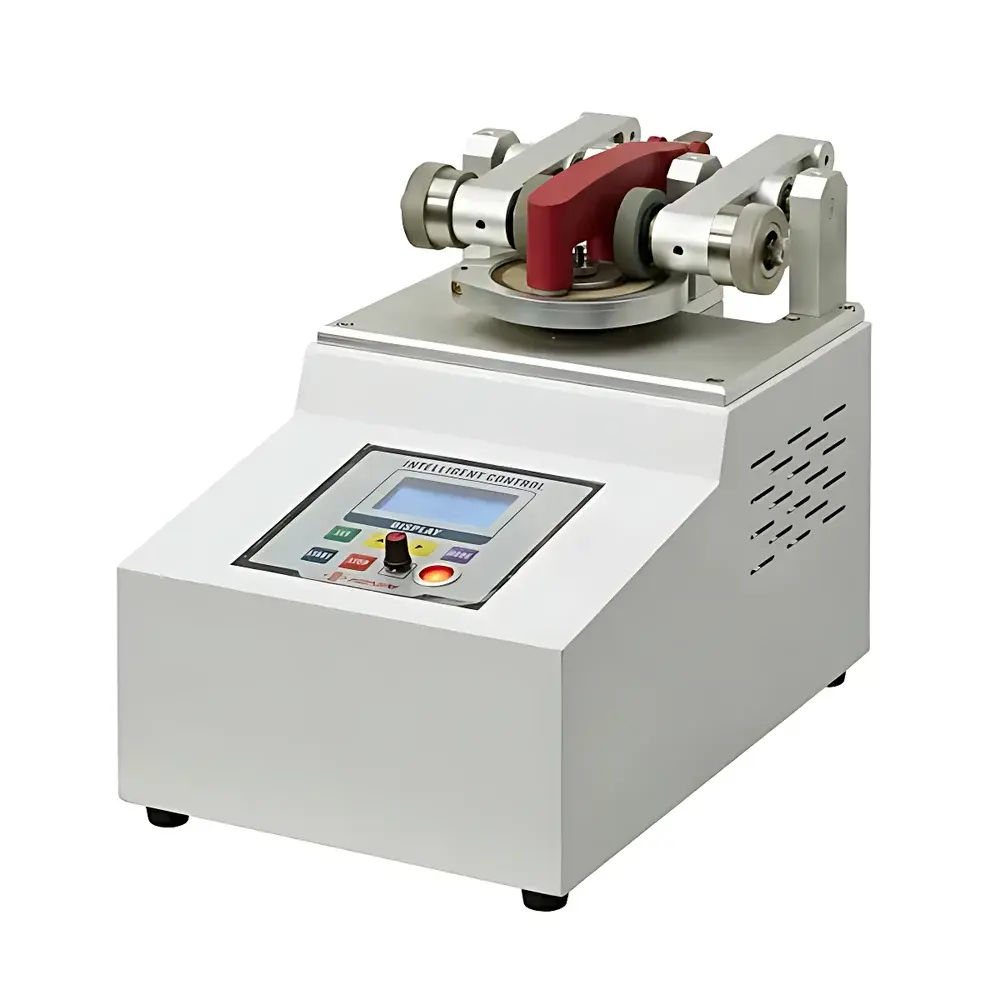
TABER Abrasion Tester HY-768-1 by HENGYU
| Brand | HENGYU |
|---|---|
| Origin | Tianjin, China |
| Model | HY-768-1 |
| Load Options | 250 g, 500 g, 1000 g |
| Rotational Speed | 60–72 rpm (infinitely variable) |
| Dimensions (L×W×H) | 52 × 30 × 42 cm |
| Weight | 40 kg |
| Power Supply | AC 220 V, 50 Hz, 500 W |
| Operating Environment | 10–35 °C, 10–80 % RH |
| Compliance Standards | ASTM D3884, ASTM D1175, ASTM D4060, ASTM D1044, TAPPI T476, ISO 9352, ISO 5470-1, JIS K7204, JIS A1453, JIS K6902, JIS L1096, JIS K6964, DIN 52347, DIN 53109, DIN 53754, DIN 53799, QB/T 2726, QB/T 2703, QB/T 16799, FZ/T 01128, Adidas GE22 |
Overview
The TABER Abrasion Tester HY-768-1 is a precision-engineered rotational wear testing instrument designed for quantitative evaluation of surface resistance to abrasive wear under controlled, standardized conditions. Based on the fundamental principle of dual-abrasive-wheel rotation—where two calibrated abrasive wheels rotate in opposite directions while applying vertical load against a horizontally mounted flat specimen—the HY-768-1 replicates real-world mechanical degradation mechanisms such as scuffing, scratching, and material loss due to repeated frictional contact. This geometry conforms strictly to the kinematic requirements defined in ASTM D4060 and ISO 9352, ensuring metrological traceability and inter-laboratory comparability. The instrument is widely deployed in quality control laboratories, R&D centers, and certification facilities across textile, footwear, automotive interior, flooring, packaging, and coated materials industries to support specification validation, batch release, and regulatory compliance documentation.
Key Features
- Three standardized load configurations (250 g, 500 g, and 1000 g) enable systematic wear severity grading across material classes—from soft leathers to rigid ceramic tiles.
- Infinitely variable rotational speed control (60–72 rpm) permits precise adjustment to match test method requirements and minimize inertial artifacts during acceleration phases.
- Dedicated dust extraction port integrates seamlessly with standard laboratory vacuum systems to maintain consistent particle clearance during extended cycles—critical for maintaining abrasion kinetics and preventing third-body interference.
- Modular wheel-mounting assembly supports rapid interchange of TABER CS-10, CS-17, CS-30, or custom-calibrated abrasive wheels per ASTM D3884 Annex A1 and ISO 5470-1 Annex B.
- Rigid cast-iron base and precision-machined bearing housings ensure long-term mechanical stability and minimal runout (<0.02 mm), contributing to high repeatability (CV ≤ 3.5 % across 10 replicate tests on reference polyurethane sheet per ASTM D4060).
- Integrated sample clamping system accommodates specimens up to 108 mm in diameter with concentricity tolerance <0.1 mm, minimizing edge effects and enabling full-surface wear mapping.
Sample Compatibility & Compliance
The HY-768-1 accepts flat, rigid, or semi-flexible specimens up to 10 mm thickness, including woven/nonwoven textiles, synthetic and natural leathers, laminated composites, polymer-coated metals, architectural finishes, rubber compounds, and engineered floor coverings. Its mechanical design and operational envelope fully satisfy the dimensional, loading, and motion specifications required by all referenced standards—including ASTM D1044 (for transparent plastics), JIS L1096 (for fabrics), and QB/T 2726 (for leather). Test reports generated using this system are admissible in GLP-compliant environments when paired with documented calibration records, operator training logs, and environmental monitoring data per ISO/IEC 17025:2017 Clause 7.7.
Software & Data Management
While the HY-768-1 operates as a standalone electromechanical platform, it is compatible with optional digital cycle counters (0–999,999 cycles, ±1 count accuracy) and external data acquisition systems via TTL pulse output. When integrated into networked QC workflows, test parameters—including load, speed, cycle count, and ambient temperature/humidity metadata—can be logged into LIMS or ELN platforms supporting ASTM E1469 and FDA 21 CFR Part 11 audit-trail requirements. Calibration certificates for applied loads (traceable to NIM, China) and rotational speed verification (using certified tachometer) are supplied with each unit.
Applications
- Quantifying abrasion resistance of automotive interior trim materials under SAE J2527-referenced protocols.
- Evaluating scuff resistance of PU-coated synthetic leathers used in luxury handbags per Adidas GE22.
- Validating durability of anti-scratch coatings on touchscreens and optical lenses per ISO 9352.
- Assessing wear life of commercial vinyl composition tile (VCT) per ASTM D1175 and ASTM D3884.
- Supporting ISO 105-X12 colorfastness-to-rubbing correlation studies in textile labs.
- Performing comparative wear screening of novel elastomeric sealants and gasket compounds in HVAC component qualification.
FAQ
What standards does the HY-768-1 directly support?
ASTM D3884, ASTM D1175, ASTM D4060, ASTM D1044, TAPPI T476, ISO 9352, ISO 5470-1, JIS K7204, JIS A1453, JIS K6902, JIS L1096, JIS K6964, DIN 52347, DIN 53109, DIN 53754, DIN 53799, QB/T 2726, QB/T 2703, QB/T 16799, FZ/T 01128, and Adidas GE22.
Is the instrument suitable for elevated temperature testing?
No—the HY-768-1 is configured for ambient-temperature operation only (10–35 °C). High-temperature wear evaluation requires auxiliary thermal chambers and modified load train components not included in this model.
Can the device accommodate non-circular specimens?
Yes—rectangular or irregularly shaped samples may be tested using custom fixture adapters, provided they maintain planar contact and do not exceed the 108 mm effective wear zone diameter.
What maintenance is required to sustain measurement integrity?
Monthly verification of wheel concentricity and load application accuracy, biannual replacement of abrasive wheels per usage log, and annual recalibration of speed controller and load cells by an accredited service provider.
Does the system include software for automated reporting?
No—the HY-768-1 is a hardware-only platform; however, its TTL pulse interface enables integration with third-party data logging and report generation tools compliant with ISO/IEC 17025 and 21 CFR Part 11.



