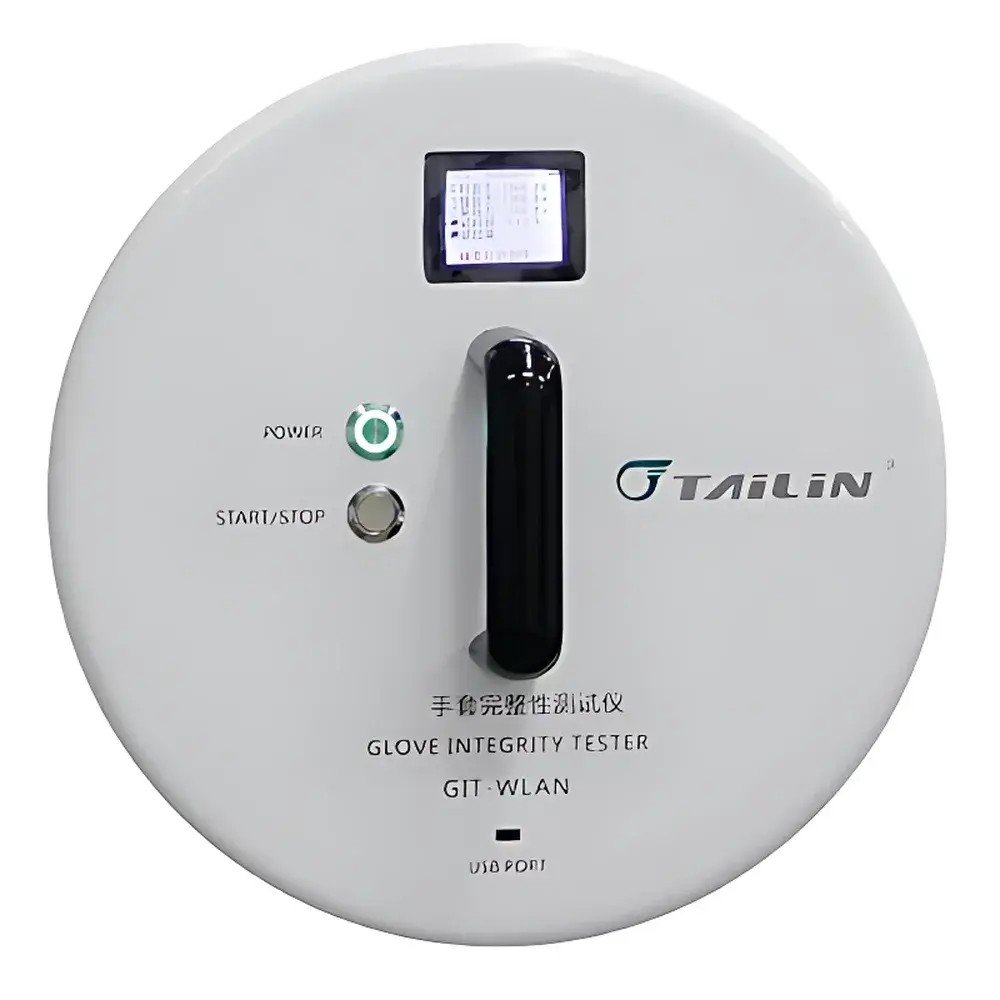
Tailin GIT-WLAN Wireless Glove Integrity Tester
| Brand | Tailin |
|---|---|
| Origin | Zhejiang, China |
| Manufacturer Type | Direct Manufacturer |
| Product Origin | Domestic (China) |
| Model | GIT-WLAN |
| Price Range | USD 14,000 – 28,000 |
| Test Duration | 7 min |
| Continuous Operation Time | ≥2 h |
| Inflation Pressure Range | 500–3000 Pa |
| Pressure Resolution | 0.1 Pa |
| Communication | Wi-Fi |
| Offline Data Storage Capacity | 5000 test records |
| Battery | 12 V Li-ion |
| Power Consumption | ≤20 W |
| Compliance | GB/T 25915.7–2010 / ISO 14644-7:2004 |
| Software Compliance | FDA 21 CFR Part 11 |
Overview
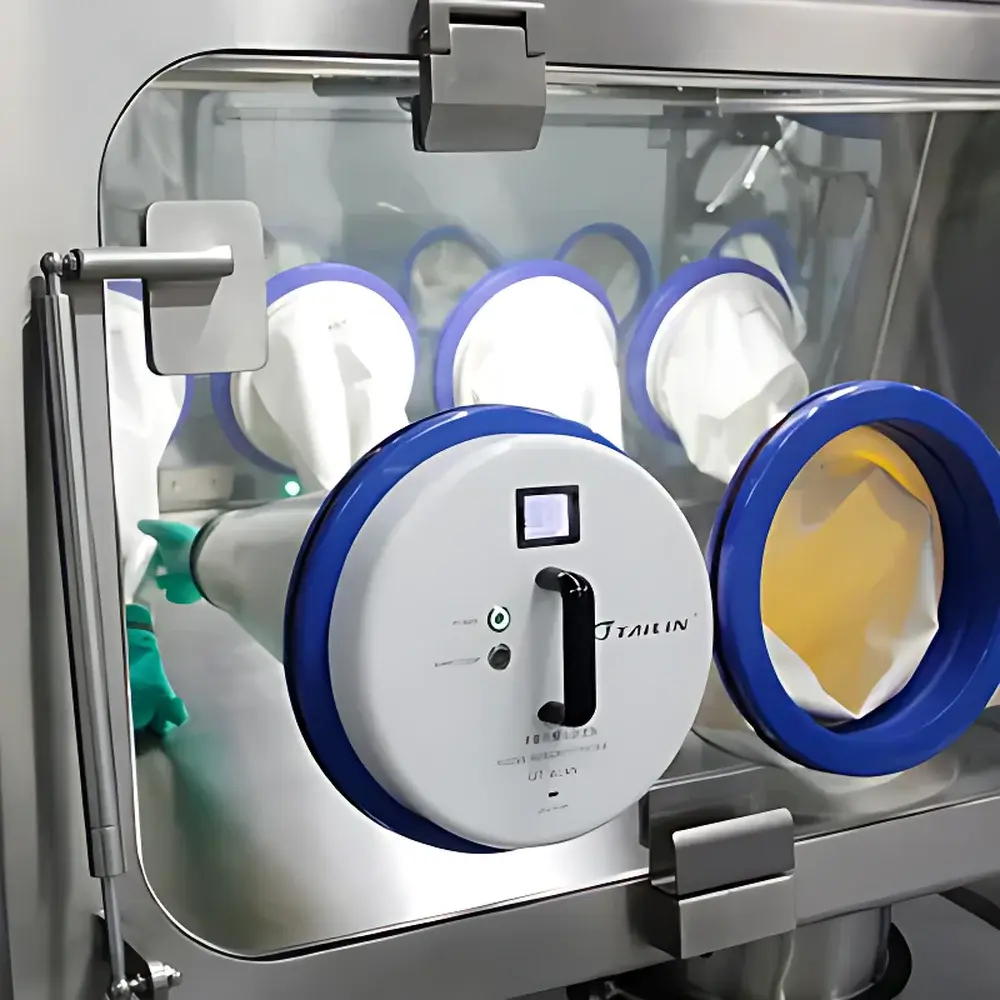
The Tailin GIT-WLAN Wireless Glove Integrity Tester is an engineered solution for non-destructive, quantitative pressure decay testing of elastomeric gloves and sleeves integrated into isolators, Restricted Access Barrier Systems (RABS), and other aseptic processing enclosures. Based on the principle of controlled pressurization followed by high-resolution pressure decay monitoring, the instrument measures minute leakage rates through glove material or seal interfaces—providing objective, traceable evidence of integrity in accordance with ISO 14644-7:2004 and GB/T 25915.7–2010. Unlike manual or analog testers, the GIT-WLAN implements fully automated inflation, stabilization, and decay analysis cycles, eliminating operator-dependent variability and ensuring repeatable pass/fail determinations across multiple glove configurations.
Key Features
- Integrated wireless architecture: Real-time bidirectional communication via IEEE 802.11 b/g/n Wi-Fi enables remote test initiation, live pressure curve visualization, and immediate result export to laboratory information management systems (LIMS) or electronic batch records (EBRs).
- RFID-enabled glove identification: Each test automatically logs glove serial number, installation date, and location using embedded RFID tags—ensuring full traceability and eliminating manual entry errors.
- Modular, field-serviceable design: The tester comprises three mechanically decoupled subassemblies—main chassis, pneumatic module, and user interface panel—allowing rapid disassembly for cleaning, calibration verification, or replacement without system downtime.
- Self-contained operation: Built-in 12 V lithium-ion battery supports ≥2 hours of continuous testing; integrated diaphragm-type air pump eliminates dependency on external compressed air sources or wall power.
- High-fidelity pressure metrology: Dual-sensor architecture (reference and test line) with 0.1 Pa resolution ensures accurate differential pressure tracking during both inflation and decay phases—even at low-pressure thresholds (500–3000 Pa) required for thin-walled elastomer gloves.
- Multi-glove parallel capability: Configurable port adapters support simultaneous testing of up to four gloves per cycle when deployed with optional multi-port fixtures—reducing total qualification time for large isolator installations.
Sample Compatibility & Compliance
The GIT-WLAN accommodates standard and custom glove ports with diameters ≥130 mm, including but not limited to Norprene®, Hypalon®, Viton®, and silicone-based elastomers used in pharmaceutical-grade isolators. Its mechanical interface conforms to ISO 14644-7 Annex B requirements for seal geometry and clamping force uniformity. All firmware and application software are validated per ICH Q9/Q10 principles and comply with FDA 21 CFR Part 11 for electronic records and signatures—including audit trail generation, role-based access control, and electronic signature capture with biometric or PKI authentication options. The device meets GLP and GMP environmental monitoring documentation standards and supports full 21 CFR Part 11 compliance packages for regulatory submissions.
Software & Data Management
The accompanying Tailin IntegritySuite™ software provides centralized configuration management, test protocol definition (e.g., hold time, target pressure, acceptance criteria), and automated report generation in PDF/A-1b or CSV formats. All raw sensor data—including time-stamped pressure curves, temperature compensation values, and environmental metadata—are stored locally (5000 records) and synchronized upon network reconnection. Audit trails record every user action, parameter change, and result modification with immutable timestamps and operator ID linkage. Export modules support direct integration with SAP QM, TrackWise, and LabVantage LIMS via HL7 or RESTful API.
Applications
- Pre-use qualification of RABS and isolator gloves prior to aseptic manufacturing operations (e.g., sterile fill-finish, lyophilization, cell therapy processing).
- Periodic in-service integrity verification per EU GMP Annex 1 (2022) and USP <1116> recommendations.
- Root cause investigation of microbial excursions linked to glove breaches—correlating failure locations with historical pressure decay profiles.
- Validation support for glove change protocols, including post-replacement requalification and lifecycle trending.
- Training and competency assessment for operators performing manual glove integrity checks—using GIT-WLAN as a reference standard.
FAQ
Does the GIT-WLAN require external calibration gas or reference standards?
No. The system uses factory-calibrated piezoresistive pressure transducers traceable to NIM (National Institute of Metrology, China) and includes built-in zero-drift compensation algorithms verified during each startup sequence.
Can test data be exported in machine-readable format for statistical process control (SPC)?
Yes. Raw pressure vs. time datasets are exportable as CSV with millisecond timestamps, enabling SPC charting in JMP, Minitab, or Python-based analytics pipelines.
Is the device suitable for use inside Grade A cleanroom environments?
Yes. The enclosure meets IP54 ingress protection rating, and all surface materials comply with ISO 14644-1 Class 5 particulate limits when wiped with IPA. No internal fans or moving parts generate airborne particles.
How is firmware updated in regulated environments?
Firmware updates are delivered as signed, version-controlled packages with full change logs and impact assessments. Updates require dual-operator approval and generate an immutable audit trail entry documenting version, timestamp, and approver IDs.
What happens if Wi-Fi connectivity is lost mid-test?
All tests execute autonomously from onboard memory. Results and raw data are cached locally and auto-synced once connectivity resumes—no data loss occurs.
Related Products