
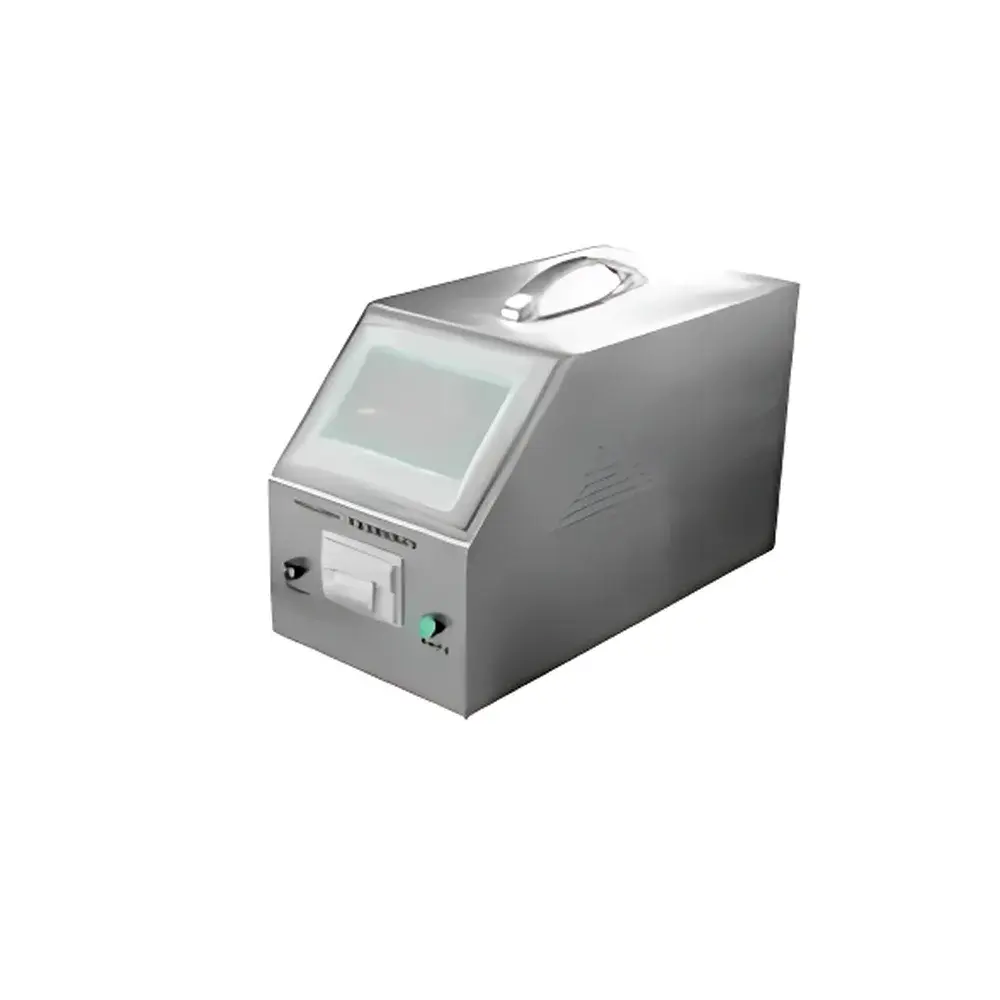
Tailin HTY-GIT01 Glove Integrity Tester
| Brand | Tailin |
|---|---|
| Origin | Zhejiang, China |
| Manufacturer Type | OEM Manufacturer |
| Region of Manufacture | Domestic (China) |
| Model | HTY-GIT01 |
| Pricing | Upon Request |
| Input Pressure Range | 0.2–0.6 MPa |
| Inflation Pressure Range | 500–1000 Pa |
| Test Duration | 5–8 min |
| Pressure Resolution | 0.1 Pa |
| Leak Detection Sensitivity (Minimum Detectable Hole Diameter) | 500 µm |
| Unit Weight | 20 kg |
| Dimensions (L×W×H) | 530 × 235 × 330 mm |
| Test Port Diameter | Ø255 mm (custom sizes available) |
| Printing | Integrated dot-matrix microprinter |
| Data Storage Capacity | 10 test records |
| Power Supply | 220 V, 50 Hz |
| Rated Power Consumption | 200 W |
| Control System | Siemens S7-1200 PLC with 7-inch HMI touchscreen interface |
| Compliance Standard | ISO 14644-7 |
Overview
The Tailin HTY-GIT01 Glove Integrity Tester is a dedicated pressure-decay-based leak detection instrument engineered for routine integrity verification of elastomeric gloves and sleeve assemblies integrated into sterile isolation systems—including isolators, Restricted Access Barrier Systems (RABS), and transfer hatches. It operates exclusively in positive-pressure mode: the glove or sleeve is inflated to a defined test pressure (500–1000 Pa), isolated from the supply source, and monitored for pressure decay over a standardized duration (5–8 minutes). The rate of pressure loss—expressed in pascals per minute (Pa/min)—is quantitatively measured with 0.1 Pa resolution and compared against user-defined acceptance thresholds derived from risk-based qualification protocols. This method aligns with the fundamental principles of differential pressure decay testing as specified in ISO 14644-7:2015, Annex B, which establishes performance criteria for containment system integrity verification in pharmaceutical cleanroom environments.
Key Features
- Compact, portable stainless-steel chassis (AISI 304) compliant with ISO 14644-1 Class 5 (ISO Class 5) cleaning requirements; fully autoclavable surface finish and zero crevice design minimize particle entrapment.
- Ergonomically tilted 7-inch industrial HMI touchscreen interface, powered by Siemens S7-1200 PLC logic—enabling intuitive test setup, real-time pressure curve visualization, and step-by-step operator guidance.
- Dual-gas compatibility: supports external supply of compressed air or nitrogen (filtered to ≤0.01 µm) via regulated inlet; gas path includes integrated particulate and oil coalescing filters.
- Integrated dot-matrix microprinter delivers time-stamped, GMP-compliant hardcopy reports including test ID, date/time stamp, inflation pressure, hold time, measured ΔP, pass/fail status, and operator ID.
- Onboard non-volatile memory stores up to 10 complete test records with full audit trail metadata—supporting retrospective review without external data export.
- Modular test port (standard Ø255 mm flange) enables rapid coupling to common isolator glove ports; custom flange geometries (e.g., DIN, ISO-KF, or proprietary) are available upon request.
Sample Compatibility & Compliance
The HTY-GIT01 is validated for use with standard nitrile, neoprene, and butyl rubber gloves ranging from 6–12 mil thickness, as well as welded-sleeve glove modules used in single-use isolators. It meets the mechanical and procedural requirements outlined in ISO 14644-7:2015 Section 7.3 (Integrity Testing of Gloves and Sleeves) and supports alignment with EU GMP Annex 1 (2022) §6.42 and USP <1116> on environmental monitoring. While the instrument itself does not carry CE marking or FDA 510(k) clearance, its test methodology is referenced in multiple manufacturer qualification dossiers accepted under EMA and PMDA regulatory submissions. All firmware and calibration routines are traceable to national metrology institutes (NIM, China); annual calibration certificates include uncertainty budgets per ISO/IEC 17025.
Software & Data Management
The embedded control software provides role-based access control (operator, supervisor, administrator) and enforces electronic signature requirements per 21 CFR Part 11 Annex A when enabled via optional password-protected configuration mode. Each test record contains immutable timestamps, PLC-generated serial numbers, and checksum-verified raw pressure data arrays. Export functionality is intentionally omitted to prevent uncontrolled data manipulation—data retrieval occurs solely via printed report or manual transcription. Audit logs capture all critical events: power cycles, parameter changes, test initiation/abort, and printer status—retained for minimum 12 months within internal memory.
Applications
- Pre-use qualification of isolator gloves prior to aseptic processing campaigns.
- Post-use integrity verification following high-risk interventions (e.g., filter changeouts, component transfers).
- Periodic scheduled testing per facility SMP-021 (Isolator Maintenance Schedule).
- Root cause investigation during environmental excursion investigations involving glove breaches.
- Supporting validation of glove replacement procedures and material compatibility studies (e.g., solvent exposure effects on seal integrity).
FAQ
What pressure range is required for instrument operation?
The HTY-GIT01 requires an external supply pressure between 0.2 MPa and 0.6 MPa to ensure stable regulation down to the 500–1000 Pa test range.
Can the device detect sub-500 µm leaks?
No—the stated detection limit of 500 µm reflects the practical resolution boundary under standard test conditions (5–8 min hold, ambient temperature ±2°C, no vibration); smaller defects require alternative methods such as helium mass spectrometry or bubble testing.
Is the printer output compliant with ALCOA+ data integrity principles?
Yes: each printed report contains unique test ID, UTC timestamp, operator identifier, and deterministic pass/fail logic—fully attributable, legible, contemporaneous, original, accurate, complete, consistent, enduring, and available per PIC/S PI 041-2.
Does the unit support integration with SCADA or MES systems?
Not natively; the HTY-GIT01 operates as a standalone, closed-loop tester. Modbus RTU output is available only via optional RS-485 expansion module (HTY-GIT01-EX1), requiring third-party protocol mapping.
How often must the internal pressure transducer be calibrated?
Annual calibration is recommended; certificate includes NIST-traceable reference standard (Fluke 754), uncertainty ≤±0.05% FS at 23°C, and full linearity verification across 0–1500 Pa range.






