
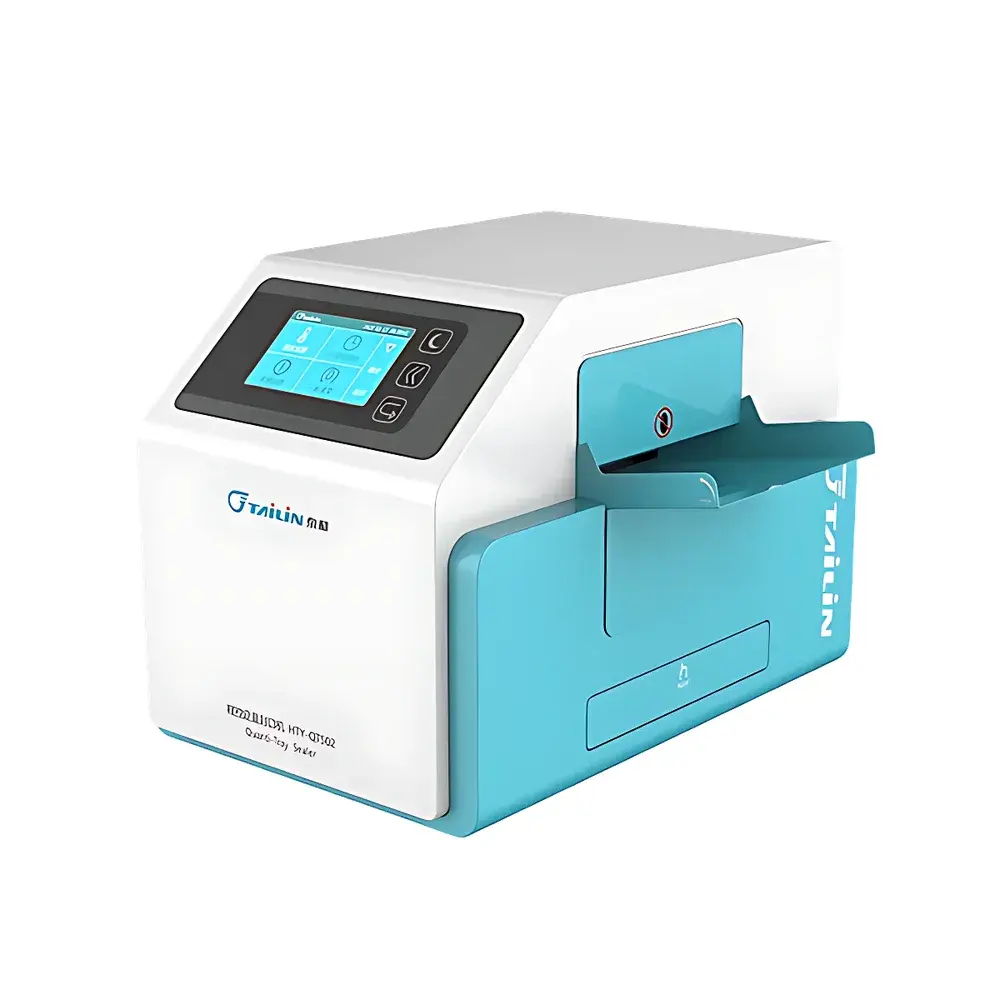
Tailin HTY-QTS02 Programmable Quantitative Sealing System
| Brand | Tailin |
|---|---|
| Origin | Zhejiang, China |
| Manufacturer Type | OEM/ODM Manufacturer |
| Country of Origin | China |
| Model | HTY-QTS02 |
| Pricing | Upon Request |
| Weight | 15 kg |
| Power Consumption | 1 kW |
| Input Voltage | AC 220 V / 50 Hz |
| Sealing Cycle Time | < 10 s |
| Warm-up Time | < 2 min |
| Heating Temperature Range | 150–200 °C (adjustable) |
| Dimensions (W × D × H) | 380 × 350 × 245 mm |
| Display | 5-inch TFT LCD touchscreen |
| UV Sterilization | Integrated germicidal UV-C lamp (254 nm) |
| Sealing Mechanism | Pneumatically assisted upward-pressing thermal sealing |
| Maintenance Access | Top-hinged service panel |
| Drainage | Spring-loaded pop-up drip tray |
Overview
The Tailin HTY-QTS02 Programmable Quantitative Sealing System is an engineered solution for standardized, high-throughput microbial enumeration in water quality laboratories. Designed specifically for use with commercially available defined-substrate quantitative trays—such as IDEXX’s Quanti-Tray®, Colilert®, Enterolert®, and similar ISO/USP-compliant multi-well formats—the HTY-QTS02 delivers precise, reproducible thermal sealing under programmable temperature and dwell-time parameters. Its operation is grounded in controlled conductive heat transfer across calibrated aluminum sealing plates, ensuring uniform thermal energy delivery to each well without distortion or cross-contamination. The system supports regulatory workflows aligned with EPA Method 1604, ISO 9308-1 (2014), ISO 16266 (2006), and USP /, enabling laboratories to maintain audit-ready documentation for GLP and GMP environments.
Key Features
- 5-inch high-resolution TFT LCD touchscreen interface with intuitive icon-driven navigation and multilingual support (English, Chinese, Spanish)
- Adjustable sealing temperature range (150–200 °C) with ±2 °C thermal stability, optimized for diverse substrate formulations and tray materials (polystyrene, polypropylene)
- Consistent sealing cycle time ≤10 seconds per tray, validated via thermographic imaging to ensure full well rim fusion without over-melting or deformation
- Integrated UV-C (254 nm) sterilization module with programmable exposure duration (1–30 min), targeting residual microorganisms on internal chamber surfaces between runs
- Top-hinged maintenance access panel facilitating rapid inspection, cleaning, and calibration verification of heating elements and pressure actuators
- Spring-actuated pop-up drip tray positioned beneath the sealing zone to capture incidental leakage—designed for easy removal, emptying, and reinstallation without tools
- Intelligent power management including auto-sleep mode after 15 minutes of inactivity, reducing standby power draw to <1.5 W
- Built-in error logging with timestamped event history (e.g., temperature deviation, lid open timeout, seal failure), exportable via USB to CSV for QA review
Sample Compatibility & Compliance
The HTY-QTS02 is validated for use with all standard 51-well and 97-well quantitative tray formats compliant with ASTM D6167, ISO 9308-1, and EN ISO 9308-2. It accommodates both single- and double-layer trays used in membrane filtration–based assays and enzyme-substrate detection systems. The system’s thermal profile ensures complete sealing integrity across varying ambient humidity conditions (20–80% RH) and laboratory temperatures (15–30 °C). All mechanical and electrical components meet CE marking requirements under the Low Voltage Directive (2014/35/EU) and EMC Directive (2014/30/EU). For regulated pharmaceutical or drinking water testing, the device supports integration into 21 CFR Part 11–compliant LIMS through optional RS-232 or USB-to-serial emulation.
Software & Data Management
The embedded firmware provides non-volatile storage for up to 1,000 sealing cycles with full metadata: date/time stamp, operator ID (via optional RFID badge reader), setpoint temperature, actual peak temperature, cycle duration, and pass/fail status. Error logs are retained for ≥12 months and exportable via USB flash drive in UTF-8 encoded CSV format compatible with Excel, LabWare LIMS, and Watson LIMS. No proprietary software installation is required—data files conform to ISO/IEC 17025 traceability standards and include checksum validation to prevent tampering. Audit trail functionality records all parameter changes with user attribution and timestamps, satisfying GLP documentation requirements.
Applications
- Routine quantification of total coliforms, fecal coliforms, Escherichia coli, Pseudomonas aeruginosa, Enterococcus spp., and Legionella pneumophila in drinking water, wastewater effluent, recreational water, and bottled water
- Environmental monitoring programs supporting ISO 14001-certified facilities and EPA Clean Water Act compliance reporting
- Pharmaceutical water system qualification (PW, WFI, Purified Water) per USP and EU Annex 1
- Contract testing laboratories performing accredited microbiological analysis under ISO/IEC 17025 scope
- Educational and research institutions conducting method validation studies for membrane-based enumeration techniques
FAQ
Is the HTY-QTS02 compatible with IDEXX Quanti-Tray® and Colilert® products?
Yes—the system is mechanically and thermally calibrated for all IDEXX-defined tray geometries and polymer compositions.
Does the unit require external cooling or ventilation?
No—passive convection and internal thermal shielding eliminate the need for forced-air exhaust; however, minimum 10 cm rear clearance is recommended for airflow.
Can sealing parameters be locked to prevent unauthorized modification?
Yes—administrator-level password protection enables parameter locking, audit log access restriction, and firmware update control.
What maintenance intervals are recommended?
Visual inspection and UV lamp output verification every 6 months; thermal calibration verification annually using NIST-traceable surface thermometers.
Is third-party IQ/OQ documentation available?
Tailin provides a comprehensive User Requirement Specification (URS)-aligned IQ/OQ protocol package upon request, including test scripts, acceptance criteria, and blank execution records.







