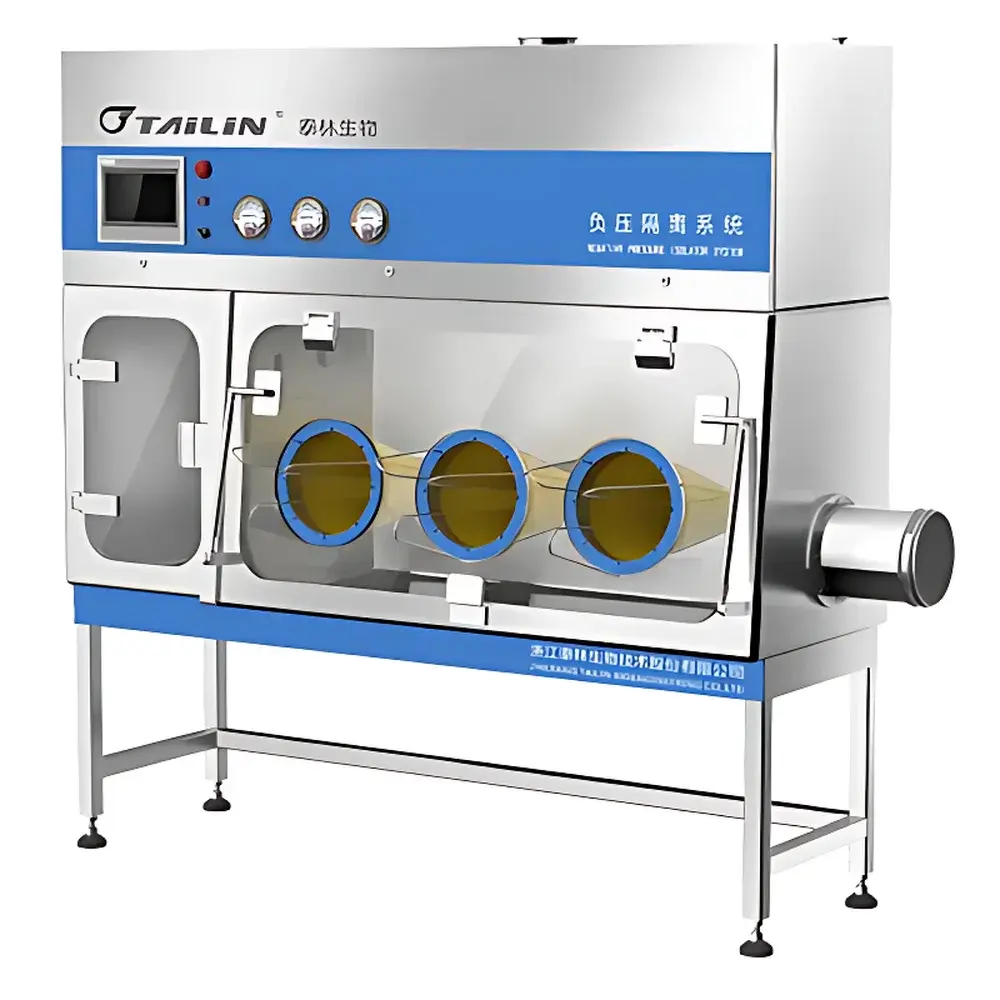
Tailin NPA Series Negative-Pressure Isolator
| Brand | Tailin |
|---|---|
| Origin | Zhejiang, China |
| Manufacturer Type | OEM Manufacturer |
| Region Category | Domestic (China) |
| Model | NPA Series |
| Price Range | USD 28,000 – 70,000 |
| Power Supply | 380 V / 50 Hz |
| Chamber Material | SUS316L Stainless Steel |
| Negative Pressure Maintenance Power | 1000 W |
| Airflow Pattern | Turbulent Flow |
| Operating Chamber Pressure | −80 Pa to −50 Pa |
| Containment Performance | Designed to OEB5 Standard |
| Noise Level (Negative Pressure Mode) | <65 dB(A) |
| Chamber Integrity | Compliant with ISO 10648-2 |
Overview
The Tailin NPA Series Negative-Pressure Isolator is an engineered containment solution designed for the safe handling of highly potent, cytotoxic, or sensitizing pharmaceutical compounds during critical manufacturing operations—including weighing, dispensing, sampling, and formulation. Based on the principle of directional airflow control and sustained negative pressure differentials, the isolator maintains a physical barrier between operators and hazardous materials by ensuring continuous inward airflow across all access points (e.g., glove ports, transfer hatches), thereby preventing escape of airborne particulates or vapors into the surrounding environment. Its architecture complies with internationally recognized occupational exposure banding (OEB) Level 5 requirements—representing the highest tier of containment for compounds with occupational exposure limits (OELs) below 10 ng/m³. The system is validated for use in non-classified rooms or D-grade cleanrooms per ISO 14644-1, eliminating dependency on high-grade HVAC infrastructure while preserving operator safety and product integrity.
Key Features
- Optimized chamber geometry delivering maximum usable working volume within minimized external footprint—reduced height and width facilitate integration into constrained facility layouts without compromising ergonomics or workflow efficiency.
- Integrated intelligent control system featuring programmable logic controller (PLC)-based automation, real-time parameter monitoring (pressure, temperature, relative humidity), event logging, and configurable alarm thresholds with visual and audible alerts.
- Dual-mode operation: supports both dynamic negative-pressure maintenance and static hold modes, each with independent validation protocols and audit-trail-enabled data capture.
- Modular construction using electropolished SUS316L stainless steel—fully welded seams, zero crevices, and passivated surface finish ensure compliance with ASME BPE and ISO 10648-2 integrity testing standards.
- Multi-point pressure monitoring with redundant transducers and automatic compensation algorithms to maintain stable differential pressure across operational cycles—even during frequent material transfers via rapid-transfer ports (RTPs) or split butterfly valves.
- Optional integrated analytical balance mounting frame with vibration isolation, compatible with METTLER TOLEDO, Sartorius, or Shimadzu load cells; available with ATEX-certified explosion-proof configuration for solvent-based processing environments.
Sample Compatibility & Compliance
The NPA Series accommodates solid dosage forms (API powders, granules, blends), lyophilized intermediates, and low-volatility small-molecule actives requiring OEB4–OEB5 containment. It supports aseptic transfer of pre-sterilized components via ISO 5-compatible RTPs and conforms to key regulatory frameworks including EU GMP Annex 1 (2022), USP , ASTM E2952-21 (Standard Guide for Evaluating Isolator Performance), and ISO 14644-7 (Cleanrooms and associated controlled environments — Part 7: Separative devices). All pressure decay and smoke visualization tests are documented per ISO 10648-2, with full traceability of leak-rate measurements (<0.5% volume/hour at −100 Pa).
Software & Data Management
The embedded HMI interface provides role-based user authentication (up to three privilege levels), electronic signature support compliant with FDA 21 CFR Part 11, and automated generation of IQ/OQ/PQ-ready reports. Process data—including pressure logs, alarm history, door cycle counts, and environmental trends—are stored locally on encrypted industrial SSDs with optional network backup to secure enterprise servers. Audit trails record timestamped actions (e.g., parameter changes, mode transitions, calibration events) with immutable hash verification. Export formats include CSV, PDF, and XML for integration into LIMS or MES platforms.
Applications
- Weighing and dispensing of oncology APIs under OEB5 conditions
- Sampling of high-potency batches for release testing
- Manual or semi-automated powder blending prior to capsule filling
- Containment during lyophilization stopper insertion or vial capping setup
- Stability study sample preparation in non-GMP R&D labs
- Supporting GLP-compliant toxicology dosing formulation
FAQ
Can the NPA isolator be installed in a non-classified room?
Yes—it is specifically engineered for installation in unclassified spaces or D-grade environments, provided ambient temperature (18–26°C) and humidity (30–60% RH) fall within operational specifications.
What validation documentation is supplied with the system?
Factory acceptance test (FAT) reports, installation qualification (IQ) templates, operational qualification (OQ) protocols aligned with ISO 14644-7 and ASTM E2952, and pressure-integrity test certificates per ISO 10648-2 are included.
Is remote monitoring supported?
Optional Ethernet/IP or Modbus TCP connectivity enables integration with building management systems (BMS) and centralized monitoring dashboards for real-time status and predictive maintenance alerts.
How often does the HEPA filter require replacement?
Filter service intervals are determined by upstream particle loading and usage frequency; typical replacement occurs every 12–18 months, with automatic differential pressure alarms triggering maintenance notifications.
Does the system support integration with existing SCADA or MES platforms?
Yes—standard OPC UA and MQTT interfaces are available for seamless bidirectional communication with enterprise-level manufacturing execution systems.