
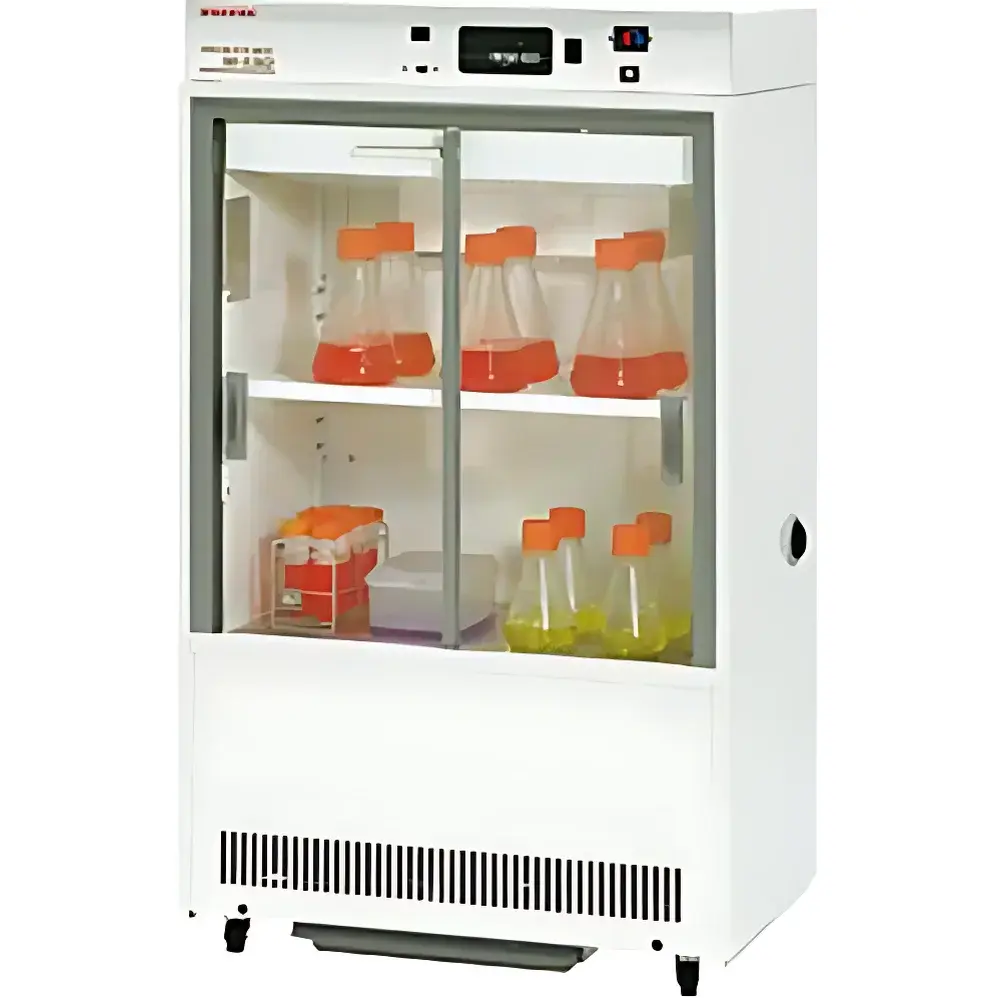
TAITEC M-130 Benchtop Precision Refrigerated Incubator
| Brand | TAITEC |
|---|---|
| Origin | Japan |
| Model | M-130 |
| Temperature Range | 3–50°C (Standard), 10–45°C (Illuminated Version) |
| Temperature Uniformity | ±0.1–0.5°C (Precision Mode), ±1.0–2.0°C (Eco Mode) |
| Control Resolution | 0.1°C (Precision), 1.0°C (Eco) |
| Internal Volume | ~85 L |
| Interior Dimensions | 563 × 378 × 412 mm (W×D×H) |
| External Dimensions | 633 × 435 × 1078 mm (W×D×H) |
| Net Weight | ~60 kg (Standard), ~85 kg (Illuminated) |
| Power Supply | AC 100 V, 6 A / 8 A |
| Heating Capacity | 350 W |
| Cooling Capacity | 75 W |
| Internal Socket | 1 × 3 A outlet |
| Air Circulation | Forced-air convection with internal fan |
| Defrost Control | Manual override button for auto-defrost disable |
| Interior Material | SUS304 stainless steel |
| Door Lock | Sliding mechanical lock with key |
| Accessories | Drip tray ×1, water collection pan ×1, waterproof plug ×1, sliding door lock ×1 |
Overview
The TAITEC M-130 Benchtop Precision Refrigerated Incubator is an engineered solution for controlled-temperature storage and low-to-moderate temperature incubation in research and quality control laboratories. Designed and manufactured in Japan, the M-130 integrates refrigeration and heating capabilities within a compact, stainless-steel enclosure to maintain stable thermal environments from 3°C to 50°C (standard model) or 10°C to 45°C (illuminated variant). Its dual-mode operation—Precision Mode and Eco Mode—enables users to balance thermal stability against energy consumption based on experimental requirements. In Precision Mode, automatic defrost is programmatically disabled to eliminate transient temperature fluctuations during critical assays such as enzyme kinetics, cold-chain sample integrity verification, or low-temperature immunoprecipitation protocols. The unit employs forced-air convection via an internal axial fan and high-efficiency heat exchangers to ensure uniform temperature distribution (±0.1–0.5°C) throughout the 85 L chamber. Constructed entirely of electropolished SUS304 stainless steel—both interior and exterior—the M-130 resists corrosion, facilitates decontamination, and complies with ISO 14644-1 Class 5 cleanroom-compatible surface standards.
Key Features
- Dual operational modes: Precision Mode (±0.1–0.5°C stability, defrost disabled) and Eco Mode (±1.0–2.0°C, optimized power consumption)
- Integrated internal 3 A power socket and dedicated cable pass-through port for seamless integration with external peripherals—including orbital shakers, rotators, and mini-centrifuges—without compromising chamber integrity
- Mechanically actuated sliding door lock with keyed security, supporting GLP-compliant access control and audit-ready sample accountability
- Forced-air circulation system with adjustable airflow profile ensures rapid thermal equilibration and minimal vertical/horizontal gradients
- Front-accessible manual defrost override button allows real-time suspension of auto-defrost cycles during time-sensitive assays
- Full SUS304 construction (interior and exterior) meets stringent hygiene requirements for pharmaceutical QC, biobanking, and clinical diagnostics labs
Sample Compatibility & Compliance
The M-130 accommodates standard laboratory containers—including 50 mL conical tubes, 15 mL Falcon tubes, microcentrifuge tube racks, multiwell plates (up to 96-well format), and Petri dishes—within its 563 × 378 × 412 mm usable chamber. Its maximum load capacity of 50 kg supports stacked shelving configurations without thermal compromise. The unit conforms to JIS Z 8703 (Japanese Industrial Standard for environmental test chambers) and aligns with IEC 61010-1 safety requirements for laboratory equipment. While not certified for medical device storage under FDA 21 CFR Part 11, its logging-capable temperature controller (optional upgrade) supports 21 CFR Part 11-compliant electronic records when paired with validated third-party software. The illuminated version (M-130-L) includes four 20 W cool-white fluorescent lamps delivering ~7000 lux at shelf level—suitable for photobiological assays per ISO 8570 and ASTM E2581 guidelines.
Software & Data Management
The base M-130 operates via an intuitive front-panel digital controller with LED display, offering setpoint entry, mode selection, and real-time temperature readout. Optional RS-485 or USB interface modules enable connection to PC-based monitoring platforms (e.g., LabVIEW, MATLAB, or custom SCADA systems) for continuous data logging at user-defined intervals (1 s to 60 min resolution). When integrated with compliant software, the system supports full audit trails—including operator ID, timestamped parameter changes, alarm events, and calibration history—meeting GLP and GMP documentation expectations. Temperature deviation alarms (high/low limit alerts) trigger visual indicators and optional relay outputs for external notification or HVAC interlock.
Applications
- Long-term storage of temperature-sensitive reagents (e.g., antibodies, restriction enzymes, RNA samples) at 4°C or controlled chilling conditions
- Low-temperature microbial culture maintenance (e.g., E. coli glycerol stocks, psychrophilic isolates) and plant tissue explant pre-incubation
- Immunoprecipitation workflows requiring sustained 4°C operation with concurrent orbital mixing via integrated shaker
- Enzyme activity profiling across sub-ambient temperature ranges (e.g., thermolabile phosphatase inhibition studies)
- Stability testing of formulations under ICH Q1A-recommended intermediate storage conditions (e.g., 30°C/65% RH simulated via chamber offset calibration)
- Photoperiod-controlled plant cell suspension cultures (illuminated model only)
FAQ
Can the M-130 accommodate standard lab shakers or rotators inside the chamber?
Yes—the internal 3 A socket and rear cable port allow safe, grounded operation of compatible benchtop shakers (≤300 rpm, ≤5 kg payload) and rotating mixers without modifying the chamber seal.
Is the stainless-steel interior suitable for repeated ethanol or hydrogen peroxide decontamination?
Yes—SUS304 resists oxidation and pitting from common laboratory disinfectants when used within manufacturer-recommended concentrations and contact times.
What is the recommended calibration frequency for traceable temperature verification?
Per ISO/IEC 17025 guidance, annual calibration using NIST-traceable PRT probes is advised; interim verification with calibrated reference sensors is recommended before critical experiments.
Does the M-130 support remote monitoring via Ethernet or Wi-Fi?
No—native connectivity is limited to RS-485 or USB; Ethernet/Wi-Fi functionality requires third-party gateway hardware and middleware integration.
Can the illumination module be retrofitted to the standard M-130 model?
No—the illuminated version (M-130-L) features structural modifications including reinforced ceiling mounting and ballast integration; retrofitting is not supported.



