
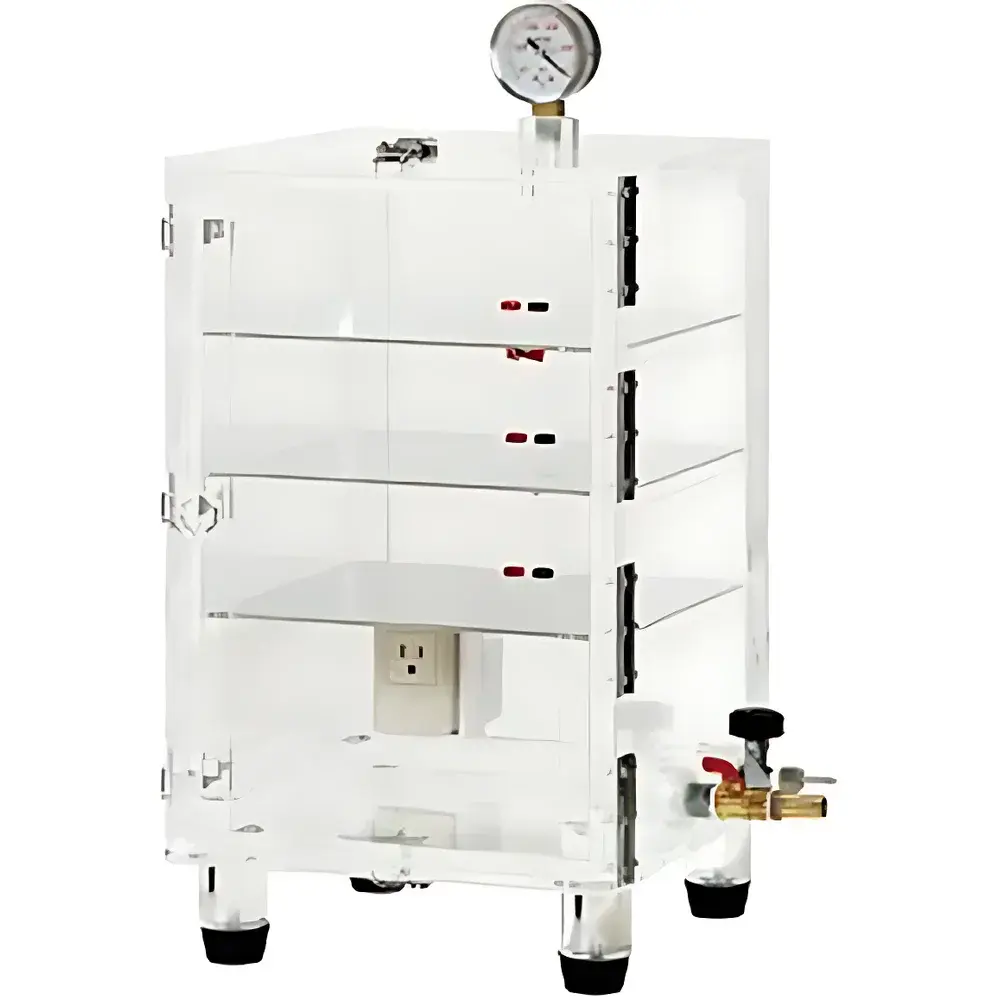
TAITEC DC-280 Vacuum Drying Chamber
| Brand | TAITEC |
|---|---|
| Origin | Japan |
| Model | DC-280 |
| Instrument Type | Vacuum Oven |
| Temperature Range | +30 °C (heating plate surface under vacuum) |
| Chamber Dimensions | 258 × 250 mm (W × D), 3 shelves (aluminum) |
| External Dimensions | 430 × 400 × 615 mm (W × D × H) |
| Weight | ~21 kg |
| Power Supply | AC 100 V, 3 A (main unit) |
| Heating Power | 100 W per shelf, independently switchable |
| Vacuum Gauge | Bourdon tube type |
| Exhaust/Inlet Nozzles | Two Ø14 mm ports (separate vacuum evacuation and gas inlet/exchange) |
| Vacuum Release | Manual needle valve (Ø9 mm, dual-purpose for venting and gas exchange) |
| Internal Socket | AC 100 V, 3 A rated, for in-chamber devices (e.g., magnetic stirrers) |
| Recommended Vacuum Pump | 50–100 L/min displacement |
| Compliance | Designed for laboratory use in accordance with JIS Z 8101-1 (general principles of drying equipment) and compatible with ISO 17025-accredited workflows requiring traceable thermal conditioning |
Overview
The TAITEC DC-280 Vacuum Drying Chamber is an engineered solution for controlled, low-pressure thermal drying of moisture-sensitive, thermolabile, or oxidation-prone samples in academic, pharmaceutical, and food testing laboratories. Unlike conventional convection ovens, the DC-280 operates under reduced atmospheric pressure—typically down to <10 kPa (approx. 75 Torr)—to lower the boiling point of solvents and water, enabling gentle dehydration without thermal degradation. Its core architecture integrates three independently heated aluminum shelves, each equipped with a 100 W embedded heating element, allowing precise thermal management across stratified sample loads. The chamber’s front-opening design and spacious interior (258 × 250 mm shelf footprint) support ergonomic handling of Petri dishes, vials, flasks, and custom trays—critical for high-throughput QC labs processing biological specimens, raw food matrices, or polymer precursors.
Key Features
- Independent Shelf-Level Heating: Three aluminum shelves (258 × 250 mm each) feature dedicated 100 W resistive heaters, switchable ON/OFF per shelf—enabling selective thermal activation during vacuum cycles while maintaining ambient conditions on unused levels.
- Dual-Function Gas Port System: Two Ø14 mm stainless steel nozzles provide physically segregated pathways: one exclusively for vacuum line connection, the other for controlled inert gas (N₂, Ar) backfilling or atmospheric re-equilibration—minimizing cross-contamination and ensuring repeatable process repeatability.
- In-Chamber Power Socket: Integrated AC 100 V / 3 A outlet permits operation of magnetic stirrers, temperature probes, or small-scale reactors inside the evacuated environment—facilitating real-time mixing or in-situ monitoring during drying.
- Mechanical Vacuum Monitoring: A calibrated Bourdon tube vacuum gauge delivers direct, drift-free pressure indication without electronic dependency—ideal for GLP-compliant documentation where analog traceability is required.
- Robust Thermal Architecture: Heaters are mounted beneath the full shelf surface area, maximizing conductive heat transfer uniformity (±2 °C typical surface variation at +30 °C setpoint under vacuum), critical for consistent drying kinetics across heterogeneous sample batches.
Sample Compatibility & Compliance
The DC-280 accommodates a broad spectrum of sample formats—including lyophilization-compatible glassware, silicone-sealed vials, aluminum weighing pans, and acrylic trays—without compromising vacuum integrity. Its design supports ASTM E145-22 (Standard Specification for Gravity-Convection and Forced-Ventilation Ovens) and aligns with ISO 5725-2 (accuracy and precision of measurement methods) when used with validated vacuum pumps and calibrated gauges. For regulated environments, the unit’s manual valve-based venting system and absence of software controls simplify 21 CFR Part 11 compliance when paired with external audit-trail-capable data loggers. It is routinely deployed in laboratories adhering to USP (Sterile Product Preparation) and ISO/IEC 17025:2017 for residual moisture determination in APIs and excipients.
Software & Data Management
The DC-280 is a standalone, hardware-controlled instrument with no embedded firmware or digital interface. All operational parameters—including shelf heater status, vacuum level (via analog gauge), and gas exchange timing—are manually recorded by users. This architecture eliminates cybersecurity risks and simplifies validation: no software qualification (IQ/OQ/PQ) is required. Laboratories integrate the unit into electronic lab notebooks (ELNs) or LIMS via external USB/RS-232 pressure and temperature loggers (e.g., Omega HH309A or Testo 549i), enabling automated timestamped capture of vacuum decay curves and thermal profiles for audit-ready reporting.
Applications
- Dehydration of enzyme preparations, bacterial cultures, and tissue sections prior to SEM or DNA extraction.
- Residual solvent removal from synthesized organic compounds and pharmaceutical intermediates under inert atmosphere.
- Rapid moisture content analysis (AOAC 950.46) for cereal grains, dairy powders, and nutraceutical blends.
- Pre-conditioning of hygroscopic reference standards before gravimetric calibration.
- Hybrid operation with TAITEC VD-series freeze dryers via MP-010 multi-port manifold—enabling sequential freezing, primary drying, and secondary drying in a single workflow.
FAQ
What vacuum pump specifications are recommended for optimal performance?
Use a two-stage rotary vane pump with 50–100 L/min free air displacement. Pumps exceeding 100 L/min may induce excessive mechanical stress on chamber seals and gauge components. Always throttle initial evacuation using the integrated needle valve to prevent sudden pressure differentials.
Can the DC-280 be used for freeze-drying without additional equipment?
No. The DC-280 lacks a condenser or refrigeration system. It functions as a vacuum drying stage only. For true lyophilization, it must be coupled with a compatible cold trap (e.g., TAITEC VD-250R) via the MP-010 manifold accessory.
Is the internal socket rated for continuous operation under vacuum?
Yes—the socket is sealed and rated for AC 100 V / 3 A under static vacuum conditions. However, devices inserted must themselves be vacuum-rated (e.g., certified magnetic stirrers with epoxy-sealed motors) to prevent outgassing or arcing.
How is temperature uniformity verified during qualification?
Per ISO 17025 Section 5.10.4, users perform mapping using NIST-traceable thermocouples placed at nine positions (center + eight corners) across all three shelves, recording data over 30 minutes at steady-state +30 °C under 5 kPa vacuum. Acceptance criterion: ≤ ±3 °C deviation.



