
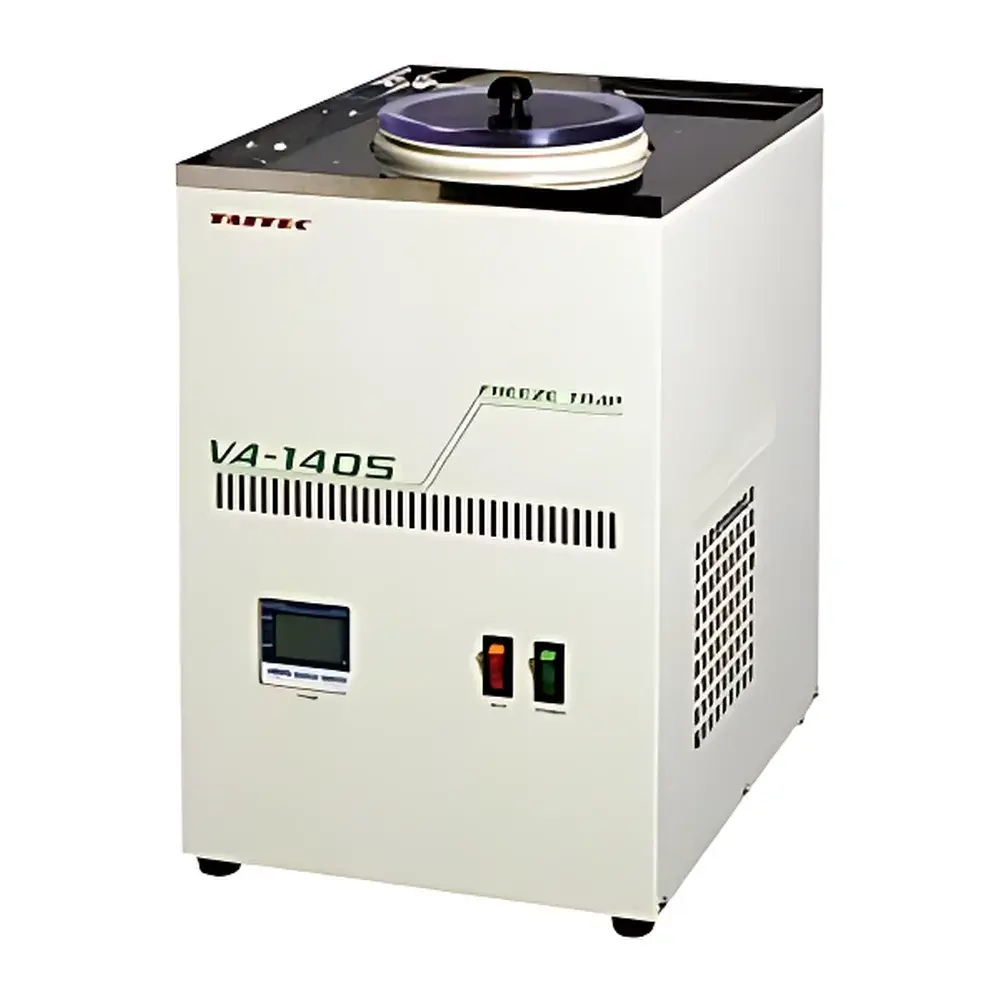
TAITEC VA-140S Cryogenic Cold Trap with Stirling Cooler
| Brand | TAITEC |
|---|---|
| Origin | Japan |
| Model | VA-140S |
| Instrument Type | Benchtop Cryo-Cold Trap |
| Application | Laboratory-Scale Condensation & Solvent Capture |
| Cooling Temperature | –65 °C (at no load, 20 °C ambient, 500 mL methanol) |
| Operating Temperature Range | –10 °C to –55 °C (temperature control accuracy ±2.0 °C) |
| Condensate Capacity | ~300 mL per cycle (with GC-025 glass condenser) |
| Cooling Bath Volume | ~960 mL (Φ120 × 80 mm) |
| Stirring Function | Integrated magnetic stirrer |
| Refrigeration System | 40 W Stirling-cycle helium cooler (zero ODP, zero GWP) |
| Power Supply | AC 100 V, 1 A (up to 7 A with auxiliary socket) |
| Dimensions | 233 × 330 × 392 mm (W × D × H) |
| Weight | ~10 kg |
Overview
The TAITEC VA-140S is a compact, high-efficiency cryogenic cold trap engineered for precise solvent vapor capture and low-temperature sample conditioning in analytical and preparative laboratory workflows. Unlike conventional compressor-based refrigeration systems, the VA-140S employs a hermetically sealed Stirling-cycle cryocooler using helium as the working fluid—eliminating ozone-depleting substances (ODP = 0) and greenhouse gas emissions (GWP = 0). Its core function is to condense volatile solvents (e.g., acetone, ethanol, ethyl acetate, chloroform) from vacuum or purge streams via direct thermal interception at –65 °C, ensuring high trapping efficiency and minimal backstreaming. Designed for integration with centrifugal concentrators (e.g., VC-15S/15SP), rotary evaporators, and vacuum manifold systems, the VA-140S also serves as a temperature-controlled cryobath when operated independently—enabling controlled pre-freezing of samples prior to lyophilization or low-temperature reaction quenching.
Key Features
- Stirling-cooled architecture delivering stable –65 °C base temperature under no-load conditions; achieves –50 °C within approximately 60 minutes from ambient (20 °C)
- Integrated magnetic stirring mechanism ensures uniform thermal distribution across the 960 mL cooling bath (Φ120 × 80 mm internal dimensions)
- Digital temperature controller with real-time display and adjustable setpoint range (–10 °C to –55 °C), calibrated to ±2.0 °C accuracy when used as a thermostatic bath
- Low-power operation (40 W nominal cooling power) reduces energy consumption by >50% compared to equivalent compressor-driven units
- Dual-mode functionality: operates as either a high-efficiency cold trap (with optional GC-010 or GC-025 glass condensers) or a standalone cryostat
- Safety-integrated design includes overcurrent protection (fuse), fault status indication, overflow port, and auxiliary AC socket (100 V, 7 A max) for synchronized accessory control
Sample Compatibility & Compliance
The VA-140S supports a wide range of solvent classes commonly encountered in sample preparation, including polar protic (methanol, ethanol), polar aprotic (acetonitrile, DMF), and halogenated solvents (chloroform, dichloromethane). When configured with the GC-025 glass condenser (300 mL/cycle capacity), it meets ASTM E2654-22 requirements for solvent recovery efficiency in vacuum concentration systems. Its helium-based refrigeration system complies fully with Montreal Protocol Annex A Group I (CFCs) and Annex B Group II (HCFCs) phase-out mandates. As a benchtop instrument intended for research and QC environments, the VA-140S adheres to IEC 61010-1:2010 safety standards for electrical equipment used in laboratory settings and supports GLP-compliant documentation through external data logging interfaces (RS-232 or analog output optional).
Software & Data Management
While the VA-140S operates via an embedded microcontroller with local digital interface (no onboard software), its temperature sensor output (PT100-class) is compatible with third-party data acquisition systems supporting 0–5 V or 4–20 mA analog input. Users may integrate the unit into centralized lab monitoring platforms (e.g., LabVIEW, DeltaV, or custom SCADA) for time-stamped temperature logging, alarm triggering, and audit trail generation—supporting 21 CFR Part 11 compliance when paired with validated electronic record systems. Firmware updates are performed via proprietary service tooling; no user-accessible OS or cloud connectivity is implemented, preserving system integrity and minimizing cybersecurity exposure in regulated environments.
Applications
- Solvent trapping downstream of centrifugal vacuum concentrators (VC-15S/15SP) to prevent pump oil contamination and extend rotary vane pump service life
- Pre-freezing biological samples (e.g., protein solutions, cell lysates) prior to primary drying in small-scale freeze-dryer configurations (using MP-080a 8-port manifold kit)
- Cryogenic stabilization of thermally labile compounds during extraction or derivatization protocols requiring sub-zero reaction temperatures
- Condensation of volatile organic compounds (VOCs) in environmental air sampling or headspace analysis workflows
- Temperature-controlled quenching of exothermic reactions in synthetic chemistry setups where precise thermal arrest is critical
- Supporting lyophilization process development by enabling controlled ice nucleation and annealing studies in sealed ampoules under nitrogen purging
FAQ
What is the minimum achievable temperature, and under what conditions is –65 °C specified?
The –65 °C rating is measured at no load, with ambient temperature at 20 °C and 500 mL methanol as heat transfer medium. Under typical operational load (e.g., continuous vapor inflow), sustained trap surface temperature remains ≤ –55 °C.
Can the VA-140S be used without a glass condenser?
No—the unit requires a compatible glass condenser (GC-010 or GC-025) mounted directly onto the cooling bath to provide effective vapor–surface contact area. The cooling bath alone does not offer sufficient surface geometry for efficient condensation.
Is the stirring function adjustable in speed or duty cycle?
The magnetic stirrer operates at a fixed, optimized RPM to ensure laminar thermal mixing without inducing cavitation or splashing in low-viscosity cryogenic media.
Does the VA-140S meet regulatory requirements for use in GMP manufacturing environments?
As a Class I laboratory support device, it complies with IEC 61010-1 and can be qualified (IQ/OQ/PQ) for GMP applications; however, final validation must be conducted per site-specific protocols and documented against defined acceptance criteria.
What maintenance is required for the Stirling cooler?
The sealed Stirling module is maintenance-free for ≥10,000 hours of operation; no lubrication, gas replenishment, or periodic servicing is required under normal laboratory conditions.



