
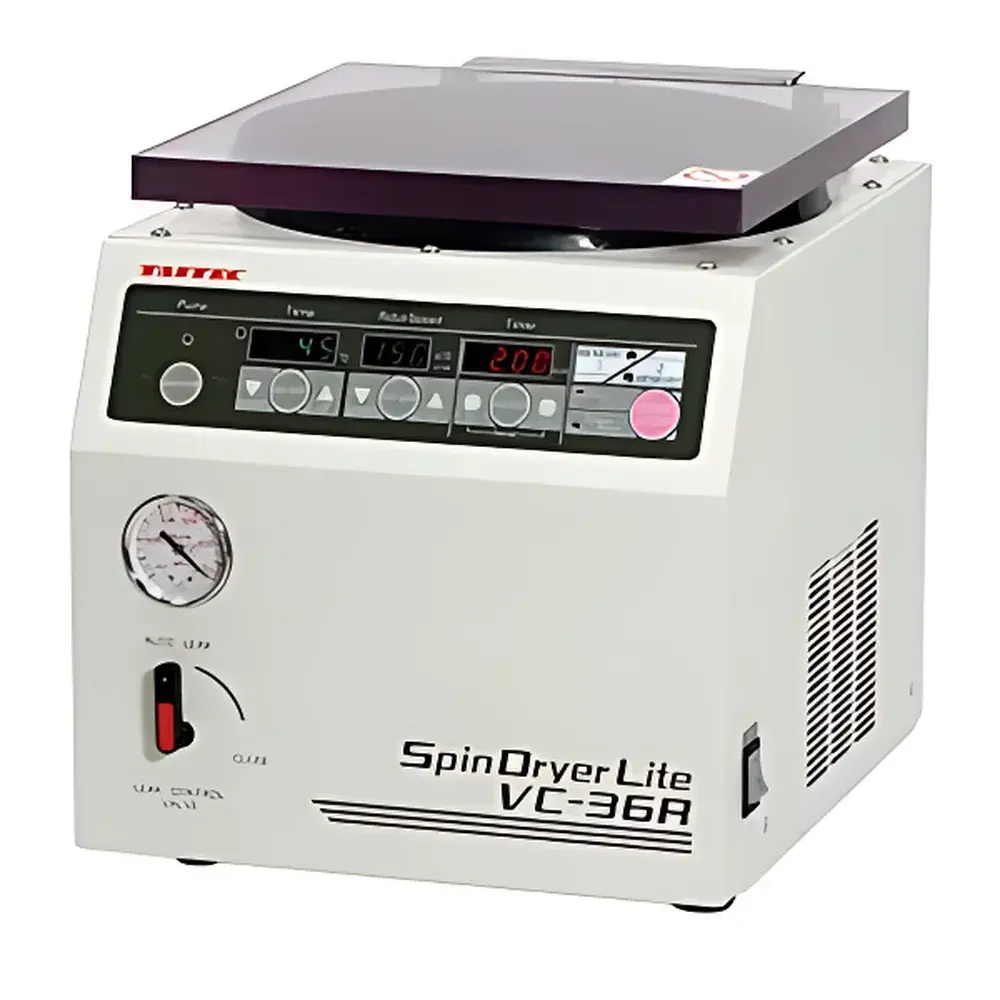
TAITEC VC-36R and VC-96R Vacuum Centrifugal Concentrators
| Brand | TAITEC |
|---|---|
| Origin | Japan |
| Model | VC-36R / VC-96R |
| Instrument Type | Vacuum Centrifugal Concentrator |
| Temperature Range | +4°C to +70°C |
| Temperature Control Accuracy | ±0.1°C |
| Sample Capacity | 2.0 mL × 96 (VC-96R) |
| Rotational Speed | 300–2000 rpm (max 440 × g with 36A rotor) |
| Vacuum Range | 0 to –0.1 MPa |
| Timer | 1 min to 99 h 59 min (digital) |
| Chamber Material | SUS304 stainless steel with PTFE coating |
| Lid Material | PVC |
| Vacuum & Vent Nozzle Diameters | Exhaust Φ14 mm, Vent Φ6 mm, Cooling Water Φ12 mm |
| Safety Features | Overcurrent protection, automatic shutdown upon lid opening (heater/rotor/vacuum pump), real-time thermal and motor diagnostics with non-volatile memory logging |
Overview
The TAITEC VC-36R and VC-96R are precision-engineered vacuum centrifugal concentrators designed for reproducible, low-temperature concentration and lyophilization of heat-sensitive biological samples in research, clinical, and pharmaceutical laboratories. Operating on the principle of simultaneous centrifugal force, controlled heating, and deep vacuum, these instruments accelerate solvent evaporation while minimizing sample degradation—particularly critical for nucleic acids (DNA/RNA), proteins, glycans, peptides, and small-molecule metabolites. Unlike ambient-pressure drying methods, vacuum centrifugation lowers the boiling point of solvents (e.g., water, ethanol, ethyl acetate), enabling gentle removal at sub-denaturation temperatures. The VC-36R accommodates up to 36 microtubes (1.5–2.0 mL) or equivalent formats; the VC-96R scales capacity to 96 tubes—ideal for high-throughput genomics, proteomics, and QC workflows. Both models integrate a magnetically coupled rotor drive system, eliminating mechanical seals and reducing maintenance while ensuring consistent torque transmission under vacuum.
Key Features
- Magnetically driven rotor system with sealed coupling—no lubricants, no vacuum leakage paths, and minimal vibration across speed range (300–2000 rpm)
- PTFE-coated SUS304 chamber and corrosion-resistant PVC lid—compatible with acidic, basic, and organic solvent vapors (e.g., TFA, acetonitrile, chloroform)
- Digital PID temperature control with ±0.1°C accuracy across +4°C to +70°C operating range; programmable setpoint resolution of 0.1°C
- Integrated venting logic: automatic or manual vacuum release via rear-mounted Φ6 mm vent port—designed for direct connection to nitrogen supply (via optional PP three-way connector) to prevent oxidative damage during sample handling
- FreezDry mode: automates freeze-drying sequences for aqueous samples—intelligently suspends heater output and rotor rotation while sustaining vacuum pump operation to maintain frozen state during desiccation
- Memory function stores up to multiple complete protocols—including temperature, speed, timer, and mode selection—for one-touch recall and execution
- Safety-certified architecture: non-volatile fault logging (temperature sensor drift, heater overtemp, motor stall, lid interlock status), automatic shutdown on lid opening, and overcurrent protection
Sample Compatibility & Compliance
The VC-36R and VC-96R support a broad spectrum of sample containers via interchangeable rotors—including 1.5/2.0 mL microcentrifuge tubes, 2.0 mL vials (≤12 mm OD), 15 mL and 50 mL conical tubes, and custom glass vials (optional). All rotors are validated for use under full vacuum and rated for maximum relative centrifugal force (RCF) up to 440 × g. The system complies with IEC 61010-1:2010 (Safety Requirements for Electrical Equipment for Measurement, Control, and Laboratory Use) and supports GLP/GMP-aligned workflows through deterministic parameter logging and operator-accessible event history. When paired with a certified oil-free vacuum pump (e.g., VU-100HC) and optional cold trap (e.g., dry ice–cooled capture bottle), the platform meets ASTM E2654-21 criteria for residual solvent quantification in pharmaceutical intermediates.
Software & Data Management
While the VC-36R/VC-96R operate via intuitive front-panel controls—featuring dedicated memory, mode, and start/stop buttons—their operational integrity is reinforced by embedded firmware with non-volatile memory. Each run logs timestamped metadata including actual vs. set temperature, real-time RCF, vacuum level (Bourdon gauge), elapsed time, and safety events (e.g., lid-open interrupt, overtemp flag). These records persist across power cycles and support audit-ready traceability without external software dependency. For laboratories requiring electronic records per FDA 21 CFR Part 11, integration with third-party LIMS or ELN systems is achievable via RS-232 or analog signal outputs (available on request)—enabling automated data export of protocol parameters and runtime diagnostics.
Applications
- Concentration and desalting of enzymatic digests prior to LC-MS/MS analysis
- Rapid solvent exchange in oligonucleotide synthesis (e.g., DMT deprotection washes)
- Preparative-scale recovery of low-abundance glycopeptides from HILIC fractions
- Lyophilization of antibody-drug conjugate (ADC) intermediates under inert atmosphere
- High-throughput DNA library normalization in NGS sample prep workflows
- Removal of volatile solvents (e.g., hexane, dichloromethane) from lipid extracts without thermal decomposition
FAQ
What vacuum pumps are recommended for optimal performance?
TAITEC specifies corrosion-resistant diaphragm pumps (e.g., DTU-20/DTC-60) for routine aqueous/organic solvent work. For FreezDry applications involving aqueous buffers, an oil-sealed rotary vane pump (e.g., GCD-051XA) is required to achieve ≤10 Pa base pressure.
Can the VC-96R accommodate 5 mL glass vials?
Yes—custom rotors for 5 mL glass vials are available as OEM options; contact technical support for dimensional validation and rotor balancing certification.
Is cooling water circulation mandatory for operation below ambient temperature?
Yes. Operation below +4°C requires connection to an external chiller (e.g., Julabo F25) via the Φ12 mm cooling water port; the instrument does not include integrated Peltier cooling.
How does the FreezDry mode ensure sample integrity during lyophilization?
FreezDry mode executes a pre-programmed sequence: once target vacuum is reached and freezing confirmed, it halts heater output and rotor motion while sustaining vacuum—preserving the solid phase and enabling sublimation-driven drying without collapse or recrystallization.
Are rotor certifications compliant with ISO 22810:2015 for centrifuge safety?
All standard rotors (36A, 96A, etc.) undergo static and dynamic balance verification per ISO 22810 Annex B and carry CE marking under Machinery Directive 2006/42/EC. Rotational fatigue testing exceeds 10,000 cycles at maximum rated speed.



