
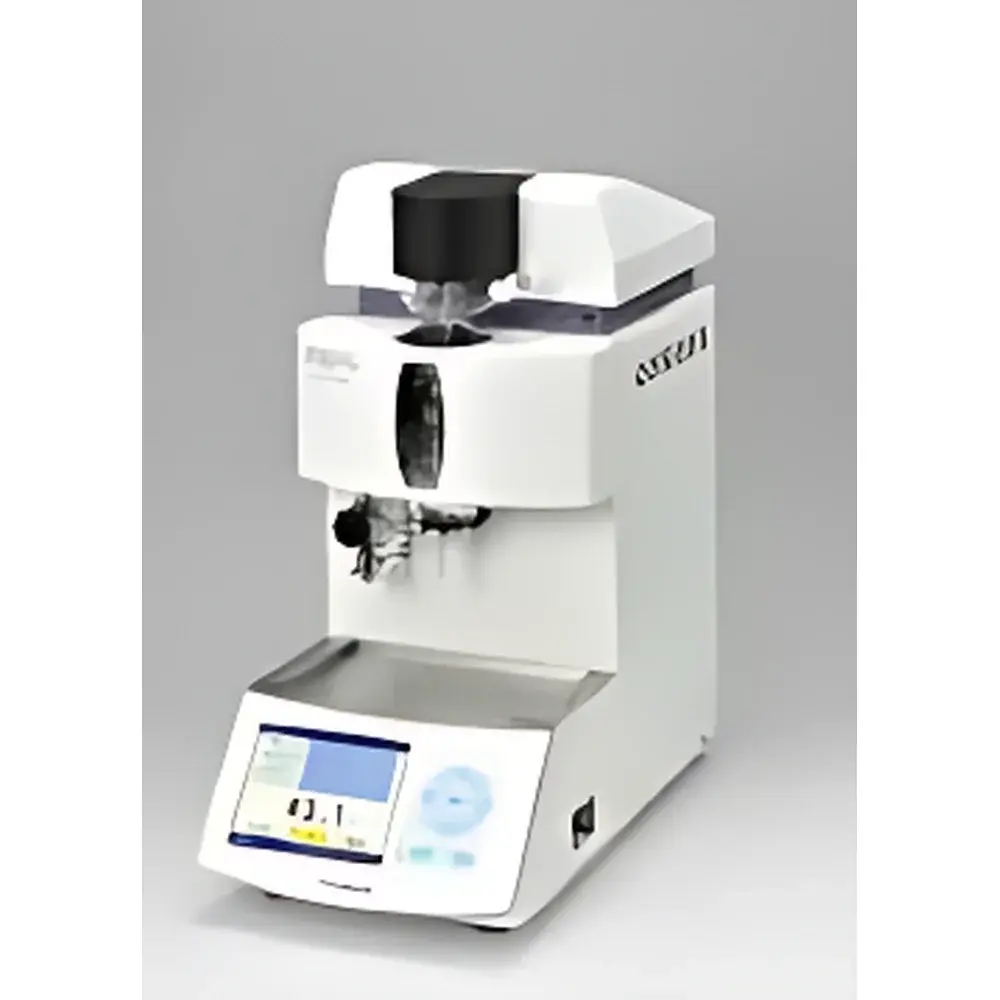
TANAKA AAP-6 Automatic Aniline Point Tester
| Brand | TANAKA (Japan) |
|---|---|
| Origin | Japan |
| Model | AAP-6 |
| Standards Compliance | ASTM D611, ISO 2977, GB/T 262 |
| Temperature Range | Ambient to 160 °C |
| Heating Rate | 10 °C/min (up to 10 °C below expected aniline point), then 2 °C/min |
| Safety Cutoffs | Auto-stop at +10 °C above expected aniline point or at 170 °C (whichever occurs first) |
| Sample Handling | Modular dual-section test vessel (removable lower section for solid/semi-solid sampling and weighing) |
| Cleaning | In-situ tube cleaning without disassembly |
| Display Interface | Color-coded status indicators (standby / active test / completion) |
| Dimensions | Compact integrated footprint |
| Control System | Embedded microprocessor with repeat-test automation and no sample replacement required between runs |
| Cooling Requirement | External cooling bath or chilled vessel mandatory for ambient temperatures <20 °C |
Overview
The TANAKA AAP-6 Automatic Aniline Point Tester is a precision-engineered analytical instrument designed for the standardized determination of the aniline point of petroleum products—including fuels, lubricants, and distillates—according to internationally recognized methods: ASTM D611, ISO 2977, and GB/T 262. The aniline point is defined as the minimum temperature at which equal volumes of aniline and the test sample become completely miscible, serving as a critical indicator of aromatic content, solvent power, and hydrocarbon composition. The AAP-6 implements a controlled, dual-rate heating protocol based on user-input expected aniline point estimation, enabling accurate endpoint detection through real-time optical homogeneity monitoring within a sealed, thermostatically regulated reaction chamber. Its design emphasizes metrological rigor, operational safety, and adaptability across diverse physical states—transparent liquids, opaque suspensions, and even solid or semi-solid samples at ambient temperature.
Key Features
- Dual-Zone Heating Control: Programmable ramp profile: 10 °C/min up to 10 °C below the operator-defined expected aniline point, then automatically transitions to a precise 2 °C/min fine-approach phase for high-resolution endpoint resolution.
- Universal Sample Compatibility: Accommodates transparent liquids, hazy or opaque distillates, and solid/semi-solid materials (e.g., waxy distillates, heavy fuel oils) via a modular two-part test vessel—featuring a detachable lower section for accurate gravimetric sampling and pre-weighing outside the instrument.
- In-Situ Cleaning Architecture: Eliminates disassembly requirements; the measurement tube is cleaned in place using solvent flush cycles compatible with common laboratory-grade cleaning agents—even for high-viscosity or carbonaceous residues.
- Redundant Safety Protocols: Dual independent thermal cutoffs: (1) automatic heater deactivation if temperature exceeds the expected aniline point by >10 °C, or (2) hard limit at 170 °C; additionally, open-circuit detection on the Pt100 RTD sensor triggers immediate shutdown and fault display.
- Intuitive Operator Interface: Backlit LCD with color-coded status indicators (green = standby, blue = active test, amber = completion/error); real-time temperature offset calibration accessible via four-directional keypad without software access.
- Maintenance-Optimized Design: Separable control unit and measurement module; all printed circuit boards conform to JIS-standardized form factors, ensuring rapid field-replaceability and minimizing downtime during service events.
Sample Compatibility & Compliance
The AAP-6 supports full method compliance for heterogeneous petroleum matrices. Solid-phase samples (e.g., paraffinic waxes or asphaltene-rich fractions) are handled via the removable lower vessel segment, allowing direct weighing on analytical balances prior to insertion—ensuring traceable mass accuracy per ASTM D611 §7.2. For ambient conditions below 20 °C, users must integrate an external refrigerated bath or utilize a certified low-temperature vessel option to maintain thermal stability during initial mixing. All test sequences generate timestamped, audit-ready records—including setpoint, actual temperature trajectory, homogeneity detection time, and final reported aniline point—supporting GLP and ISO/IEC 17025 documentation requirements. Instrument firmware includes configurable data retention policies and optional export to CSV or LIMS-compatible formats.
Software & Data Management
Control logic resides in a dedicated embedded microcontroller (ARM Cortex-M4 architecture), eliminating reliance on external PCs and reducing cybersecurity exposure vectors. Test parameters—including expected aniline point, sample ID, operator code, and calibration history—are stored in non-volatile EEPROM with write-cycle protection. Each test generates a structured metadata log containing: start/stop timestamps, heating rate transitions, optical clarity detection threshold crossing, and final calculated value with ±0.5 °C repeatability (per internal validation against NIST-traceable reference oils). Data export is supported via USB 2.0 port (mass storage mode) or RS-232 serial interface; raw logs include CRC-16 checksums for integrity verification. Optional firmware upgrade path supports future integration with 21 CFR Part 11-compliant electronic signature modules for regulated QC environments.
Applications
- Quality control of jet fuels (Jet A-1, JP-8) for aromatic content verification per DEF STAN 91-91
- Refinery process monitoring of kerosene and diesel fractions during hydrotreating
- Assessment of solvent compatibility in elastomer formulation testing (ASTM D471)
- Correlation studies between aniline point and cetane number in middle distillates
- Regulatory submission support for EPA Tier 3 gasoline certification (40 CFR Part 1090)
- Research into bio-blendstock polarity effects on refinery stream miscibility
FAQ
Does the AAP-6 require manual intervention between consecutive tests?
No. Once loaded, the instrument performs fully automated repeat analyses without sample replacement or operator input—ideal for statistical repeatability assessment per ISO 5725.
Can the AAP-6 measure samples with high pour points or wax content?
Yes. The detachable lower vessel enables precise handling of waxy solids at room temperature; pre-heating of the sample vessel is not required prior to loading.
Is third-party calibration certification available?
TANAKA provides factory calibration certificates traceable to JCSS (Japan Calibration Service System); on-site calibration services with accredited providers can be arranged through authorized distributors.
What maintenance intervals are recommended?
Visual inspection and solvent flush every 50 tests; annual verification of RTD accuracy and optical sensor response using certified reference standards.
How is data integrity ensured during power interruption?
Non-volatile memory retains all configuration and partial test data; upon recovery, the system resumes from last stable state without data loss.





