
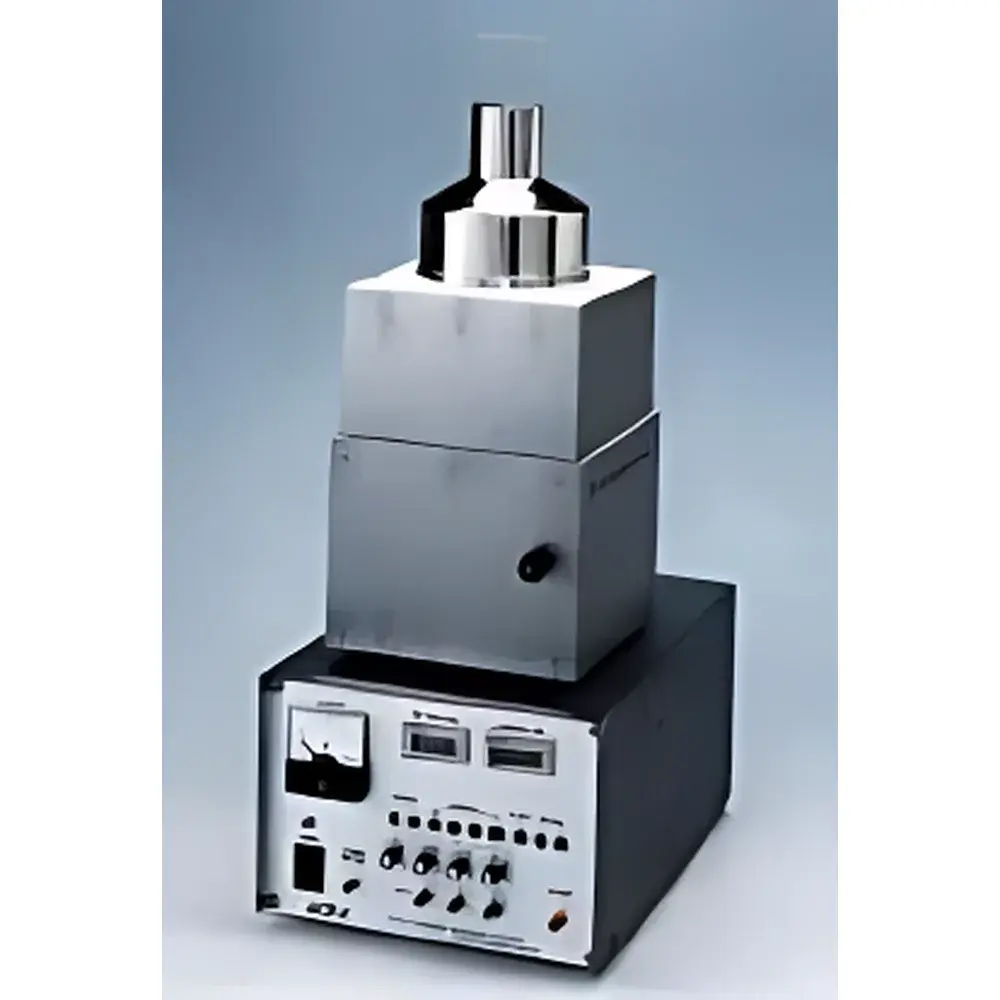
Tanaka ACR-6 Automatic Conradson Carbon Residue Tester
| Brand | Tanaka Scientific Instruments |
|---|---|
| Origin | Japan |
| Model | ACR-6 |
| Heating Power | 1.3 kW |
| Ignition System | Pilot Flame with Manual Lighting of Pilot Tube |
| Cooling Method | Forced Air Cooling via Fan |
| Temperature Monitoring | Thermocouple-Based Flame Detection |
| Control System | Electronic Time Relay |
| Power Supply | 100/220 V AC, 50/60 Hz, 1.4 kW |
| Compliance | ASTM D189, IP 13, GB/T 268 |
Overview
The Tanaka ACR-6 Automatic Conradson Carbon Residue Tester is an engineered laboratory instrument designed for precise, repeatable determination of carbon residue in petroleum products using the standardized Conradson method. Based on the fundamental principle of controlled thermal decomposition under specified atmospheric conditions, the ACR-6 replicates the classical Conradson test protocol—comprising defined preheating, open-flame combustion, high-temperature coking (at approximately 500 °C), and post-test cooling—within a fully automated, operator-guided framework. Unlike manual benchtop procedures requiring continuous supervision and timing intervention, the ACR-6 integrates synchronized electronic time relays, thermocouple-based flame detection, and programmable thermal sequencing to ensure strict adherence to ASTM D189, IP 13, and GB/T 268 regulatory requirements. Its robust architecture supports routine QC testing in refinery laboratories, independent testing facilities, and R&D centers where traceability, inter-laboratory reproducibility, and audit-ready operation are essential.
Key Features
- Automated thermal sequence execution: Preheat → Open-flame combustion → High-temperature coking → Forced-air cooling—all governed by calibrated electronic time relays.
- Real-time thermal monitoring via integrated thermocouple sensor, enabling flame presence verification and temperature trend logging during combustion phase.
- Dual-voltage compatible heating system (100/220 V AC) delivering stable 1.3 kW output for consistent coke formation across diverse sample matrices.
- Pilot-flame ignition architecture: Pilot tube is manually lit at startup; subsequent ignition events are automatically triggered upon reaching prescribed preheat temperature thresholds.
- Digital dual-timer display: Independent readouts for (1) elapsed time from power-on to pilot ignition initiation, and (2) duration from flame ignition to commencement of high-temperature coking stage.
- Forced-air cooling subsystem utilizing a dedicated axial fan, reducing post-test cooldown time while maintaining thermal stability of crucible assembly and minimizing operator exposure to residual heat.
Sample Compatibility & Compliance
The ACR-6 accepts standard Conradson crucibles (typically 10–15 mL capacity) and accommodates a broad range of petroleum distillates, residual fuels, lubricating oils, and cracked stocks per ASTM D189 scope. It is validated for use with samples exhibiting initial boiling points above 175 °C and kinematic viscosities up to 100 mm²/s at 40 °C. Instrument operation conforms to the procedural rigor mandated by ASTM D189 (2023 edition), Institute of Petroleum Standard IP 13 (2021), and Chinese National Standard GB/T 268–2022. All timing sequences, temperature profiles, and cooling intervals are traceable to internal clock calibration and thermocouple reference points—supporting GLP-compliant documentation and internal audit readiness.
Software & Data Management
The ACR-6 operates as a standalone hardware platform without embedded microprocessor-based data logging or PC connectivity. However, its digital timer outputs and thermocouple signal interface (via optional analog output module) enable integration into facility-wide LIMS or SCADA systems when configured with external data acquisition hardware. For regulatory environments governed by FDA 21 CFR Part 11 or ISO/IEC 17025, users may implement manual logbook entries or structured electronic worksheets aligned with instrument-specific SOPs. Time-stamped operational records—including ignition confirmation, combustion duration, and cooling completion—can be cross-referenced with batch identifiers and analyst credentials to satisfy traceability requirements.
Applications
- Refinery process control: Monitoring carbon residue trends in vacuum residuum, FCC feedstocks, and delayed coker feed to optimize coke drum cycle times and furnace tube fouling predictions.
- Fuel specification compliance: Verifying residual fuel oil (e.g., RMG 380, RMK 700) against ISO 8217 Annex B carbon residue limits prior to bunkering.
- Lubricant formulation development: Assessing thermal stability and deposit-forming tendency of base oil blends and additive packages under simulated oxidative stress.
- Third-party certification labs: Supporting ISO/IEC 17025 accreditation through documented equipment verification, periodic performance checks, and interlaboratory comparison programs.
- Educational laboratories: Demonstrating standardized petroleum testing methodology with reduced operator dependency and enhanced procedural fidelity.
FAQ
Does the ACR-6 support automatic data export to Excel or LIMS?
No—the ACR-6 is a dedicated hardware tester without built-in USB, Ethernet, or RS-232 interfaces. Data capture requires manual transcription or integration via external DAQ systems.
Is calibration certificate included with shipment?
A factory calibration report covering timer accuracy (±0.5 s over 30 min) and thermocouple response (NIST-traceable Type K) is provided; user-performed verification per ASTM D189 Annex A is recommended before first use.
Can the ACR-6 be used for testing biofuels or synthetic lubricants?
Yes—provided the sample meets ASTM D189 volatility and viscosity criteria; however, validation studies are required for non-petroleum-derived matrices to confirm residue morphology consistency.
What maintenance is required for long-term reliability?
Quarterly inspection of pilot tube integrity, annual thermocouple recalibration, and biannual cleaning of crucible holder and air ducts are advised per Tanaka’s Maintenance Protocol TNK-ACR-6-MP-2023.
Is the instrument compliant with CE or UKCA marking requirements?
The ACR-6 complies with IEC 61010-1:2010 for electrical safety and EMC Directive 2014/30/EU; CE marking is applied for EU-market units supplied through authorized distributors.





