
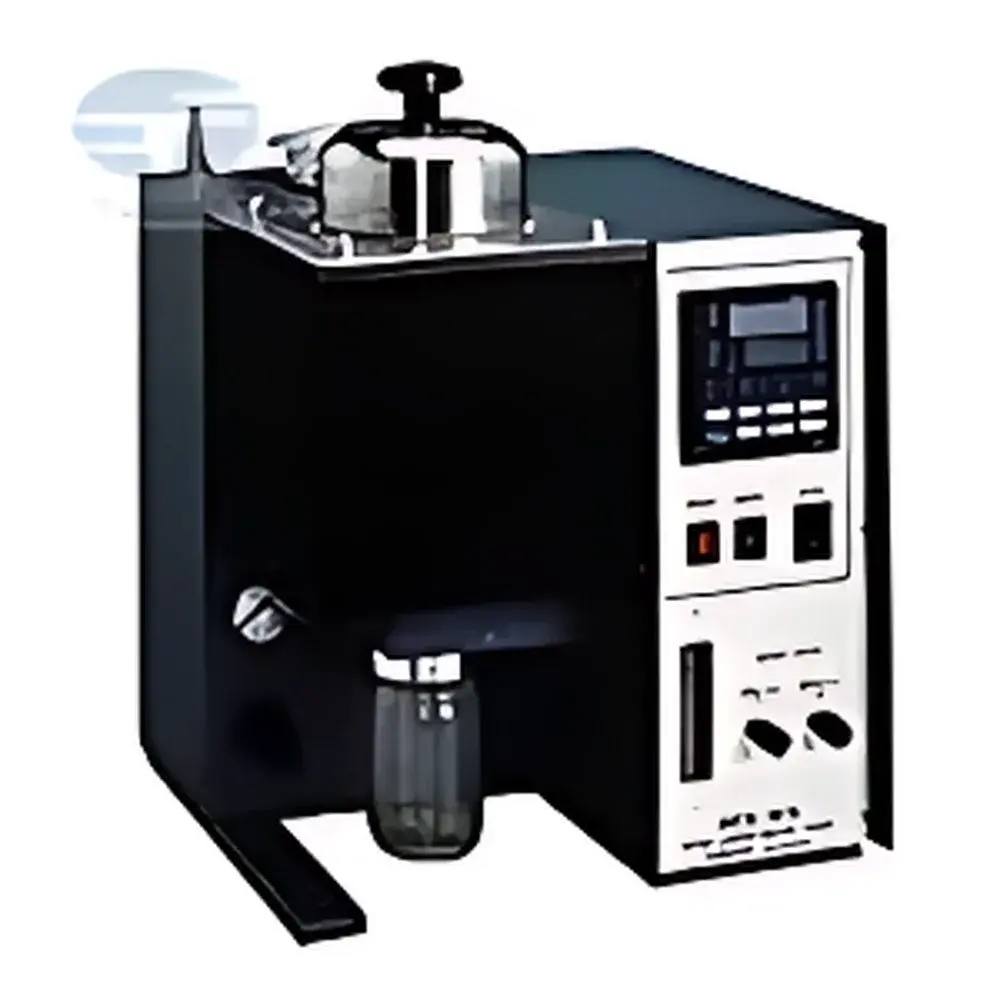
TANAKA ACR-M3 Automated Micro Carbon Residue Tester
| Brand | TANAKA |
|---|---|
| Origin | Japan |
| Model | ACR-M3 |
| Standards Compliance | ISO 10370, ASTM D4530, GB/T 17144 |
| Gas Flow Control | Auto-switching between 150 mL/min and 600 mL/min |
| Sample Capacity | 6 × large crucibles (5.0 g each) or 12 × small/medium crucibles (0.15–3.0 g each) |
| Heating Temperature | 500 °C ± 2 °C under inert gas atmosphere |
| Residue Weighing Resolution | 0.1 mg (requires external analytical balance) |
| Condensate Collection | Integrated high-temp resistant, explosion-proof condensate bottle |
| Front-panel Float Flowmeter | Visual flow verification and calibration support |
| Automation Level | Fully automated thermal ramping, dwell, cooling, and end-of-test audio alert (10 s) |
Overview
The TANAKA ACR-M3 Automated Micro Carbon Residue Tester is a precision-engineered instrument designed for the quantitative determination of carbon residue in petroleum products and feedstocks according to the micro-method principle. It operates on the fundamental thermochemical principle of controlled pyrolysis: a precisely weighed sample is subjected to thermal decomposition at 500 °C for a defined duration under a regulated inert nitrogen atmosphere, simulating the coking behavior observed during high-temperature refining processes. The residual char—chemically stable carbonaceous material remaining after volatile components are driven off—is gravimetrically quantified as a mass percentage relative to the original sample weight. This method supersedes the traditional Conradson Carbon Residue (CCR) test by eliminating open-flame heating, reducing operator exposure, improving thermal uniformity, and delivering superior repeatability (R ≤ 0.05 wt%) and reproducibility (RR ≤ 0.10 wt%) across laboratories. As specified in ASTM D4530 and ISO 10370, the micro-method results demonstrate statistical equivalence to CCR values, enabling direct correlation with legacy specifications without method revalidation.
Key Features
- Fully automated test sequence—including sample loading confirmation, inert gas purging, programmable heating ramp (to 500 °C), isothermal hold (15 min), natural cooling, and end-of-test acoustic notification—eliminates manual intervention and inter-operator variability.
- Dual-range mass flow control system automatically switches between 150 mL/min (pre-heating purge) and 600 mL/min (pyrolysis phase) to ensure optimal oxygen exclusion and consistent volatiles removal, per ASTM D4530 Section 7.3.
- Modular crucible configuration supports flexible throughput: up to six 5.0 g large crucibles for heavy fuel oils or twelve 0.15–3.0 g small/medium crucibles for distillates, lubricants, and cracked stocks—enabling efficient batch processing without cross-contamination.
- Front-mounted calibrated float flowmeter provides real-time visual verification of nitrogen flow rate, serving both operational monitoring and routine metrological validation per ISO/IEC 17025 internal calibration requirements.
- Integrated explosion-proof condensate collector, positioned beneath the furnace chamber, captures condensed hydrocarbons and tars at ambient temperature; quick-release mounting enables tool-free removal and solvent-based cleaning.
- Thermal architecture features PID-controlled silicon carbide heating elements and multi-zone insulation, ensuring ±2 °C temperature stability across the crucible array during the critical 500 °C hold period.
Sample Compatibility & Compliance
The ACR-M3 accommodates a broad spectrum of petroleum-derived materials, including but not limited to: vacuum gas oils, catalytic cracker feeds, marine fuels (ISO 8217 RMG/RMD), bitumen binders, lube base stocks, and synthetic hydrocarbon blends. All test procedures strictly adhere to the procedural mandates of ASTM D4530 (Standard Test Method for Determination of Carbon Residue (Micro-Method)), ISO 10370 (Petroleum Products — Determination of Carbon Residue — Micro Method), and GB/T 17144 (Chinese national standard equivalent). Instrument design incorporates fail-safes aligned with IEC 61010-1 for laboratory electrical equipment safety, and inert gas handling conforms to CGA G-1.1 guidelines. Data integrity meets ALCOA+ principles when paired with compliant balance and LIMS systems, supporting GLP and refinery QA/QC audit readiness.
Software & Data Management
The ACR-M3 operates via embedded firmware with no PC dependency; however, it generates ASCII-formatted result logs (timestamp, sample ID, initial mass, residue mass, %CR, operator code) exportable via USB port for integration into enterprise LIMS or ELN platforms. Each test cycle records full thermal profile metadata (ramp rate, hold time, actual furnace temperature vs. setpoint) to support root-cause analysis and regulatory traceability. While the unit itself does not implement FDA 21 CFR Part 11 electronic signature controls, its deterministic, non-editable output stream complies with Annex 11 (EU GMP) data integrity expectations when ingested into validated downstream systems. Audit trails—including calibration events, firmware updates, and user login history—are retained for ≥12 months.
Applications
This instrument is deployed in upstream R&D labs for catalyst deactivation modeling, midstream refinery QC for coker feed screening and FCCU slurry management, and downstream product certification for marine bunker fuels subject to IMO 2020 sulfur and carbon residue limits. Its low sample requirement (as little as 0.15 g) makes it ideal for precious or limited-availability samples such as pilot-plant fractions or shale-derived condensates. Routine use supports predictive maintenance of heat exchangers and fired heaters, where elevated carbon residue correlates strongly with fouling propensity and tube metal loss rates.
FAQ
What standards does the ACR-M3 validate against?
ASTM D4530, ISO 10370, and GB/T 17144—all referenced in the instrument’s type examination report and factory calibration certificate.
Is an external balance required?
Yes. The ACR-M3 does not include an integrated balance; users must provide a certified analytical balance with ≥0.1 mg readability and ISO 17025 traceability.
Can the instrument be used for biofuels or renewable diesel?
Yes—provided the sample exhibits thermal stability up to 500 °C and yields a measurable char; validation per ASTM D4530 Annex A1 is recommended for novel feedstocks.
How often does the condensate bottle require servicing?
Typically after every 20–30 tests with heavy residual fuels; frequency decreases significantly with distillate-grade samples.
Does the ACR-M3 support remote diagnostics or network connectivity?
No. It is a standalone benchtop unit with local USB data export only—designed for environments where electromagnetic interference or cybersecurity constraints prohibit networked instrumentation.






