
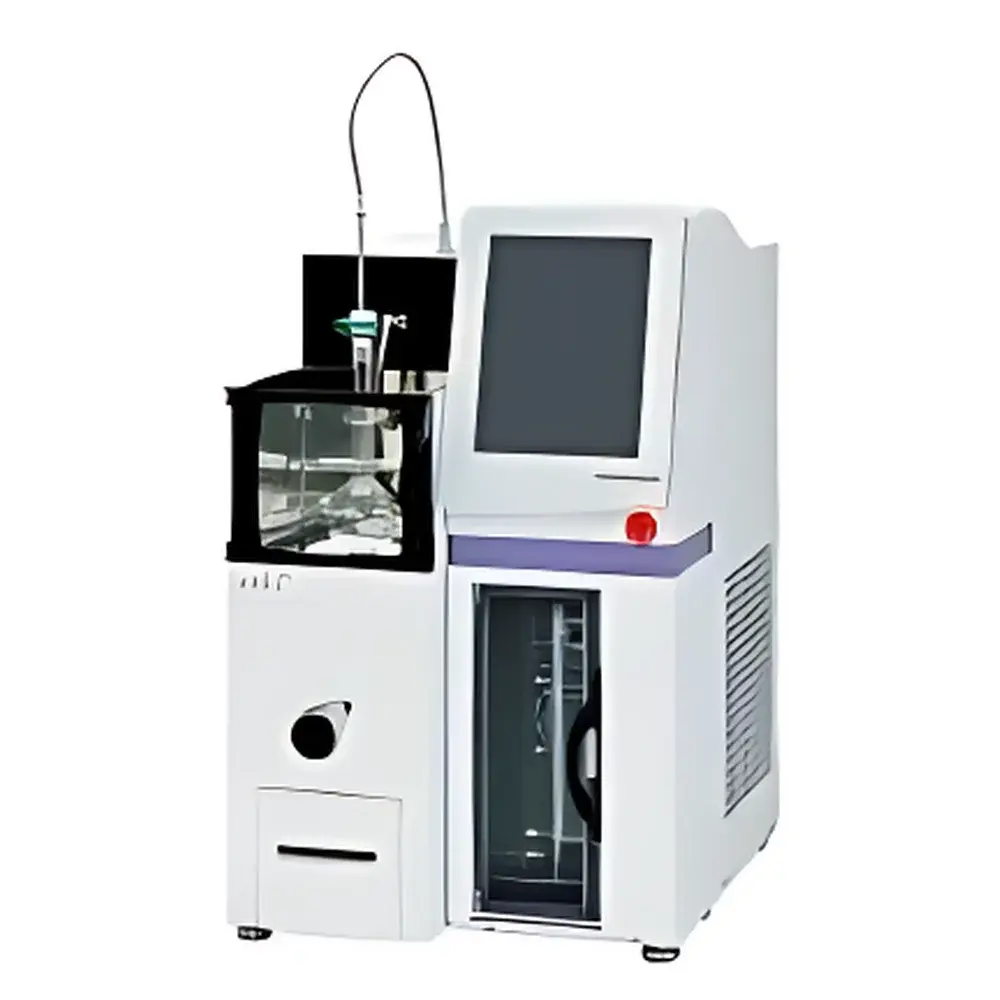
TANAKA AD-7 Automatic Petroleum Distillation Tester
| Brand | TANAKA |
|---|---|
| Origin | Japan |
| Model | AD-7 |
| Temperature Range | 0–450 °C |
| Condenser & Receiving Chamber Cooling | Peltier-based with internal recirculating coolant |
| Temperature Resolution | 0.1 °C |
| Condenser Temp Control Range | 0–69.9 °C (±0.2 °C accuracy) |
| Receiving Chamber Temp Control Range | 0–50 °C (±0.05 °C accuracy) |
| Distillate Rate Control | 2–10 mL/min (PID-regulated, factory default 4.5 mL/min) |
| Initial Boiling Point (IBP) Detection | Infrared photoelectric sensor |
| Dry Point Detection | Manual visual or optional automatic sensor |
| Heating System | 24 V/600 W vortex-type heater with forced-air cooling |
| Safety Systems | Flame detection sensor, automatic power cutoff, integrated fire suppressant discharge, flask support misalignment lockout, sensor fault monitoring |
| Data Storage | 5,000 test records |
| Test Method Presets | 200 programmable modes |
| Interfaces | RS-232C, Ethernet (for TDAS/LIMS), USB |
| Display | 10.4″ capacitive touchscreen LCD |
| Atmospheric Pressure Compensation | Automatic or manual input |
| Compliance | ASTM D86, ASTM D850, ASTM D1078, GB/T 6536 |
| Software | TDAS (Test Data Acquisition System) with curve export, remote operation, and printer output (thermal paper) |
Overview
The TANAKA AD-7 Automatic Petroleum Distillation Tester is an engineered solution for standardized atmospheric distillation analysis of petroleum products, operating in strict accordance with ASTM D86, ASTM D850, ASTM D1078, and GB/T 6536 methodologies. It implements a controlled batch distillation process under ambient pressure, measuring the volume percent distilled versus temperature to generate precise boiling point distribution profiles—critical for fuel specification compliance, refinery process control, and quality assurance of hydrocarbon solvents and light distillates. The system employs a microprocessor-controlled heating furnace with dynamic thermal profiling, coupled with dual-zone Peltier-based temperature regulation for both condenser and receiving chamber. This eliminates external chilled water supply requirements while maintaining high thermal stability and reproducibility across the full operational range (0–450 °C). The AD-7’s architecture integrates real-time infrared optical detection for initial boiling point (IBP), distillate rate monitoring, and endpoint determination—ensuring traceability and repeatability aligned with GLP and GMP laboratory practices.
Key Features
- Comprehensive standards compliance: Fully validated for ASTM D86 (gasoline, naphtha, kerosene), ASTM D850 (solvent spirits), ASTM D1078 (volatility of volatile liquids), and GB/T 6536 (Chinese national standard for petroleum distillation).
- Intelligent thermal management: Dual independent Peltier modules regulate condenser (0–69.9 °C, ±0.2 °C) and receiving chamber (0–50 °C, ±0.05 °C) temperatures with closed-loop recirculation—no external coolant or plumbing required.
- High-fidelity temperature metrology: Four calibrated sensors—including PT100 platinum resistance thermometers for distillation and ambient zones, plus K-type thermocouple for furnace monitoring—traceable to NIST-equivalent references.
- Automated procedural validation: Real-time verification of experimental setup—including flask support orifice diameter, receiver positioning, and sensor integrity—prevents invalid runs before initiation.
- Adaptive distillate flow control: PID-regulated collection at user-defined rates (2–10 mL/min), with factory default set to 4.5 mL/min per ASTM D86 Section 7.2.1.
- Integrated safety architecture: Flame-detection sensor triggers immediate power cutoff and halocarbon-based fire suppression; mechanical interlock prevents flask misinstallation; continuous sensor diagnostics flag faults pre- or mid-run.
- 10.4-inch industrial-grade capacitive touchscreen interface with multilingual OS support, enabling intuitive method selection, real-time curve visualization, and on-device result review.
Sample Compatibility & Compliance
The AD-7 accommodates a broad spectrum of volatile and semi-volatile petroleum fractions, including gasoline, aviation turbine fuel (Jet A-1), naphthas, mineral spirits, toluene, xylene, and other ASTM Class I–III hydrocarbon solvents. Its design conforms to regulatory expectations for analytical instrumentation used in ISO/IEC 17025-accredited laboratories. All thermal and optical subsystems are calibrated against certified reference materials, and the instrument supports full audit trails via TDAS software—meeting FDA 21 CFR Part 11 requirements for electronic records and signatures when configured with user authentication and change logging. Environmental compliance includes RoHS-compliant construction and energy-efficient Peltier cooling (no CFCs or HCFCs).
Software & Data Management
The TDAS (Test Data Acquisition System) software provides complete instrument control, data acquisition, and reporting functionality. It enables remote operation over Ethernet or RS-232C, direct integration into LIMS environments via structured CSV or XML export, and synchronized timestamped storage of raw temperature/volume data, distillation curves, and metadata (operator ID, atmospheric pressure, calibration status). Each stored record includes full traceability: method parameters, sensor readings at 1-second intervals, alarm logs, and operator annotations. Thermal printer output supports GLP-compliant hardcopy reports with embedded curve plots and pass/fail flags against specification limits. Data retention supports up to 5,000 test results on internal memory, expandable via USB mass storage backup.
Applications
- Refinery QC/QA: Verification of gasoline vapor pressure (RVP) correlation, volatility grading (E200/E300/E500), and distillation band conformity per API RP 2541.
- Fuel certification labs: Third-party testing for EN 228, ASTM D4814, and GB 17930 compliance documentation.
- Solvent manufacturing: Batch release testing of industrial cleaning agents, paint thinners, and extraction media per ASTM D850.
- Research & development: Boiling point distribution modeling for alternative fuel formulations and additive interaction studies.
- Regulatory submission support: Generation of auditable datasets for EPA, CE marking, or customs clearance dossiers requiring ASTM-aligned distillation profiles.
FAQ
Does the AD-7 support automated dry point detection?
Yes—dry point may be determined either manually by visual observation through the calibrated sight glass or automatically using the optional dry point sensor module, which detects cessation of distillate flow with <1 mL uncertainty.
How is atmospheric pressure compensation handled during testing?
The system performs real-time barometric correction using an integrated digital pressure transducer; users may also enter manual pressure values via the touchscreen if external weather station data is preferred.
Can the AD-7 be integrated into a centralized LIMS environment?
Yes—via native Ethernet or RS-232C interfaces, the AD-7 exports structured test data compatible with major LIMS platforms, including configurable field mapping and automated file transfer protocols (FTP/SFTP).
What maintenance is required for the Peltier cooling system?
No consumables or periodic refrigerant recharging are needed; routine verification includes annual calibration of PT100 sensors and biannual inspection of condenser tube integrity (brass or stainless steel options available).
Is firmware upgrade capability supported remotely?
Firmware updates are delivered via USB drive or secure HTTPS download through TDAS; all updates preserve existing method libraries and historical data without reset.






