
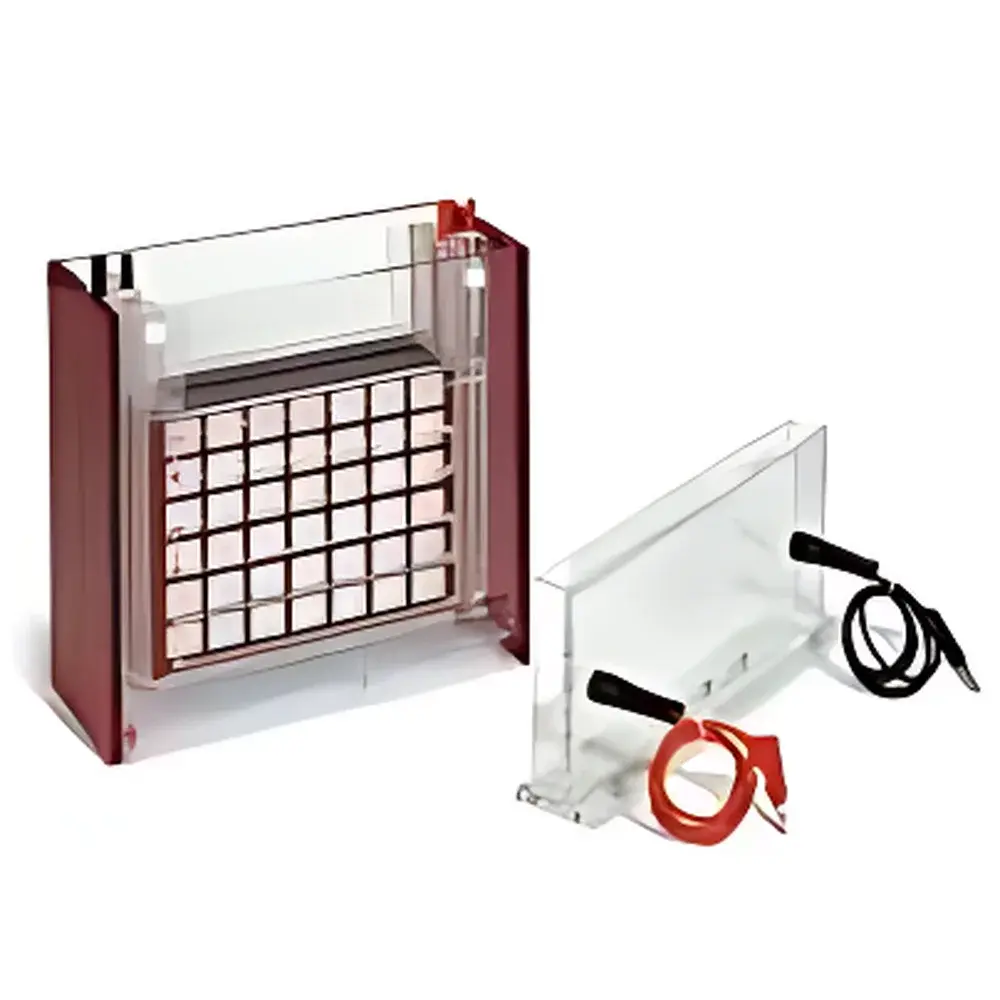
Tankblot Eco-Maxi Wet Transfer System
| Origin | Germany |
|---|---|
| Manufacturer Type | Authorized Distributor |
| Origin Category | Imported |
| Model | Tankblot Eco-Maxi |
| Pricing | Upon Request |
Overview
The Tankblot Eco-Maxi Wet Transfer System is a high-performance, laboratory-grade electrophoretic blotting instrument engineered for reliable and reproducible wet transfer of proteins from polyacrylamide gels to solid supports (e.g., nitrocellulose or PVDF membranes). Based on classical electroblotting principles—where an electric field drives negatively charged proteins out of the gel matrix and into the membrane—the Eco-Maxi employs optimized buffer dynamics, uniform current distribution, and active thermal management to achieve high-efficiency transfer of challenging analytes, including large-molecular-weight proteins (>200 kDa) and thermolabile species such as native enzymes or post-translationally modified isoforms. Designed and manufactured in Germany, the system adheres to stringent engineering standards for dimensional stability, electrical safety (IEC 61010-1), and long-term operational consistency under continuous load.
Key Features
- High-capacity transfer chamber accommodating up to four standard SDS-PAGE gels (22.0 × 19.0 cm) simultaneously—enabling parallel processing without cross-contamination or current diversion.
- Integrated, large-surface-area cooling jacket with continuous recirculating coolant flow—maintaining buffer temperature at 6 °C ± 0.5 °C across the entire transfer volume, even during extended runs exceeding 12 hours.
- Color-coded electrode plates (red = anode, black = cathode) to eliminate polarity misalignment—a common source of failed transfers—and ensure correct orientation of gel/membrane sandwiches every time.
- Modular architecture compatible with the Eco vertical electrophoresis system, allowing seamless integration into existing protein separation workflows without requiring additional power supplies or control units.
- Rugged polycarbonate housing with chemical-resistant seals and corrosion-proof stainless-steel electrodes—designed for repeated exposure to methanol-containing transfer buffers and prolonged immersion conditions.
Sample Compatibility & Compliance
The Tankblot Eco-Maxi supports a broad range of gel formats (including gradient, Tris-Glycine, Bis-Tris, and native PAGE gels) and membrane types (nitrocellulose, PVDF, and low-fluorescence variants). It meets essential performance criteria outlined in ISO/IEC 17025 for method validation in accredited laboratories and is routinely employed in workflows aligned with USP <1043>, EP 2.2.45, and ICH Q5E guidelines for protein characterization. Its thermal uniformity profile enables compliance with GLP/GMP documentation requirements where temperature-controlled transfer steps are critical for assay reproducibility—particularly in biopharmaceutical QC labs performing identity, purity, and integrity testing of monoclonal antibodies and fusion proteins.
Software & Data Management
As a standalone benchtop instrument, the Tankblot Eco-Maxi operates via front-panel digital controls with programmable voltage/current/time settings and real-time LED indicators for power status, cooling activation, and run completion. While it does not include embedded software or network connectivity, its analog interface is fully compatible with external data loggers (e.g., calibrated thermistors and ammeters) for 21 CFR Part 11–compliant audit trails when integrated into validated environments. All operational parameters—including run duration, applied voltage (typically 25–100 V DC), and coolant inlet/outlet temperatures—are manually recorded per SOP; optional external USB temperature loggers can be deployed to generate timestamped, exportable CSV reports for regulatory submission.
Applications
- Western blotting of high-MW proteins (e.g., titin, dystrophin, laminin complexes) where conventional semi-dry systems fail due to insufficient penetration depth or thermal denaturation.
- Transfer of enzymatically active proteins requiring strict temperature control (e.g., caspases, kinases, dehydrogenases) to preserve catalytic function post-blotting.
- High-throughput screening workflows in academic core facilities and CROs supporting structural biology projects involving co-immunoprecipitation followed by mass spectrometry validation.
- Process development and release testing in biosimilar manufacturing, where consistent transfer efficiency directly impacts quantitative densitometry accuracy and lot-to-lot comparability.
FAQ
What is the maximum recommended run time for continuous operation?
The system is rated for uninterrupted operation up to 16 hours at 6 °C, provided the external chiller maintains stable coolant supply (flow rate ≥ 1.2 L/min, inlet temperature ≤ 4 °C).
Can the Tankblot Eco-Maxi be used with pre-cast gels from major suppliers?
Yes—it accepts all commercially available mini and maxi gels within the 22.0 × 19.0 cm footprint, including those from Bio-Rad, Thermo Fisher, and Lonza, without adapter modifications.
Is there a built-in timer or automatic shutdown function?
It features a mechanical countdown timer with audible alert; no auto-shutdown is implemented to avoid unintended termination during critical long-duration transfers.
Does the system support constant current mode?
No—it operates exclusively in constant voltage mode, which is preferred for wet transfer due to predictable field strength and reduced risk of joule heating-induced band distortion.
What maintenance is required for the cooling circuit?
Annual inspection of O-rings, periodic descaling of the jacket interior using 0.1 M citric acid solution, and verification of coolant flow rate using a calibrated rotameter are recommended per manufacturer service guidelines.





