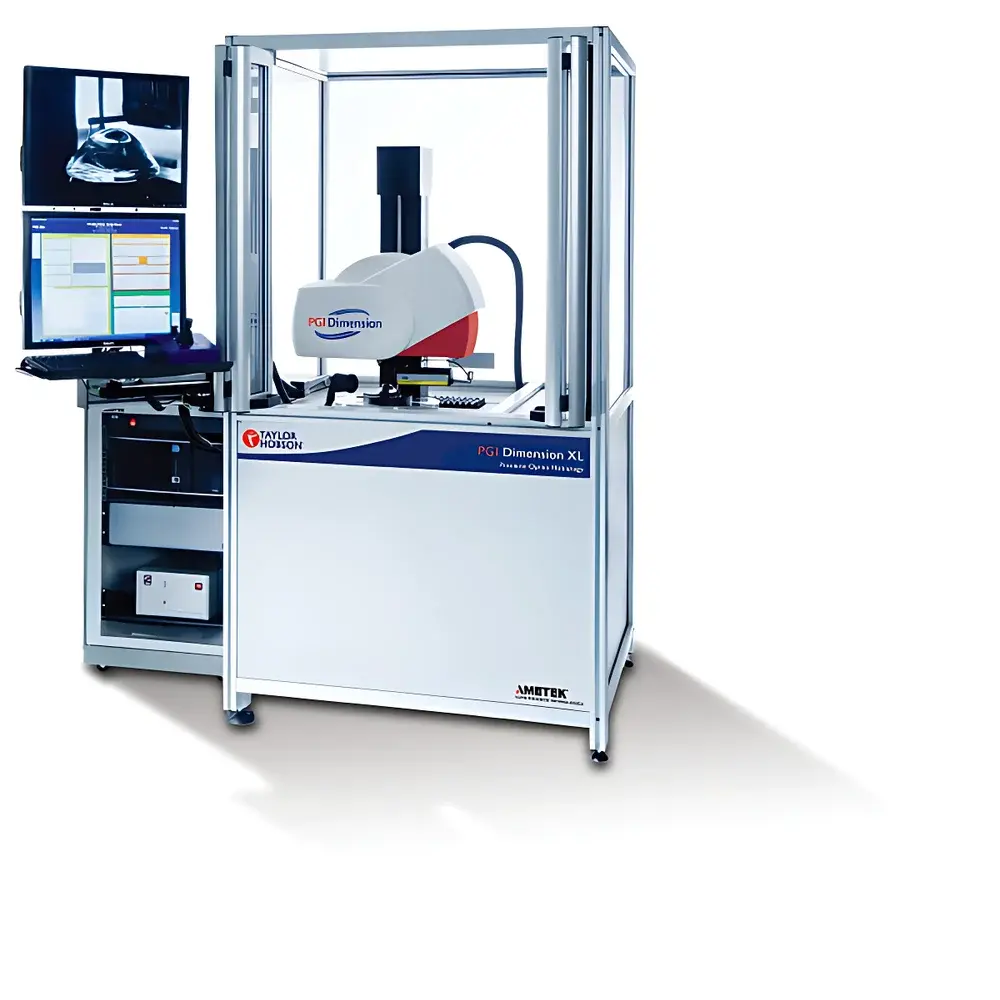
Taylor Hobson PGI Matrix High-Speed Fully Automatic Precision Optical Profilometer
| Brand | Taylor Hobson |
|---|---|
| Origin | United Kingdom |
| Model | PGI Matrix 1 / PGI Matrix 3 / PGI Matrix 5 |
| Category | Precision Geometric Measurement Instrument (Optical Profilometer) |
| Compliance | ISO 25178-2, ISO 10110-5, ISO 1101, ASTM E2923, USP <1058> (for instrument qualification), FDA 21 CFR Part 11 ready (with optional audit trail module) |
Overview
The Taylor Hobson PGI Matrix is a high-speed, fully automated optical profilometer engineered for nanometre-level form and surface texture metrology of precision optical components—including spherical, aspheric, diffractive, and freeform lenses. It employs proprietary Phase Grating Interferometry (PGI) technology—a non-contact, white-light interferometric measurement principle—combined with high-stability air-bearing motion systems and real-time fringe analysis algorithms. Unlike conventional stylus or confocal profilers, the PGI Matrix delivers traceable, high-reproducibility topographic data without surface contact or scanning-induced artefacts. Its core architecture integrates a motorized, programmable Z-axis objective turret, precision X–Y translation stage with sub-micrometre repeatability, and thermal drift compensation via embedded environmental sensors. Designed for integration into production environments, the system meets stringent requirements for geometric fidelity, measurement speed, and operational robustness in high-volume optical manufacturing.
Key Features
- Fully automated measurement workflow—from part loading and alignment to analysis and reporting—with zero manual intervention required after initial setup.
- Proprietary PGI optical engine delivering <1 nm residual shape error resolution on optical surfaces up to Ø300 mm, validated per ISO 25178-2 calibration protocols.
- Real-time radius optimization and burr removal algorithms that dynamically suppress edge artefacts and deliver repeatable PV/RMS form error values across batch measurements.
- Advanced Aspheric Analysis Unit (AAU) software module enabling instantaneous evaluation of slope error, ring zone depth, local curvature deviation, and best-fit radius—fully compliant with ISO 10110-5 tolerancing conventions.
- Reverse-coefficient calculation capability: reconstructs actual manufactured surface profiles (including fabrication-induced deviations) and exports Zernike or Q-type polynomial coefficients for optical design iteration and tolerance stack-up analysis.
- X-axis and radius compensation algorithms calibrated for CNC grinding and diamond turning feedback loops—enabling closed-loop process control with temperature drift correction down to ±0.02 °C sensitivity.
- Modular hardware configuration: PGI Matrix 1 (entry-level), PGI Matrix 3 (mid-range with extended vertical range and larger aperture optics), and PGI Matrix 5 (full-production grade with dual-sensor head option and integrated part-handling interface).
Sample Compatibility & Compliance
The PGI Matrix accommodates plano-convex, bi-convex, meniscus, and aspheric lenses ranging from Ø3 mm to Ø300 mm diameter and sag heights up to ±50 mm. It supports materials including fused silica, BK7, CaF₂, sapphire, and chalcogenide glasses. All configurations comply with ISO 1101 (geometrical product specifications), ISO 10110-5 (surface form tolerances), and ISO 25178-2 (areal surface texture). Optional IQ/OQ/PQ documentation packages support GLP/GMP-regulated environments. When configured with audit trail logging and electronic signature modules, the system satisfies FDA 21 CFR Part 11 requirements for regulated optical component manufacturing.
Software & Data Management
The PGI Matrix operates on Taylor Hobson’s unified Metrology Suite v6.x platform—a Windows-based, role-based application with intuitive ribbon UI and context-aware wizards. Measurement programs are created via drag-and-drop sequencing; no scripting expertise is required. All raw interferograms, height maps, and analysis reports are stored in vendor-neutral HDF5 format with embedded metadata (timestamp, operator ID, environmental conditions, calibration status). Export options include CSV, STEP AP242, Zemax .ZRD, Code V .DAT, and ISO-standard GD&T XML schemas. The system supports networked deployment with central database archiving, SFTP-based report distribution, and RESTful API access for MES/SCADA integration.
Applications
- Final inspection and process validation of injection-moulded, diamond-turned, and precision-ground optical elements.
- Asphere certification per MIL-PRF-13830B and ISO 10110-5 for aerospace and defence contractors.
- Feedback-driven toolpath correction in ultra-precision machining cells (e.g., Moore Nanotech, Precitech).
- Root-cause analysis of wavefront degradation in high-NA lithography lenses and laser resonator optics.
- Design verification of diffractive optical elements (DOEs) and multi-level microstructures using phase-unwrapping and staircase-height reconstruction.
- Supplier quality assurance audits requiring full traceability from raw material batch to finished lens certification.
FAQ
What standards does the PGI Matrix comply with for optical surface metrology?
It conforms to ISO 25178-2 (areal surface texture), ISO 10110-5 (optical element form tolerances), ISO 1101 (GD&T), and ASTM E2923 (interferometric profilometry validation). Optional qualification packages align with USP and FDA 21 CFR Part 11.
Can the PGI Matrix measure diffractive or freeform optics?
Yes—its PGI engine resolves high-spatial-frequency phase steps typical of multilevel DOEs, and its AAU software performs reverse-coefficient fitting for freeform surfaces defined by Q-polynomials or XY polynomial expansions.
Is thermal drift compensation built-in?
Yes—the system includes real-time ambient temperature and stage thermal monitoring, with adaptive X-axis and radius compensation algorithms activated automatically during extended runs.
How is measurement uncertainty quantified and documented?
Each measurement report includes expanded uncertainty (k=2) calculated per GUM (JCGM 100:2008), referencing NPL-traceable interferometer calibration certificates and stage repeatability test records archived in the Metrology Suite database.
Does the system support automated pass/fail sorting?
Yes—customizable sorting rules based on PV/RMS form error, slope deviation, or localized defect detection can trigger visual indicators, pneumatic part ejection signals, or MES-linked disposition codes.