
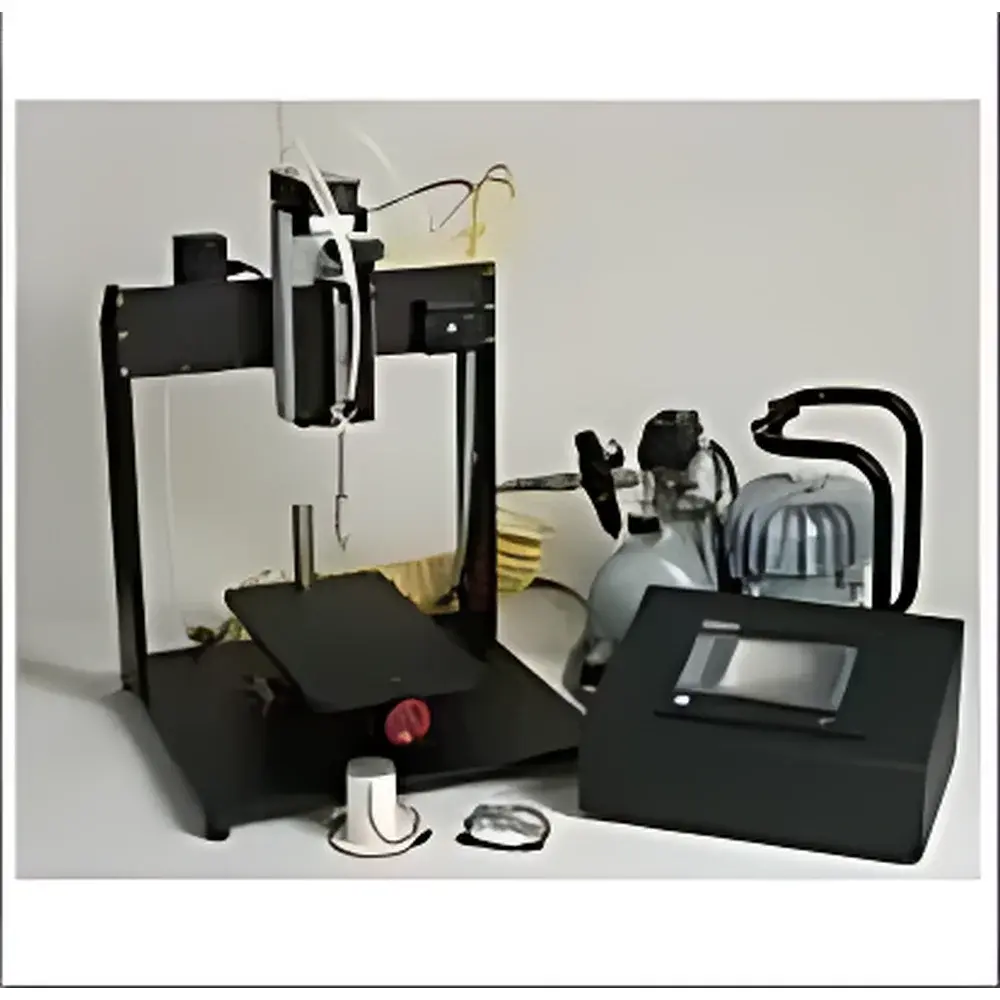
TBI 0310 Pneumatic Controlled Cortical Impact Device
| Origin | USA |
|---|---|
| Manufacturer Type | Authorized Distributor |
| Origin Category | Imported Instrument |
| Model | TBI 0310 |
| Pricing | Available Upon Request |
| Impact Depth Range | 0–3.5 mm (adjustable in 0.01 mm increments) |
| Impact Velocity Range | 1.5–6.0 m/s (adjustable in 0.1 m/s increments) |
| Default Depth | 0.5 mm |
| Default Velocity | 3.5 m/s |
| Z-Axis Automated Travel Range | 102 mm |
| Manual X-Y Adjustment Range | 276 mm × 203 mm |
| Overall System Height | 736 mm |
| Actuation | Precision Pneumatic Cylinder (Bimba) |
Overview
The TBI 0310 Pneumatic Controlled Cortical Impact Device is a research-grade, programmable mechanical impactor engineered for the standardized induction of controlled cortical impact (CCI) injuries in small rodent models—primarily mice and rats. Designed in accordance with widely accepted preclinical TBI modeling protocols, the system operates on a validated pneumatic actuation principle: compressed air drives a calibrated impactor tip at precisely defined velocities and depths to produce reproducible focal contusions in the exposed dura or intact skull (with craniotomy). Unlike spring- or electromagnetic-based impactors, the TBI 0310 utilizes a high-precision Bimba pneumatic cylinder integrated with real-time contact-sensing feedback, enabling deterministic initiation of impact only upon verified physical contact with the cortical surface. This eliminates variability introduced by inconsistent head positioning or tissue compliance, significantly improving inter-experimental and inter-laboratory model fidelity.
Key Features
- Pneumatic actuation architecture delivering consistent kinetic energy delivery across repeated trials, independent of ambient temperature or mechanical wear.
- Integrated capacitive or optical proximity sensor that validates cortical surface contact prior to impact initiation—ensuring depth accuracy within ±0.01 mm tolerance.
- Programmable control unit supporting discrete stepwise adjustment of impact depth (0.00–3.50 mm, 0.01 mm resolution) and velocity (1.5–6.0 m/s, 0.1 m/s resolution), with user-defined defaults stored in non-volatile memory.
- Three-axis positioning system: manual coarse X-Y translation (276 mm × 203 mm range) and motorized Z-axis fine positioning (102 mm travel), facilitating rapid repositioning between animals without recalibration.
- Modular impact tip interface accommodating standardized stainless-steel or tungsten carbide tips (diameters: 1.5 mm, 2.0 mm, 3.0 mm), compatible with ASTM F2921-14 guidelines for biomechanical impactor tip geometry.
- CE-compliant electrical enclosure and ISO 8573-1 Class 2 compressed air interface, supporting integration into GLP-aligned vivarium environments.
Sample Compatibility & Compliance
The TBI 0310 is validated for use with adult C57BL/6, Sprague-Dawley, and Wistar rats (250–350 g) and mice (20–30 g) under stereotaxic restraint. Craniotomy dimensions (typically 4–5 mm diameter over parietal cortex) must conform to IACUC-approved surgical protocols. The device meets mechanical safety requirements per ISO 13857:2019 (safety distances) and incorporates emergency stop circuitry compliant with IEC 60204-1. All operational parameters—including depth, velocity, dwell time, and tip geometry—are fully documentable for audit readiness under NIH OLAW, AAALAC International, and EU Directive 2010/63/EU reporting frameworks.
Software & Data Management
The embedded microcontroller logs timestamped impact events—including actual depth, velocity, contact force threshold, and Z-axis position—to internal flash memory. Exportable CSV files support traceability in longitudinal studies and regulatory submissions. While the system does not include proprietary GUI software, its RS-232 and TTL trigger outputs enable synchronization with external data acquisition platforms (e.g., PowerLab, Spike2, or MATLAB-based acquisition systems) for concurrent electrophysiological, cerebral blood flow, or intracranial pressure monitoring. Audit trails comply with ALCOA+ principles; all parameter changes are time-stamped and user-annotated where integrated with LIMS or ELN systems.
Applications
- Preclinical evaluation of neuroprotective agents targeting secondary injury cascades (e.g., excitotoxicity, oxidative stress, neuroinflammation).
- Mechanistic studies of blood-brain barrier disruption, axonal injury biomarkers (e.g., NF-L, tau), and glial activation kinetics post-impact.
- Validation of advanced imaging modalities—including diffusion tensor imaging (DTI), susceptibility-weighted MRI, and two-photon microscopy—for detecting microstructural damage.
- Testing of implantable neuromodulation devices or bioengineered scaffolds in chronic recovery paradigms (up to 28 days post-injury).
- Standardization of injury severity grading across multi-center consortia (e.g., TRACK-TBI preclinical working group).
FAQ
Is the TBI 0310 compatible with stereotaxic frames from other manufacturers?
Yes—the base mounting plate accepts standard ¼”-20 threaded holes and aligns with Kopf, Stoelting, and Leica stereotaxic frame footprints.
Does the system require compressed air supply conditioning?
Yes—a filtered, dried, oil-free air source meeting ISO 8573-1 Class 2 specifications (dew point ≤ −40°C, particle size ≤ 1 µm) is mandatory for cylinder longevity and repeatability.
Can impact dwell time be programmed?
Yes—dwell duration (0–500 ms) is configurable via the control unit and synchronized with pneumatic valve timing.
Is validation documentation available for regulatory submissions?
Yes—Factory Acceptance Test (FAT) reports, sensor calibration certificates, and IEC 61000-4 EMC test summaries are provided upon request for FDA IND/IDE or EMA CTA submissions.
What maintenance is required for long-term reliability?
Quarterly inspection of cylinder seals, annual recalibration of contact sensors, and biannual verification of velocity/depth linearity using NIST-traceable laser displacement and high-speed photogate systems.




