
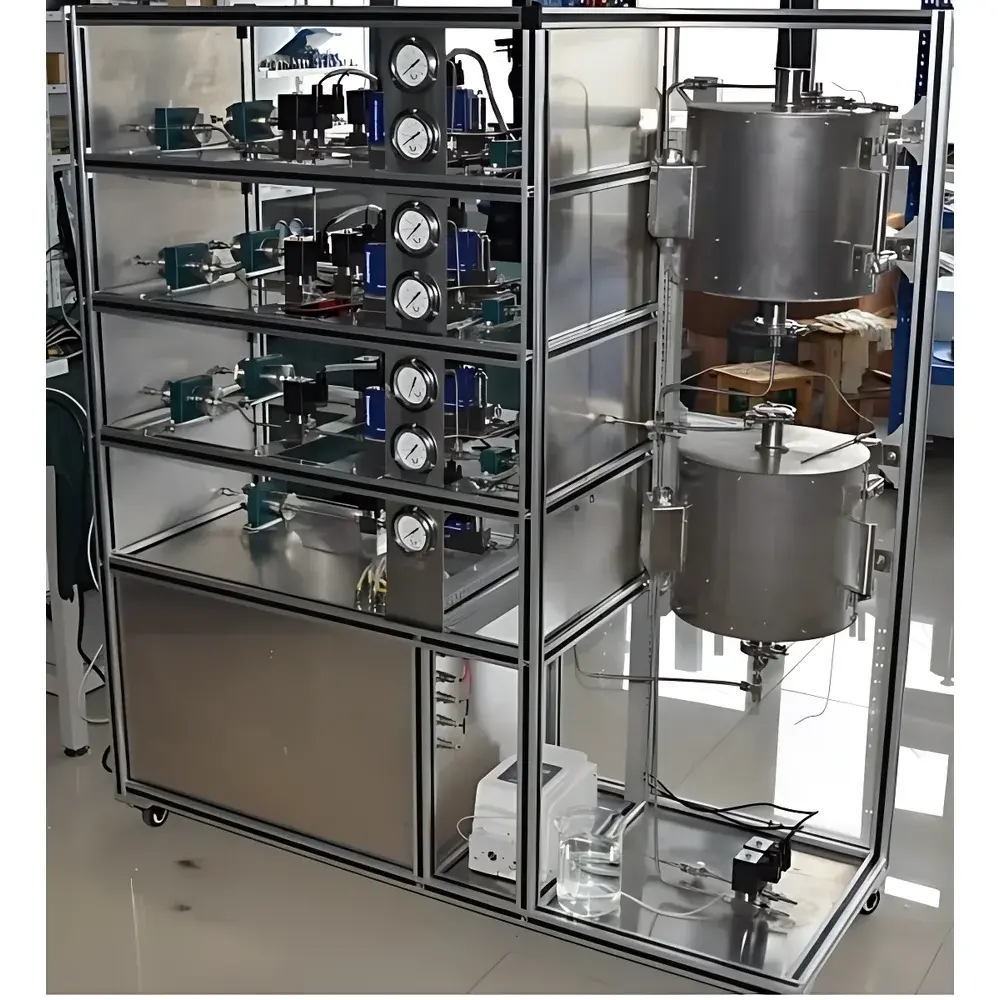
TCT CSSE1000 Automated Small-Sample Catalyst Evaluation System for Automotive Exhaust Aftertreatment
| Brand | TCT (Xiamen Tongchuang) |
|---|---|
| Origin | Fujian, China |
| Model | CSSE1000 |
| Reaction Pressure | Atmospheric (optional backpressure up to 0.5 MPa) |
| Reaction Temperature Range | Ambient to 1100 °C |
| Catalyst Bed Dimensions | 25 mm ID × 40 mm L |
| Gas Flow Control Range | 5 sccm – 30 SLPM |
| Temperature Control Accuracy | ±0.5 °C (heating zones & evaporator) |
| Gas Species Analyzed | CO, CO₂, CH₄, C₆H₁₄, C₃H₈, NO, NOₓ, O₂, NH₃, H₂O (optional), NO₂ (optional), SO₂ (optional) |
| Space Velocity Range | 3,000 – 50,000 h⁻¹ |
| Gas Mixing | Integrated turbulent-mixing chamber with flow conditioning baffle |
| Materials | 316L stainless steel tubing with VCR/SS-400 fittings |
| Condensate Management | Integrated inline condenser with phase separation prior to analyzer inlet |
| Liquid Dosing | Dual-plunger micropump or precision syringe pump (0.1–1000 mL/h) for controlled humidification |
| Compliance | Designed for GLP-compliant catalyst screening per ISO 21365, ASTM D7214, and SAE J1829 test protocols |
Overview
The TCT CSSE1000 Automated Small-Sample Catalyst Evaluation System is a purpose-built, bench-scale fixed-bed reactor platform engineered for rigorous laboratory screening and kinetic characterization of automotive exhaust aftertreatment catalysts. It operates on the principle of dynamic gas-phase catalytic reaction under precisely controlled thermal, compositional, and hydrodynamic conditions—mimicking real-world engine exhaust profiles including transient temperature ramps, stoichiometric variations, and realistic space velocities. The system enables quantitative assessment of critical performance metrics such as light-off temperature (T₅₀, T₉₀), conversion efficiency across defined temperature windows, ammonia slip (for SCR systems), sulfur tolerance, hydrothermal aging resistance, and oxygen storage capacity (OSC). Its modular architecture supports both gasoline three-way catalyst (TWC) development and diesel aftertreatment configurations—including diesel oxidation catalysts (DOC), selective catalytic reduction (SCR) formulations, and lean NOₓ traps (LNT)—all within a single, software-synchronized workflow.
Key Features
- Eight to twelve independently programmable mass flow control channels using certified 7-Series thermal mass flow meters and high-cycle-life solenoid valves, enabling reproducible multi-gas blending with <±1% full-scale accuracy.
- Integrated gas mixing manifold featuring patented turbulent-flow baffles and pre-heating capability, ensuring homogeneous gas composition upstream of the catalyst bed without dead volume or laminar stratification.
- Horizontally oriented, split-tube quartz or Inconel-lined 316L stainless steel reactor with rapid-access flange design; accommodates cylindrical catalyst samples measuring 25 mm inner diameter × 40 mm length, with axial thermocouple positioning for precise bed temperature profiling.
- Dual-zone furnace system with independent PID-controlled heating sections—reaction zone and vaporization zone—both maintaining ±0.5 °C stability from ambient to 1100 °C over >150 mm active isothermal length.
- Optional backpressure regulation module (0.1–0.5 MPa range) and post-reactor condensation trap with Peltier-cooled separator, protecting downstream analyzers (e.g., FTIR, CLD, FID, paramagnetic O₂) from moisture and particulate ingress.
- Corrosion-resistant fluid path: all wetted surfaces electropolished to Ra < 0.4 µm, passivated per ASTM A967, and sealed via metal gasket VCR connections rated to 10,000 psi.
Sample Compatibility & Compliance
The CSSE1000 accepts powdered, extruded, or pelletized catalyst formulations mounted in standardized stainless-steel sample holders. It supports testing of noble-metal (Pt/Pd/Rh), base-metal (Cu/Fe/Ce), and perovskite-type formulations under dry or humidified feed streams (via integrated dual-plunger dosing pump for H₂O saturation control). The system adheres to internationally recognized catalyst evaluation standards, including ISO 21365 (automotive catalyst light-off testing), ASTM D7214 (catalyst durability under cyclic aging), and SAE J1829 (bench-scale simulation of exhaust gas composition). All temperature, flow, and pressure data are timestamped and archived with audit-trail functionality compliant with FDA 21 CFR Part 11 requirements when configured with electronic signature modules.
Software & Data Management
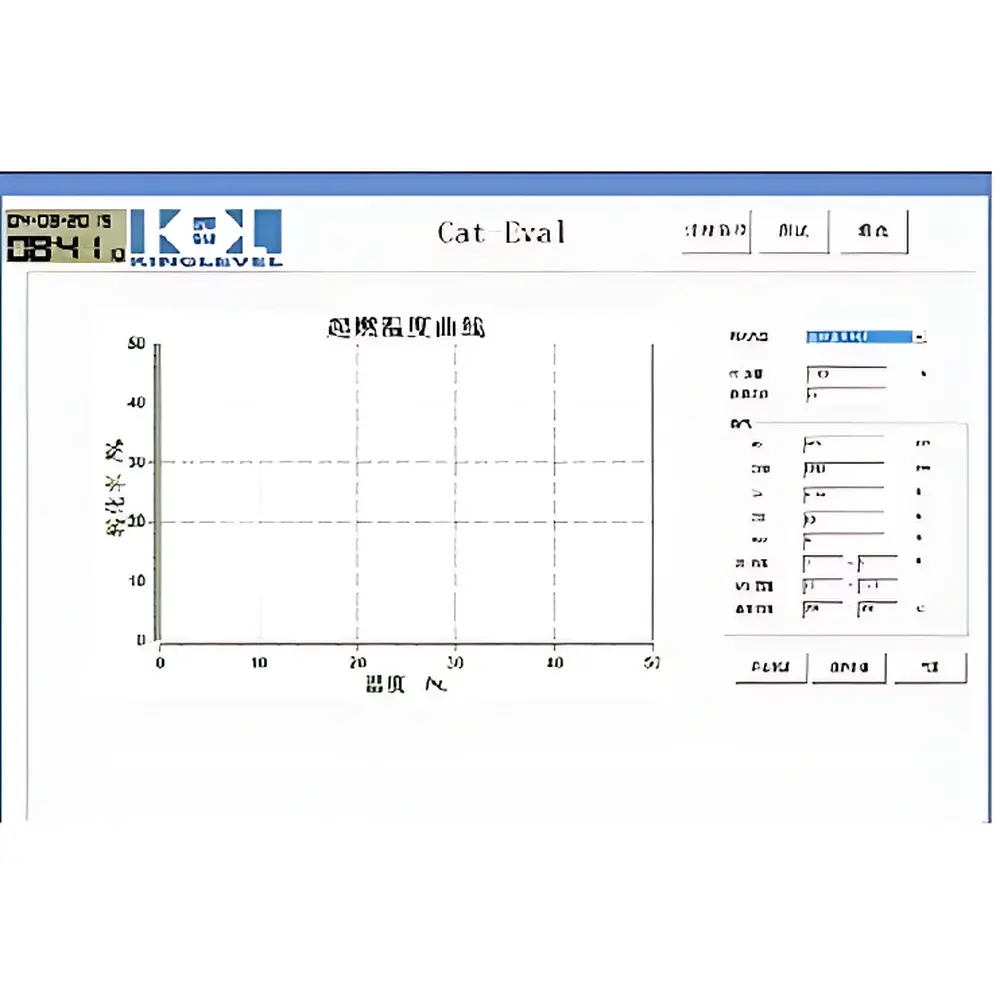
Control and data acquisition are managed through TCT’s proprietary CatalystLab™ software suite, built on .NET Framework with SQL Server backend. The interface provides real-time visualization of 64+ process variables—including individual MFC setpoints, reactor axial temperature gradients, dew point monitoring, and analyzer-reported concentration traces. Users define multi-step test protocols (e.g., light-off ramp, step-change, aging cycles) with conditional logic and automatic data export to CSV, Excel, or HDF5 formats. Raw datasets include metadata tags for catalyst lot number, pretreatment history, and calibration certificate references. Optional integration with LIMS platforms is supported via OPC UA and RESTful API endpoints.
Applications
- High-throughput comparative screening of novel catalyst formulations during early R&D phases.
- Hydrothermal aging studies simulating 100,000 km equivalent exposure under controlled steam/oxygen environments.
- NOₓ reduction kinetics modeling for Cu-zeolite and Fe-zeolite SCR catalysts under NH₃ slip constraints.
- Sulfur poisoning and regeneration behavior analysis using calibrated SO₂ pulses followed by desorption profiling.
- Oxygen storage capacity quantification via CO pulse titration and dynamic O₂ uptake measurement.
- Validation of kinetic models (e.g., Langmuir-Hinshelwood, Mars-van Krevelen) against experimental conversion vs. temperature and space velocity data.
FAQ
What catalyst geometries and loadings are compatible with the CSSE1000?
Standard configuration supports monolithic substrates (cut to 25 mm diameter × 40 mm length) or loose powder/pellets loaded into a quartz insert. Maximum catalyst mass is ~15 g depending on density.
Can the system perform cyclic aging tests per ISO 21365 Annex B?
Yes—the software includes preloaded ISO-compliant thermal cycling profiles with programmable ramp rates, dwell times, and exhaust gas composition switching between rich/lean conditions.
Is remote operation and data monitoring supported?
The system supports secure VPN-based remote access via RDP or web dashboard, with live video feed from optional integrated reactor-viewing port camera.
How is humidity introduced and controlled during testing?
A dual-plunger metering pump delivers deionized water into a heated vaporizer (20–300 °C), generating saturated gas streams; relative humidity is calculated in real time from vaporizer temperature and total flow rate.
Does the system meet explosion-proof requirements for H₂-containing feeds?
While not intrinsically rated, the CSSE1000 can be upgraded with ATEX-certified solenoid valves, purge interlocks, and hydrogen-specific MFCs upon request—subject to site-specific hazard analysis.



