
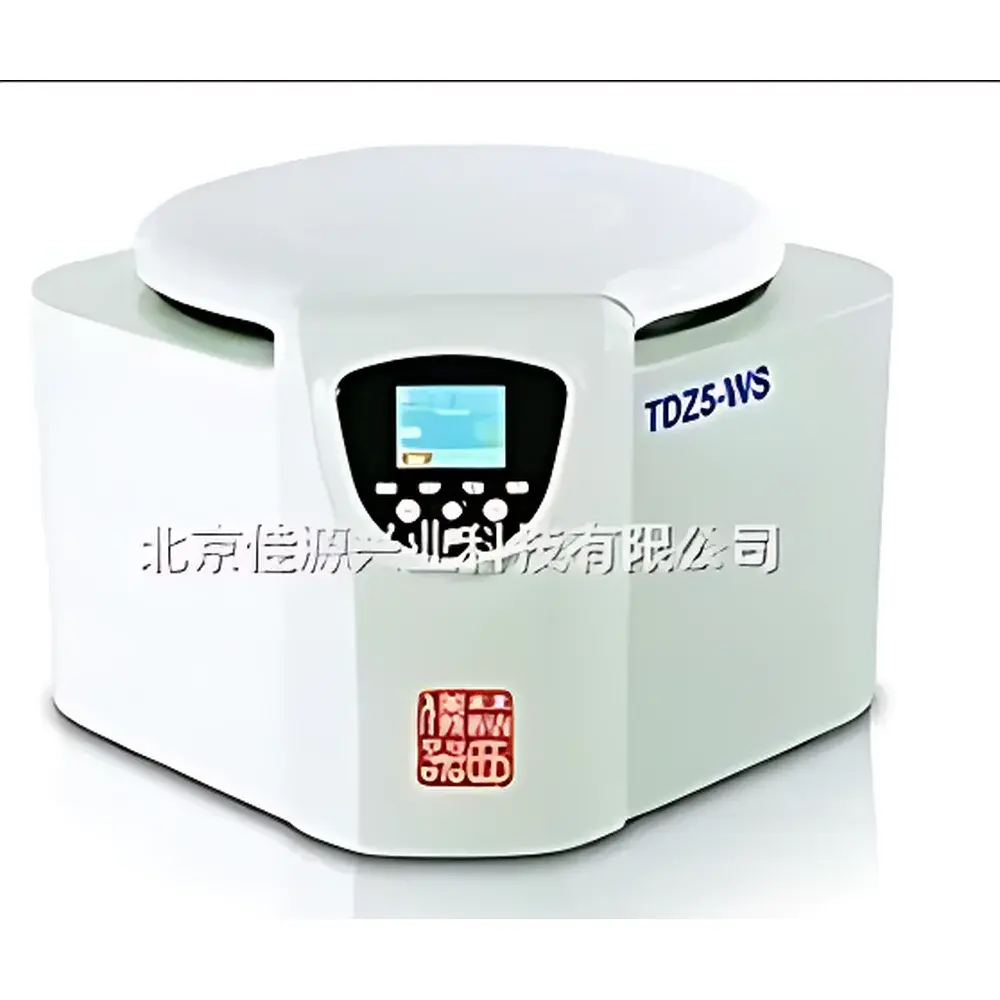
TDZ5-WS Low-Speed Centrifuge
| Origin | Hunan, China |
|---|---|
| Manufacturer Type | Distributor |
| Product Origin | Domestic |
| Model | TDZ5-WS |
| Price | USD 600 (approx.) |
| Type | Low-Speed Centrifuge |
| Max Capacity | 4 × 100 mL |
| Max Speed | 5000 rpm |
| Max RCF | 4800 × g |
| Dimensions (L×W×H) | 500 × 450 × 280 mm |
| Weight | 25 kg |
| Motor | Brushless AC Inverter Motor |
| Display | TFT True-Color Touchscreen |
| Programs | 20 Stored Protocols |
| Acceleration/Deceleration | 10 Adjustable Ramp Profiles |
| Noise Level | ≤65 dB(A) |
| Construction | All-Steel Frame with Stainless Steel Rotor Chamber |
| Safety | Electromechanical Door Lock, Automatic Rotor Imbalance Detection, Multi-Stage Vibration Damping System |
Overview
The TDZ5-WS Low-Speed Centrifuge is an engineered workhorse for routine separation tasks in clinical laboratories, biotechnology facilities, and academic research settings. Designed around the principles of sedimentation centrifugation—where differential particle migration under gravitational force (expressed as relative centrifugal force, RCF) enables phase separation—the TDZ5-WS delivers reliable, reproducible performance at speeds up to 5000 rpm and a maximum RCF of 4800 × g. Its operational envelope targets applications requiring gentle pelleting of cells, precipitates, or suspended particulates without inducing shear stress or thermal denaturation—such as blood component separation, yeast harvesting, crude protein precipitation, and polymer clarification. Unlike high-speed or ultracentrifuge systems, this model prioritizes robustness, ease of validation, and long-term stability over extreme g-forces, making it particularly suited for GLP-compliant workflows where traceability, repeatability, and mechanical integrity are foundational.
Key Features
- Brushless AC inverter motor ensures maintenance-free operation, eliminates carbon dust contamination, and supports precise speed regulation with ±50 rpm accuracy.
- TFT true-color touchscreen interface provides intuitive navigation, real-time display of setpoints (speed, time, RCF), and live monitoring of actual run parameters—including instantaneous RCF calculation based on rotor radius and rotational velocity.
- Stainless steel centrifuge chamber and all-steel structural frame deliver corrosion resistance, mechanical rigidity, and compliance with ISO 13485 cleanroom-compatible housing standards.
- Electromechanical door lock system prevents accidental lid opening during operation and interlocks with rotor detection to ensure only certified rotors initiate runs.
- Multi-stage passive damping system combined with automatic dynamic balancing compensates for minor sample imbalances, enabling stable operation even with asymmetric loading across the 4 × 100 mL capacity.
- 20 programmable protocols support method standardization; last-run program auto-recalls on power-up, reducing setup time and minimizing operator-dependent variability.
- 10 selectable acceleration and deceleration ramp profiles allow optimization for sensitive samples—e.g., soft braking for fragile cell pellets or rapid spin-down for high-throughput serum separation.
Sample Compatibility & Compliance
The TDZ5-WS accommodates a broad range of tube formats via interchangeable rotor configurations—including horizontal swing-out rotors (4 × 100 mL, 4 × 50 mL, 32 × 15 mL, 76 × 5/2 mL vacuum collection tubes) and optional fixed-angle adapters (12 × 15 mL, 24 × 10 mL). All rotors are precision-balanced and certified to ASTM F1842–22 specifications for mechanical integrity under cyclic loading. The unit meets IEC 61010-1:2010 safety requirements for laboratory electrical equipment and complies with CE marking directives for electromagnetic compatibility (EMC) and low-voltage operation. While not refrigerated, its thermally stable enclosure design maintains ambient temperature drift within ±2 °C during extended runs—critical for protocols sensitive to thermal history (e.g., coagulation assays per CLSI H21-A5). Documentation packages include Factory Acceptance Test (FAT) reports, material certifications for stainless steel components, and calibration records traceable to NIST standards.
Software & Data Management
Though standalone in operation, the TDZ5-WS supports audit-ready data integrity through its embedded firmware architecture. Each run logs timestamp, rotor ID (via manual entry), speed, duration, RCF, and final brake status—stored locally in non-volatile memory for ≥1000 cycles. Export is enabled via USB port (FAT32 formatted drive), generating CSV files compatible with LIMS integration or Excel-based QC review. For regulated environments, the device supports 21 CFR Part 11-aligned user access control when paired with optional PC-based supervision software (sold separately), enabling electronic signatures, change history tracking, and role-based permission tiers. All parameter modifications require dual-key confirmation, and firmware updates follow secure signed-binary verification protocols.
Applications
- Clinical diagnostics: Serum/plasma separation from whole blood (EDTA, heparin, citrate tubes); urinalysis sediment concentration; CSF clarity assessment.
- Cell culture labs: Harvesting adherent or suspension mammalian cells (e.g., HEK293, CHO) prior to lysis or cryopreservation.
- Food & beverage QA: Milk fat standardization (complementary to Gerber/LT6Y methods), juice clarification, starch granule isolation.
- Environmental testing: Solid-phase extraction of suspended solids from wastewater effluents per EPA Method 1600.
- Pharmaceutical manufacturing: Crude antibody pellet recovery post-protein A chromatography; excipient suspension homogenization.
- Educational use: Teaching sedimentation kinetics, Stokes’ law validation, and centrifugal force vector analysis in undergraduate physics and biochemistry curricula.
FAQ
What is the maximum RCF achievable with the 4 × 100 mL horizontal rotor?
The TDZ5-WS achieves 4800 × g at 5000 rpm with the 4 × 100 mL rotor (radius = 152 mm), calculated per ISO 21501-4:2019 Annex B.
Is rotor imbalance protection active during both acceleration and deceleration phases?
Yes—the dynamic imbalance detection system continuously monitors vibration spectra throughout the entire run cycle and triggers immediate shutdown if displacement exceeds ISO 1940-1 G2.5 tolerance thresholds.
Can the TDZ5-WS be validated for GMP environments?
Yes—its mechanical design, documentation package (including IQ/OQ templates), and data logging capability support qualification per ASTM E2500-13 and EU Annex 15 guidelines.
Does the unit support external timer triggering or PLC integration?
It features dry-contact relay outputs (NO/NC) for remote start/stop and fault signaling, compatible with industrial control systems operating at 24 VDC.
Are rotors autoclavable?
All aluminum and stainless steel rotors are rated for steam sterilization at 121 °C / 15 psi for 20 minutes; however, repeated autoclaving may affect anodized surface coatings on aluminum variants—consult the rotor-specific maintenance manual before cycling.



