
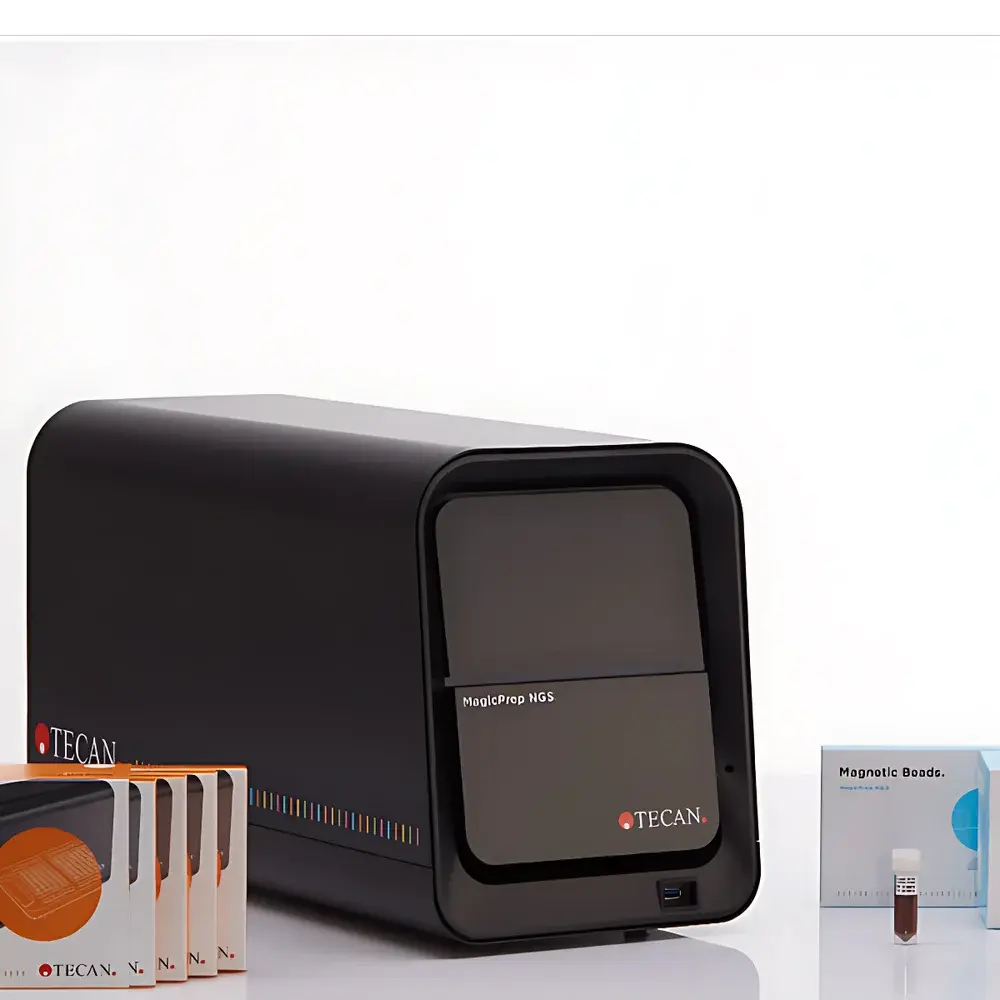
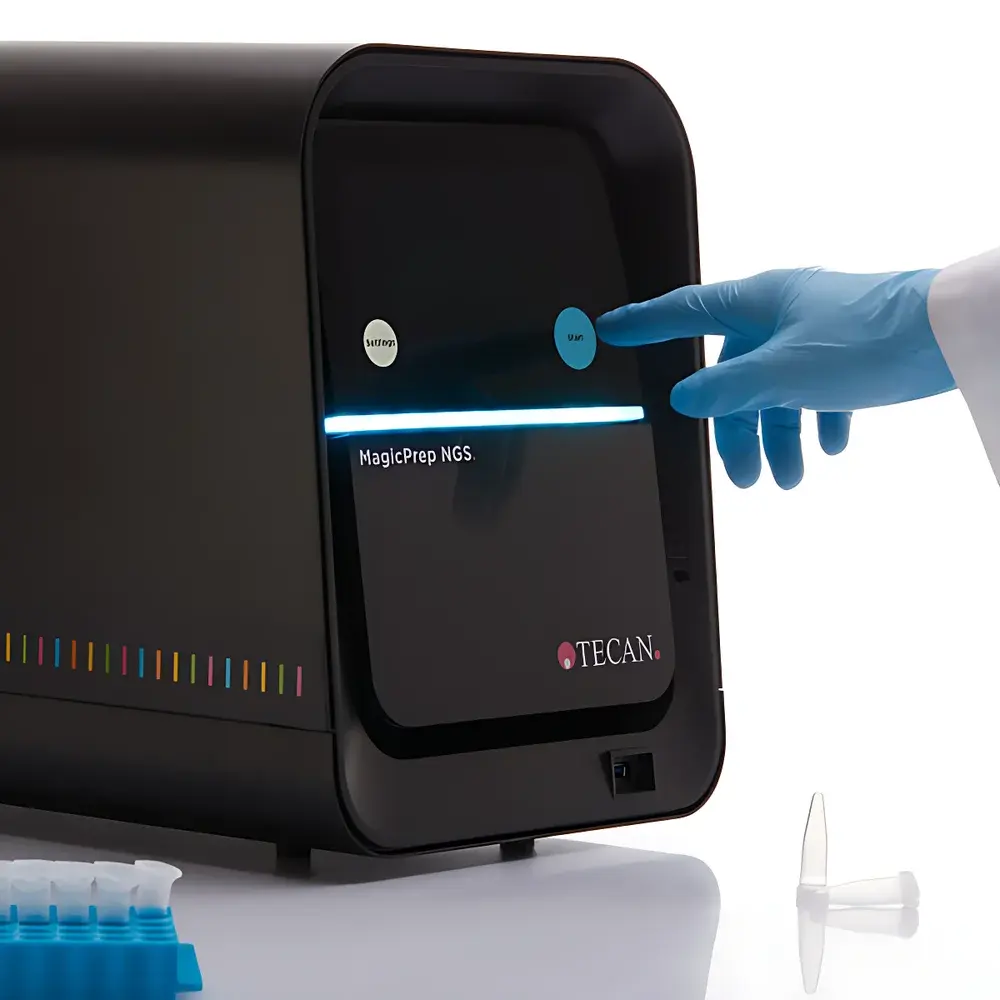
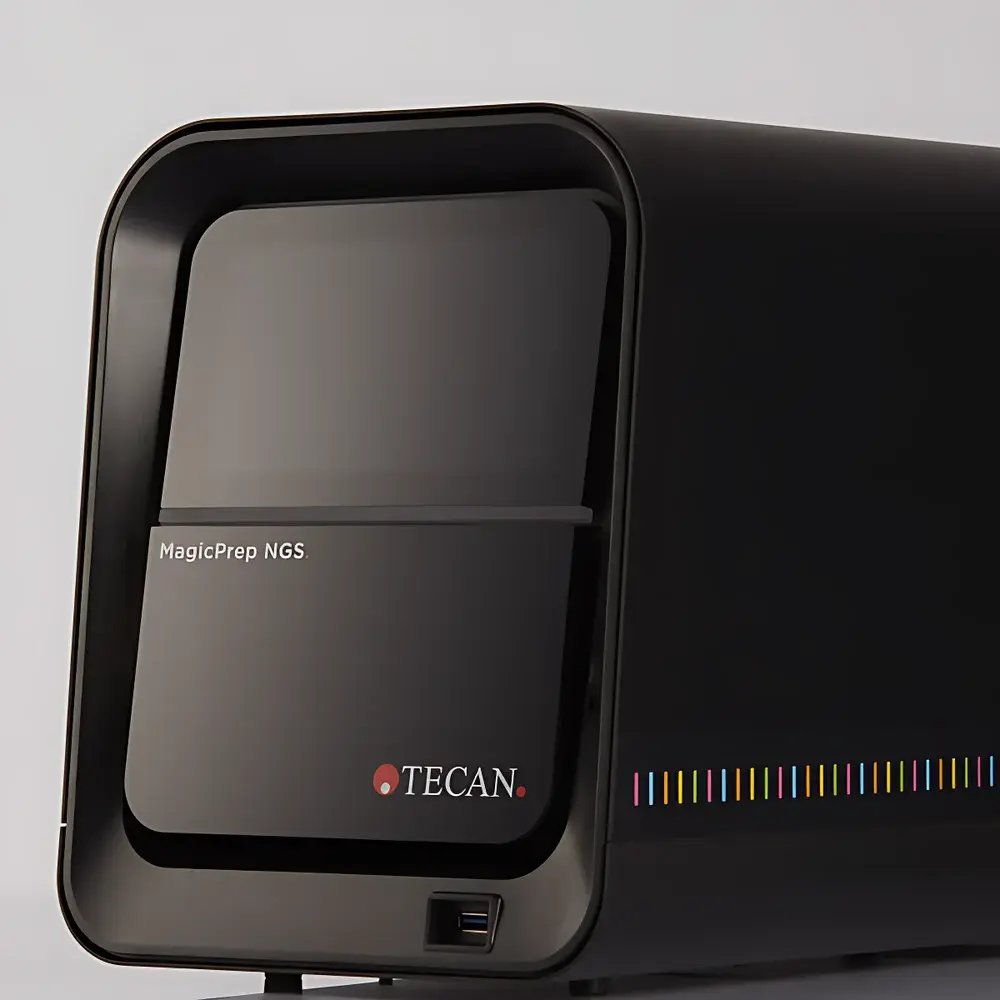
Tecan MagicPrep NGS Fully Automated Library Preparation System
| Brand | Tecan |
|---|---|
| Origin | Austria |
| Model | MagicPrep NGS |
| Intended Use | Research Use Only (RUO) |
| Automation Level | Fully Integrated, Walk-Away Operation |
| Platform Compatibility | Illumina Sequencing Platforms |
| Throughput | Up to 96 samples per run |
| Setup Time | <10 minutes |
| Library Prep Workflow | Fragmentation, End Repair, A-Tailing, Adapter Ligation, PCR Amplification, Cleanup |
| Success Rate | >99% (based on internal validation studies under controlled lab conditions) |
| Regulatory Status | Not for clinical diagnostic use |
| Compliance | Designed in accordance with ISO 13485-aligned quality system principles for RUO instrumentation |
Overview
The Tecan MagicPrep NGS Fully Automated Library Preparation System is an integrated, walk-away platform engineered to perform end-to-end next-generation sequencing (NGS) library construction for Illumina platforms. Leveraging precise liquid handling robotics, thermally controlled reaction modules, and sealed, pre-aliquoted reagent cartridges, the system implements a standardized, closed-tube workflow grounded in established molecular biology principles—including enzymatic fragmentation (tagmentation or mechanical shearing), end repair, A-tailing, adapter ligation, index PCR amplification, and magnetic bead-based purification. Unlike semi-automated benchtop devices requiring manual intervention at multiple steps, MagicPrep NGS eliminates pipetting variability, human transcription errors, and cross-contamination risks by executing all protocol stages within a single, calibrated instrument enclosure. The system operates on a deterministic script-driven architecture, where each reagent cartridge contains lyophilized or stabilized enzymes, buffers, adapters, and cleanup beads—pre-validated for lot-to-lot consistency and compatibility with common input nucleic acid types (genomic DNA, FFPE-derived DNA, cfDNA, and RNA-derived cDNA). Its design prioritizes reproducibility, traceability, and minimal hands-on time, enabling consistent library quality across operators and laboratories.
Key Features
- Fully automated, single-instrument workflow covering fragmentation through final purified library output—no manual transfers or open-tube steps
- Pre-configured, barcode-scanned reagent cartridges containing all consumables required for Illumina-compatible library prep (adapters, enzymes, beads, wash buffers)
- Integrated thermal cycling module supporting dual-temperature PCR profiles with precise ramp rate control and uniform block temperature homogeneity (±0.3°C)
- Onboard magnetic separation station with programmable bead resuspension, binding, washing, and elution cycles optimized for low-volume recovery
- Intuitive touchscreen interface with guided setup wizard, real-time run monitoring, and embedded QC checkpoints (e.g., volume verification, lid closure detection, cartridge recognition)
- Instrument firmware compliant with ALCOA+ data integrity principles; audit trail logs capture user actions, error events, and environmental parameters (e.g., ambient temperature, runtime duration)
Sample Compatibility & Compliance
The MagicPrep NGS system accepts diverse nucleic acid inputs including double-stranded genomic DNA (50 ng–1 µg), formalin-fixed paraffin-embedded (FFPE) DNA (with optional repair module), cell-free DNA (1–100 ng), and cDNA from stranded RNA-seq workflows. Input requirements are validated per application-specific protocols shipped with corresponding reagent kits. All reagents are manufactured under a quality management system aligned with ISO 13485 standards for research-use-only (RUO) products. The system does not require CLIA certification or FDA 510(k) clearance, as it is explicitly designated for non-diagnostic research applications. Data generated meets minimum reporting requirements for publication-grade NGS studies, including FastQ file generation with base-call confidence metrics and adapter-trimming metadata.
Software & Data Management
Control software (MagicPrep Control Suite v3.x) runs on an embedded Linux OS and supports method import/export via encrypted USB drives. Each protocol includes version-controlled scripts with configurable parameters (e.g., cycle number, extension time, bead-to-sample ratio). Raw instrument logs and run reports are exportable in CSV and PDF formats, including timestamps, error codes, and reagent lot traceability. While the system does not natively support 21 CFR Part 11 electronic signature functionality, its audit trail structure facilitates integration into laboratory information management systems (LIMS) that enforce electronic record retention policies. All software updates undergo regression testing against ISO/IEC 17025-aligned validation protocols prior to release.
Applications
- High-throughput whole-genome sequencing (WGS) library preparation for population genomics and biobanking initiatives
- Targeted panel sequencing in oncology research, including hotspot mutation profiling and fusion detection
- Epigenetic analysis workflows such as ChIP-seq, ATAC-seq, and methylation sequencing (with compatible kit variants)
- Single-cell and spatial transcriptomics sample multiplexing using dual-indexed Illumina adapters
- Quality control–driven library prep in core facilities where operator turnover necessitates standardized, training-minimized operation
FAQ
Is the MagicPrep NGS system compatible with non-Illumina sequencing platforms?
No. The system is validated exclusively for Illumina-compatible adapter ligation chemistry and indexing schemes. Library constructs follow Illumina’s TruSeq, Nextera, or IDT for Illumina specifications.
Can users customize library prep protocols beyond the preloaded scripts?
Protocol modification is restricted to parameter-level adjustments (e.g., PCR cycles, incubation times) within the defined script framework. Full de novo protocol development requires Tecan Professional Services engagement and additional validation.
What maintenance is required for long-term operational reliability?
Scheduled preventive maintenance includes quarterly calibration of pipetting accuracy (gravimetric verification), annual thermal block verification, and biannual magnetic separation performance checks—all documented in the service logbook.
Does the system support barcoded sample tracking across runs?
Yes. Sample tube barcodes are scanned during loading; associated metadata (sample ID, project code, operator) is embedded in run reports and exported files, enabling seamless integration with downstream bioinformatics pipelines.



