
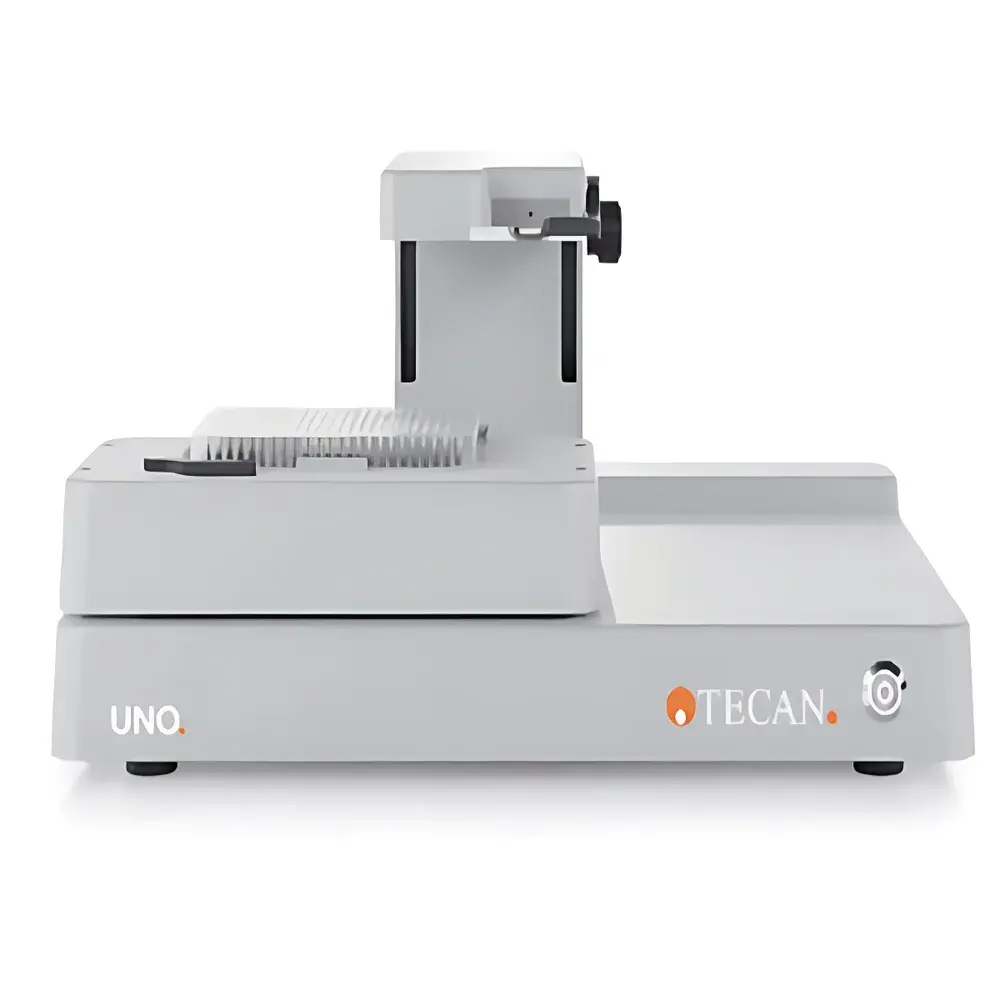
Tecan Uno Single-Cell Dispenser
| Brand | TECAN |
|---|---|
| Origin | USA |
| Model | Uno |
| Type | Fully Automated Benchtop System |
| Sample Volume | 20 µL |
| Throughput | 400 cells per run |
| Temperature Control | Ambient |
Overview
The Tecan Uno Single-Cell Dispenser is a fully automated, benchtop microfluidic platform engineered for high-fidelity, low-stress single-cell isolation and reagent dispensing. It operates on a non-contact, pressure-driven microdispensing principle—leveraging precisely calibrated pneumatic actuation and real-time impedance-based cell detection—to achieve deterministic single-cell loading into standard 384-well or 1536-well plates without droplet generation, fluorescence labeling, or FACS pre-sorting. Unlike traditional flow cytometry or microfluidic chip-based systems, the Uno eliminates shear-induced stress by avoiding hydrodynamic focusing or narrow channel constrictions, thereby preserving native cell viability, membrane integrity, and transcriptional fidelity—critical for downstream scRNA-seq, proteomics, and functional assays.
Key Features
- Fully integrated, walk-away automation: Load sample, define plate map, and initiate run with minimal user intervention; no manual pipetting or alignment required.
- Impedance-based single-cell detection: Real-time electrical sensing ensures accurate identification of viable, intact cells prior to dispensing—rejecting debris, doublets, and lysed cells without optical labels.
- Sub-nanoliter to microliter dispensing precision: Delivers reagents (e.g., lysis buffers, barcoded oligos, enzymes) from 100 pL to 20 µL per well with ≤3% CV across full dynamic range.
- Plate-agnostic compatibility: Supports standard SBS-format plates (96-, 384-, 1536-well), including low-binding, UV-transparent, and PCR-ready variants.
- Ambient operation with passive thermal stability: Designed for consistent performance in controlled laboratory environments (18–25°C); no active heating/cooling subsystems required—reducing complexity and maintenance overhead.
- Modular software architecture: Compatible with Tecan FluentControl™ and third-party LIMS via ASTM E1578-compliant instrument control protocols.
Sample Compatibility & Compliance
The Uno accommodates suspension cells (primary, iPSC-derived, hybridoma, PBMCs), organoid dissociates, and small spheroids (≤50 µm diameter) suspended in common media (e.g., PBS, DMEM/F12, HBSS). It is validated for use with viscous matrices up to 1.5 cP and tolerates moderate particulate load (<5% v/v). From a regulatory standpoint, the system supports GLP- and GMP-aligned workflows: audit trails, electronic signatures, and user-access controls are enabled through optional integration with Tecan’s iNSPIRE™ Software Suite, compliant with FDA 21 CFR Part 11 requirements. All fluidic pathways are constructed from USP Class VI-certified materials, and disposable tips meet ISO 8573-1:2010 Class 2 purity standards for particle and oil content.
Software & Data Management
Instrument control, protocol configuration, and run monitoring are managed via the web-based Uno Control Console—a responsive HTML5 interface accessible from any networked workstation. Protocols are saved as version-controlled JSON files, supporting reproducible setup across labs. Raw impedance traces, dispensing timestamps, and well-level metadata (cell count, volume delivered, detection confidence score) are exported in MIAME- and MIAPE-compliant CSV/TSV formats. The system logs all operator actions, parameter changes, and hardware events in a tamper-evident SQLite database with SHA-256 hashing—enabling full traceability for internal QA review or external audit preparation.
Applications
- Single-cell multi-omics library prep: Direct coupling to scRNA-seq, scATAC-seq, and targeted proteomics workflows requiring live, unsorted input cells.
- iPSC clone isolation and expansion: High-confidence monoclonality verification for master cell bank development under ICH Q5D guidelines.
- 3D model functional screening: Dispensing single tumor spheroids or neural organoids into assay plates for drug response profiling.
- Cell line development: Accelerated single-cell cloning of CHO or HEK293 lines with documented clonality—reducing time-to-clonal outgrowth by >40% versus limiting dilution.
- CRISPR screening validation: Isolation of edited clones post-electroporation without selection markers or antibiotic pressure.
FAQ
Does the Uno require fluorescent labeling or antibody staining for cell detection?
No. It relies exclusively on label-free impedance sensing—eliminating antibody costs, incubation steps, and potential epitope masking.
Can the Uno handle adherent cells?
Only after complete enzymatic or chemical dissociation into single-cell suspension; it does not support direct scraping or detachment-on-plate processing.
What is the maximum allowable cell concentration for reliable detection?
Optimal range is 1 × 10⁵ to 2 × 10⁶ cells/mL; concentrations above 5 × 10⁶/mL may reduce doublet discrimination accuracy due to increased coincidence events.
Is calibration required between runs?
No routine recalibration is needed; system self-validates fluidic integrity and sensor baseline before each run using integrated QC checks.
How is clonality assurance documented for regulatory submissions?
The system generates a timestamped, digitally signed PDF report per plate—including impedance waveform snapshots, dispensing log, and well-by-well cell assignment—exportable as part of a Biologics License Application (BLA) or IND dossier.
Related Products




