
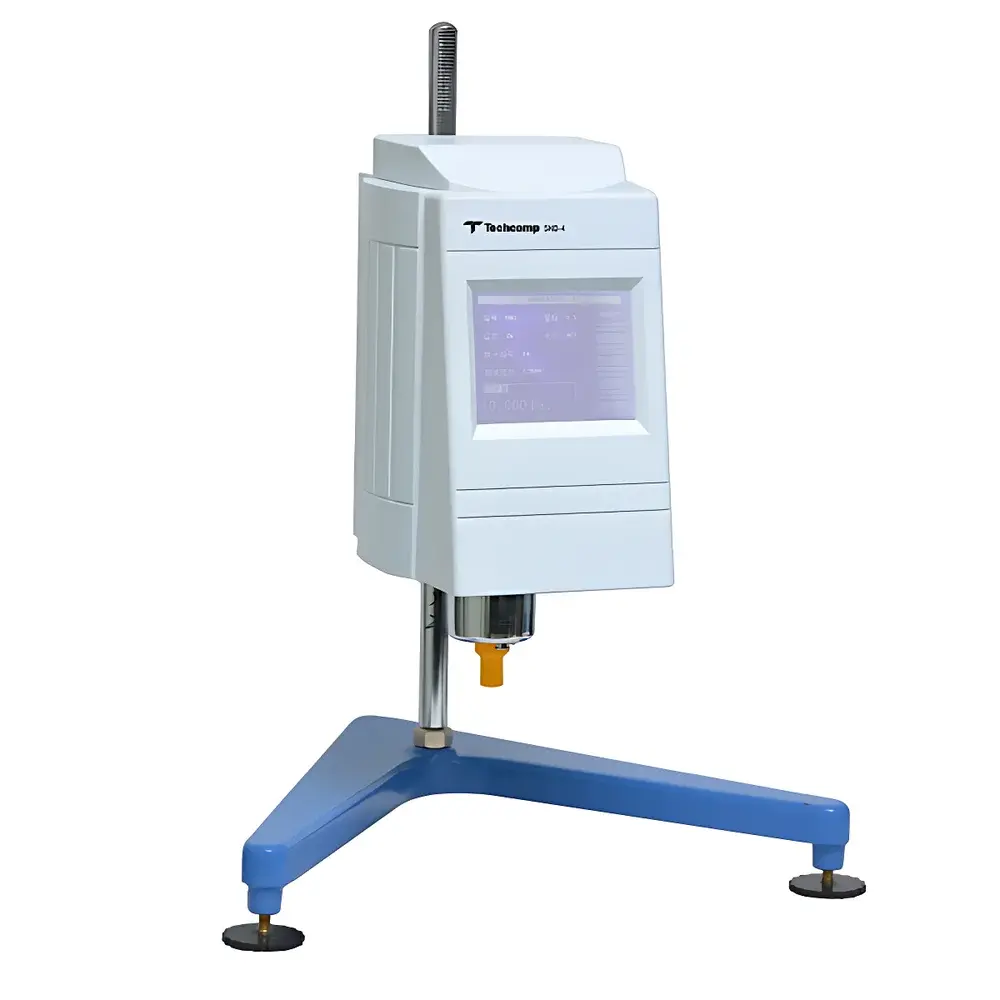
Techcomp SNB-3/SNB-4 Advanced Touchscreen Digital Rotational Viscometer
| Brand | Techcomp |
|---|---|
| Origin | Shanghai, China |
| Manufacturer Type | Direct Manufacturer |
| Instrument Type | Rotational Viscometer |
| Model | SNB-3 / SNB-4 (Color Touchscreen) |
| Viscosity Range | 1–2,000,000 mPa·s |
| Control System | MCS-51 Microcontroller-Based Stepper Motor Drive |
| Display | Full-Color TFT Touchscreen Interface |
Overview
The Techcomp SNB-3 and SNB-4 are microprocessor-controlled rotational viscometers engineered for precise, repeatable measurement of dynamic viscosity in Newtonian and mildly non-Newtonian fluids. Based on the principle of Couette flow—where torque required to rotate a spindle at controlled angular velocity within a stationary fluid is directly proportional to its shear viscosity—these instruments deliver calibrated absolute viscosity values (in mPa·s or cP) across six orders of magnitude. Designed for routine QC laboratories, R&D facilities, and production environments, the SNB series implements a robust stepper motor drive system governed by an MCS-51 microcontroller architecture, ensuring stable rotational speed control, minimal thermal drift, and high reproducibility under ambient operating conditions (10–35 °C, ≤80% RH). Unlike capillary or falling-ball viscometers, rotational systems provide direct access to shear-dependent rheological behavior, enabling consistent comparison across batch-to-batch quality checks and formulation development workflows.
Key Features
- Full-color 4.3-inch TFT capacitive touchscreen interface with intuitive icon-driven navigation and real-time graphical display of viscosity vs. time or shear rate
- Integrated microcontroller-based speed regulation delivering 18 preset rotational speeds (0.3–100 rpm) with ±0.2% speed accuracy and <0.5% torque linearity deviation
- Modular spindle system compliant with ISO 2555 and ASTM D2196 standards; includes LV, RV, and HA spindles (L-type geometry) for broad range coverage
- Automatic zero calibration and temperature compensation algorithms (with optional external Pt100 probe input)
- Self-diagnostic firmware with error logging, spindle identification verification, and over-torque protection
- Compact benchtop footprint (220 × 280 × 450 mm) and low power consumption (<15 W), suitable for shared lab spaces and mobile testing stations
Sample Compatibility & Compliance
The SNB-3/SNB-4 supports liquid and semi-liquid samples with yield stress below ~10 Pa and relaxation times compatible with steady-state shear measurement protocols. Typical applications include edible oils, polymer solutions, pharmaceutical suspensions, water-based paints, cosmetic emulsions, and adhesive preforms. All mechanical and electrical design elements conform to IEC 61010-1:2010 safety requirements for laboratory equipment. While the instrument itself does not carry CE or UL certification out-of-box (as supplied for domestic Chinese market distribution), its hardware architecture and signal conditioning circuits meet EMC Class B immunity thresholds and support third-party validation for GLP-compliant environments. Data output formats (CSV, TXT) are compatible with LIMS integration and satisfy basic traceability requirements per ISO/IEC 17025:2017 Clause 7.7.
Software & Data Management
Data acquisition and reporting are managed via embedded firmware without dependency on PC software. All measurements—including viscosity, shear rate, shear stress, and % torque—are timestamped and stored internally (up to 500 test records). Export is supported via USB 2.0 port to FAT32-formatted flash drives. The touchscreen UI enables user-defined test templates, pass/fail threshold configuration, and statistical summary (mean, SD, CV%) per sample group. Though native support for FDA 21 CFR Part 11 electronic signatures or audit trail generation is not implemented, raw data files contain unalterable metadata (operator ID, date/time stamp, spindle ID, RPM setting), facilitating manual audit readiness when deployed within documented QA procedures.
Applications
- Quality control of lubricating oils and transformer fluids per ASTM D445
- Batch release testing of topical gels and ointments in pharmaceutical manufacturing
- Rheological profiling of starch-thickened sauces and dairy alternatives during food product development
- Viscosity grading of architectural coatings prior to spray application
- Stability assessment of colloidal silica dispersions in semiconductor slurry formulations
- Educational demonstrations of Newtonian fluid behavior and shear-thinning response in university physics and chemical engineering labs
FAQ
What spindle configurations are included with the SNB-3 and SNB-4 models?
The standard configuration includes three L-type spindles (LV-1, LV-2, LV-3) optimized for low-viscosity ranges; optional RV and HA spindles are available separately for higher torque applications.
Is temperature control integrated into the instrument?
No—temperature regulation requires external water baths or Peltier accessories; however, the unit accepts analog input from third-party Pt100 sensors for manual compensation entry.
Can the SNB series perform yield stress estimation?
It does not support ramped shear rate sweeps or oscillatory modes; yield point determination must be conducted via multi-point steady-shear analysis and extrapolation using external software.
Does the device support GLP-compliant data archiving?
While full 21 CFR Part 11 compliance is not built-in, the immutable CSV log format and operator-tagged records enable alignment with GLP documentation practices when paired with controlled file management protocols.
What maintenance intervals are recommended for long-term accuracy?
Annual verification against NIST-traceable silicone oil standards (e.g., Cannon N47, N1000) is advised; spindle shaft alignment and bearing inspection should occur every 24 months under continuous operation.



