
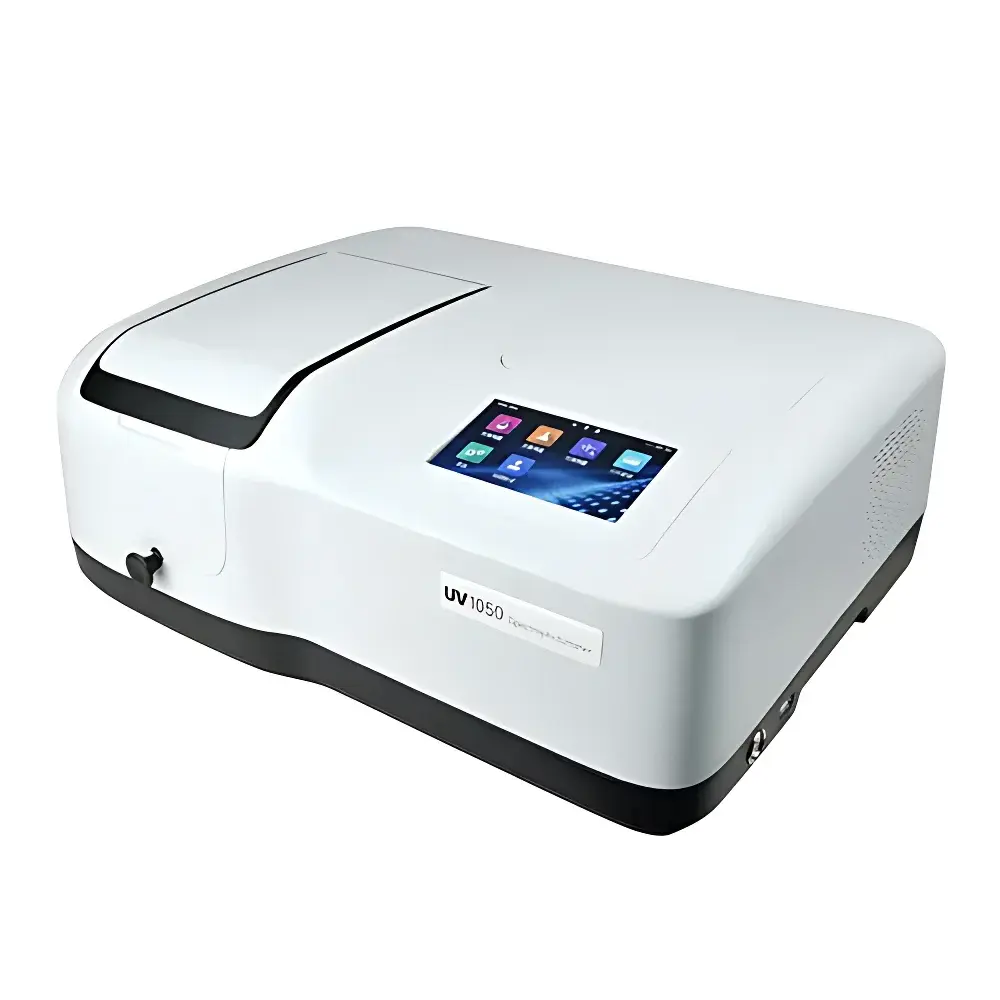
Techcomp UV1050 Single-Beam Ultraviolet-Visible Spectrophotometer
| Brand | Techcomp |
|---|---|
| Origin | Shanghai, China |
| Manufacturer Type | Direct Manufacturer |
| Instrument Structure | Single-Beam |
| Detector Type | Photocell |
| Wavelength Range | 190–1100 nm |
| Wavelength Accuracy | ±0.5 nm |
| Wavelength Repeatability | ≤0.2 nm |
| Spectral Bandwidth | 2 nm |
| Stray Light | ≤0.05% T |
| Automation Level | Automatic Wavelength Scanning |
| Display | 5-inch TFT Color Touchscreen |
| Optical Platform | Integrated Die-Cast Optical Base |
| Compliance | Designed for GLP-compliant routine analysis |
| Connectivity | USB and RS-232 interfaces for PC control and printer output |
Overview
The Techcomp UV1050 is a single-beam ultraviolet-visible (UV-Vis) spectrophotometer engineered for precision, stability, and operational simplicity in routine laboratory environments. It operates on the fundamental principle of Beer–Lambert law-based absorbance measurement, where sample transmittance or absorbance is quantified across a continuous spectral range from 190 nm to 1100 nm—covering deep UV through near-infrared. Its optical architecture features a fixed grating monochromator with a high-stability tungsten-halogen and deuterium dual-lamp system, enabling seamless spectral coverage without manual lamp switching. The instrument employs a silicon photocell detector optimized for signal-to-noise ratio and long-term responsivity stability. Designed for educational institutions, QC laboratories, and research support facilities, the UV1050 delivers reproducible photometric performance under ambient lab conditions without requiring temperature-controlled enclosures or vibration isolation.
Key Features
- 5-inch high-resolution TFT color touchscreen interface with intuitive icon-driven navigation—enabling direct method selection, spectrum acquisition, kinetic scanning, and quantitative analysis without external software.
- Integrated die-cast aluminum optical platform minimizes mechanical drift and thermal expansion effects, contributing to long-term wavelength stability and photometric repeatability.
- Refined wavelength drive mechanism utilizing precision stepper motor and optical encoder feedback ensures ≤0.2 nm wavelength repeatability and ±0.5 nm absolute accuracy—verified per ISO 8579-1 and ASTM E275 calibration protocols.
- Automatic self-calibration at power-on includes wavelength verification using holmium oxide and neutral density filters, followed by photometric zero and baseline correction routines.
- Corrosion-resistant cuvette holder with integrated spill containment channel and drainage port prevents electrolyte or organic solvent damage to internal optics and electronics—even during accidental overfilling or leakage.
- Preheat countdown timer displayed in real time improves user workflow planning and ensures optimal thermal equilibrium prior to measurement initiation.
Sample Compatibility & Compliance
The UV1050 accommodates standard 10 mm pathlength quartz, glass, or plastic cuvettes (including matched pairs for reference/sample dual-beam emulation via sequential measurement). It supports liquid, solution-phase samples only; solid or turbid suspensions require filtration or dilution to maintain optical clarity within the 0.05% T stray light specification. The instrument meets essential requirements for ISO/IEC 17025-accredited testing labs when operated within defined environmental conditions (20–25 °C, <65% RH, non-condensing). Its firmware architecture supports audit-ready operation: all measurement events—including date/time stamp, operator ID (via optional login module), method parameters, and raw absorbance values—are internally logged. While not FDA 21 CFR Part 11–certified out-of-the-box, its data export functionality (CSV, TXT) enables traceable integration into validated LIMS or ELN systems compliant with GLP/GMP documentation standards.
Software & Data Management
The UV1050 operates autonomously via embedded firmware but also supports bidirectional communication with Techcomp’s UVWin software (Windows 10/11 compatible) via USB or RS-232. This desktop application enables advanced spectral processing—including first- and second-derivative analysis, peak identification, multi-wavelength quantitation, and calibration curve generation with linear/nonlinear regression (R² reporting). All spectra and reports can be exported in machine-readable formats for regulatory submission or peer-reviewed publication. Printer connectivity (via parallel or USB thermal printers) allows immediate hardcopy output of spectra, tables, and QA/QC logs—critical for teaching labs and production line verification.
Applications
The UV1050 serves as a foundational analytical tool across diverse sectors requiring reliable UV-Vis quantification. In academic settings, it supports undergraduate chemistry and biochemistry curricula—including enzyme kinetics (e.g., NADH oxidation at 340 nm), DNA/RNA purity assessment (A260/A280 ratios), and dye concentration determination. In clinical and diagnostic labs, it performs serum bilirubin, creatinine, and uric acid assays following standardized colorimetric protocols (e.g., Jaffe reaction). Environmental labs use it for nitrate/nitrite detection in water (via diazotization), while quality control teams in pharmaceuticals apply it for active ingredient assay validation per USP . Its 2 nm spectral bandwidth and low stray light (<0.05% T at 220 nm) ensure compliance with pharmacopeial resolution requirements for overlapping peaks in complex mixtures.
FAQ
What is the maximum scan speed for full-spectrum acquisition (190–1100 nm)?
The UV1050 performs full-range scanning at 120 nm/min with 1 nm data interval—optimized for balance between resolution and throughput in routine QC workflows.
Can the instrument store methods and calibration curves internally?
Yes—up to 200 user-defined methods and 100 calibration curves can be saved in non-volatile memory, independent of PC connection.
Is quartz cuvette mandatory for measurements below 240 nm?
Yes—standard optical glass absorbs strongly below 350 nm; fused silica quartz cuvettes are required for accurate data acquisition in the UV-C and UV-B regions (190–240 nm).
Does the UV1050 support kinetic time-course measurements?
Yes—it offers programmable kinetic mode with adjustable sampling intervals (0.1–600 seconds) and up to 5,000 data points per run, suitable for monitoring enzymatic reactions or chemical degradation processes.
How often should wavelength and photometric calibration be performed?
Wavelength calibration using holmium oxide reference is recommended before each daily session or after transport; photometric verification with neutral density filters is advised weekly or after any maintenance event.





