
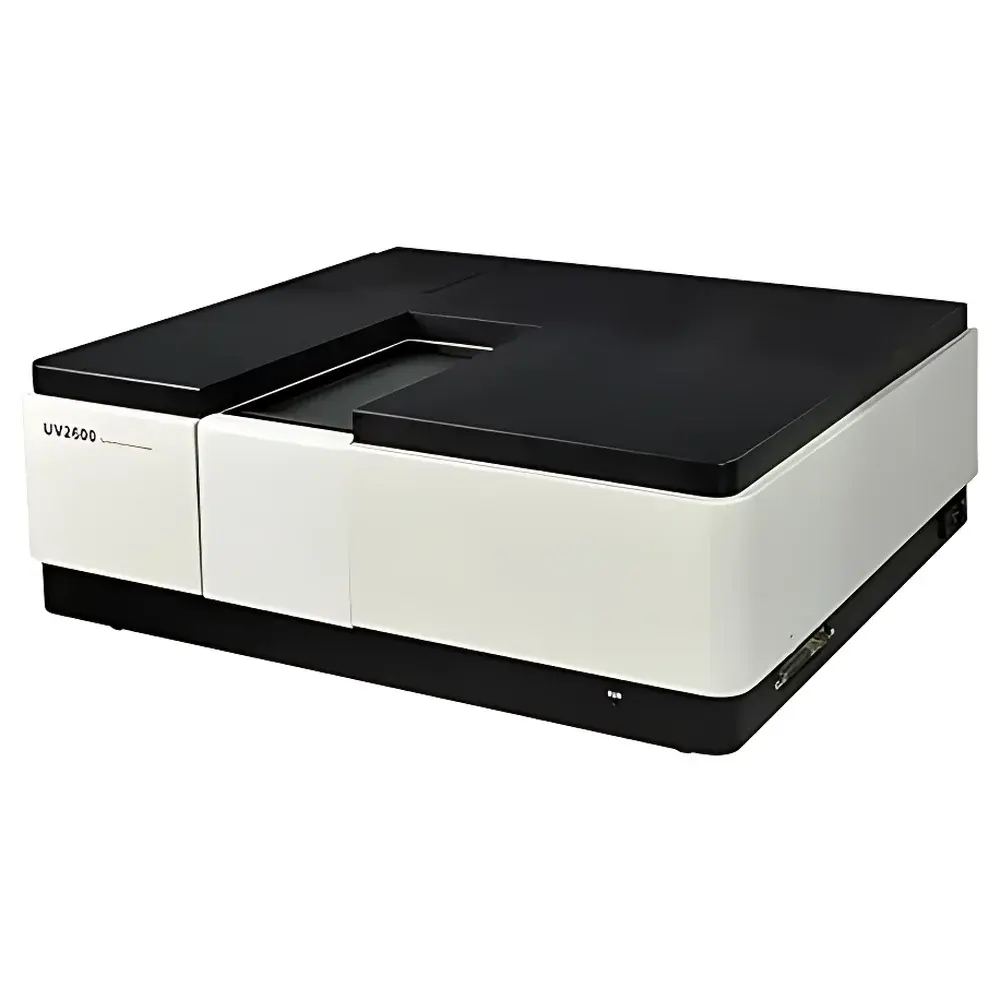
Techcomp UV2600 Dual-Beam Ultraviolet-Visible Spectrophotometer
| Brand | Techcomp |
|---|---|
| Origin | Shanghai, China |
| Manufacturer Type | Direct Manufacturer |
| Regional Classification | Domestic (China) |
| Model | UV2600 |
| Price Range | USD 9,800–13,900 (FOB Shanghai) |
| Optical Design | Dual-beam |
| Detector | Photomultiplier Tube (PMT) |
| Wavelength Range | 190–900 nm |
| Wavelength Scanning | Motorized, Software-Controlled |
| Spectral Bandwidth | 0.2, 0.5, 1, 2, 5 nm (Auto-Selectable) |
| Wavelength Accuracy | ±0.3 nm |
| Wavelength Repeatability | ±0.1 nm |
| Stray Light | <0.010% T (at 220 nm, NaI |
Overview
The Techcomp UV2600 is a high-performance dual-beam ultraviolet-visible (UV-Vis) spectrophotometer engineered for precision absorbance, transmittance, and reflectance measurements across the 190–900 nm spectral range. Based on Czerny-Turner monochromator architecture with extended focal length optics, the instrument delivers exceptional optical resolution and ultra-low stray light—critical for accurate quantitation of highly absorbing or dilute samples. Its pulse-modulated dual-beam design employs a single light source and a single PMT detector, splitting the beam dynamically via a rotating mirror to simultaneously measure sample and reference paths. This architecture eliminates inter-channel variability inherent in traditional dual-detector systems and ensures superior baseline stability over extended acquisition periods (e.g., kinetic assays or temperature-controlled scans). The UV2600 is designed for routine QC laboratories, academic research facilities, and method development environments where reproducibility, regulatory traceability, and operational robustness are mandatory.
Key Features
- Dual-beam optical path with pulse-modulated beam switching—enables real-time background correction without mechanical shutter wear or photodetector saturation.
- High-sensitivity photomultiplier tube (PMT) detector optimized for low-light signal detection across UV and visible regions, supporting high dynamic range (up to 3.5 A absorbance units).
- Five programmable slit widths (0.2–5 nm) automatically selected by software to balance resolution and signal-to-noise ratio per analytical requirement.
- Long-focal-length C-T monochromator with holographic grating—reduces aberrations and achieves <0.010% T stray light at key validation wavelengths (220 nm NaI, 340/360 nm NaNO₂), enabling reliable measurement of concentrated protein solutions or colored dyes.
- Integrated deuterium and tungsten-halogen lamps with automatic source switching—no manual alignment required during lamp replacement; lamp lifetime monitored and reported via software diagnostics.
- Real-time photometric calibration using built-in neutral density filters—eliminates need for external standards during daily verification, supporting GLP-compliant workflow efficiency.
Sample Compatibility & Compliance
The UV2600 accommodates standard 10-mm square cuvettes (quartz, glass, or plastic), micro-volume cells (down to 50 µL pathlength), and optional accessories including a thermostatted 6-position auto-sampler, Peltier-controlled cell holder (±0.1 °C stability), and integrating sphere for diffuse reflectance. All hardware and firmware comply with IEC 61010-1 safety standards and electromagnetic compatibility (EMC) Directive 2014/30/EU. Software functionality supports audit trail generation, electronic signature capability (per FDA 21 CFR Part 11 Annex 11 requirements), and customizable instrument qualification protocols aligned with ISO/IEC 17025 and USP . Routine performance verification follows ASTM E275 and ISO 6060 methodologies.
Software & Data Management
Controlled exclusively via UV Analyst v3.x software (Windows 10/11 compatible), the UV2600 provides modular operation across five core modules: Photometric Mode (single/multi-wavelength), Spectrum Scan (full-range or user-defined), Quantitative Analysis (1–5 point calibration, coefficient-based, or Beer-Lambert regression), Kinetic Mode (time-resolved monitoring up to 999 data points/sec), and Biomolecular Analysis (A260/A280 ratio, DNA/RNA concentration, protein extinction coefficient calculation). Raw spectral data are stored in vendor-neutral CSV and JCAMP-DX formats. Software enforces role-based access control, versioned method storage, and automated report generation with embedded metadata (operator ID, timestamp, instrument serial number, calibration status). All data modifications trigger immutable audit logs with time-stamped entries.
Applications
- Pharmaceutical QA/QC: Assay of active pharmaceutical ingredients (APIs), excipient purity screening, dissolution testing per USP .
- Environmental analysis: Nitrate/nitrite quantification in water (EPA Method 353.2), COD determination, heavy metal complexation studies.
- Life sciences: Nucleic acid quantification (dsDNA, ssDNA, RNA), protein concentration (Bradford/Lowry/Biuret), enzyme kinetics (e.g., LDH, ALP), cell culture density monitoring (OD600).
- Materials science: Thin-film thickness estimation via interference fringe analysis, bandgap determination of semiconductors, dye degradation kinetics under UV irradiation.
- Food & beverage: Colorimetric assessment (browning index, anthocyanin content), preservative (sorbate/benzoate) quantitation, vitamin C stability profiling.
FAQ
Does the UV2600 support compliance with FDA 21 CFR Part 11?
Yes—UV Analyst software includes configurable electronic signatures, audit trail logging, and secure user authentication, meeting core technical requirements for regulated environments.
What is the minimum sample volume required for standard cuvette measurements?
1 mL in a 10-mm pathlength quartz cuvette; optional micro-cuvettes enable analysis with as little as 50 µL.
Can the instrument perform simultaneous multi-wavelength kinetic assays?
Yes—up to 10 user-defined wavelengths can be monitored concurrently during time-scan mode with synchronized data acquisition.
Is wavelength calibration traceable to NIST standards?
Factory calibration uses NIST-traceable holmium oxide and didymium oxide filters; users may perform requalification using certified reference materials.
How often does the deuterium lamp require replacement under typical usage?
Rated for ≥2,000 hours; software tracks cumulative lamp-on time and alerts operators when replacement is recommended.






