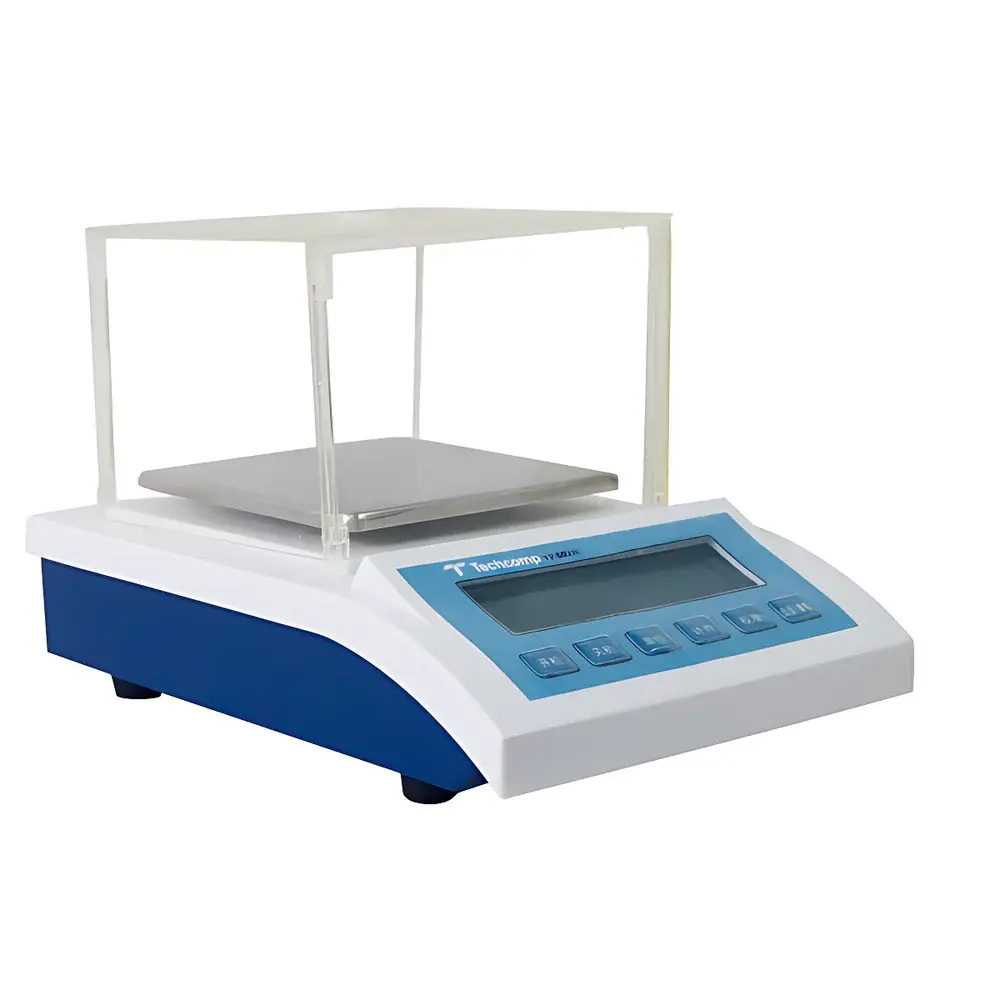
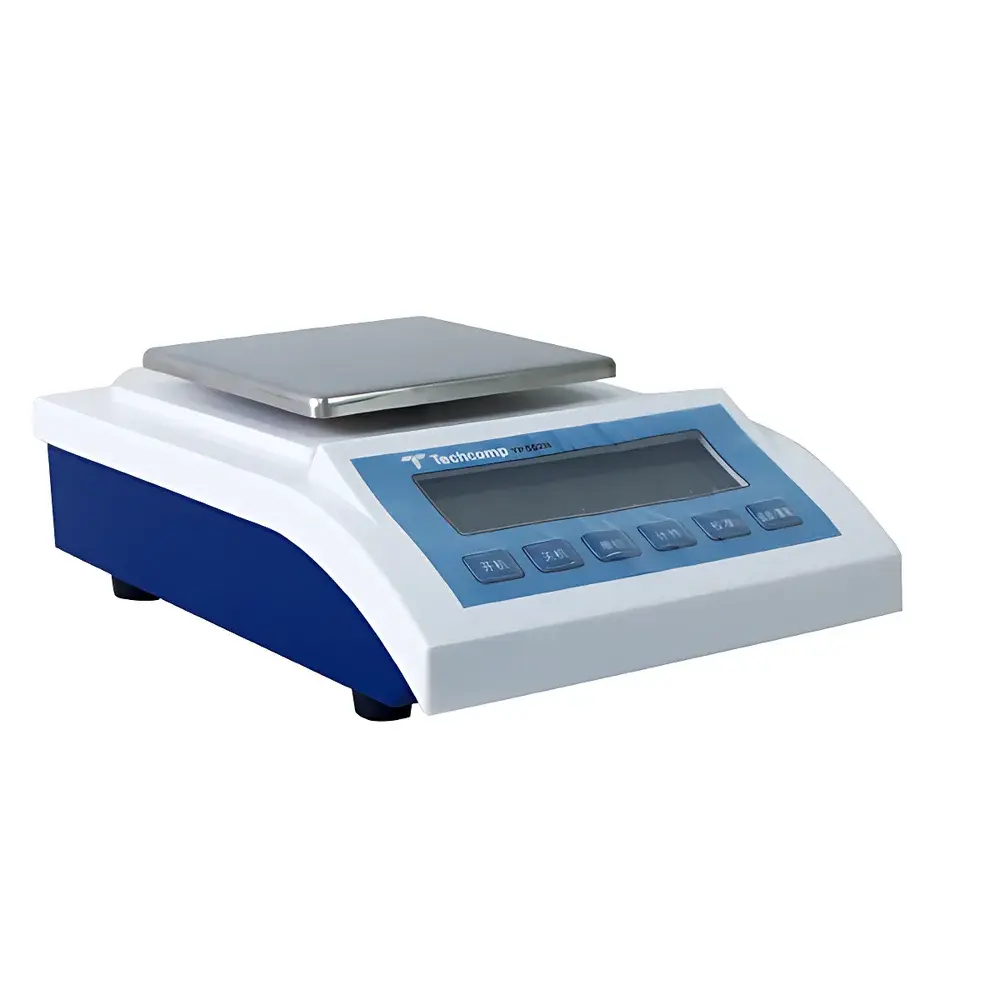
Techcomp YP-N Series Precision Electronic Balance
| Brand | Techcomp |
|---|---|
| Origin | Shanghai, China |
| Manufacturer | Techcomp (formerly Jingke/Shangping) |
| Type | Precision Balance |
| Maximum Capacity | 1000 g |
| Readability | 0.01 g |
| Repeatability | 0.01 g |
| Calibration | External |
| Linearity Compensation | Multi-point Linear Calibration |
| Drift Compensation | Yes |
| Construction | SMT-assembled PCB with SMD components |
| Display | LCD, low-power |
| Interface | RS232C (optional) |
| Operating Mode | Portable |
| Functions | Accumulation, Piece Counting, Tare, Unit Conversion, Error Alert |
Overview
The Techcomp YP-N Series Precision Electronic Balance is an entry-level yet robust analytical-grade weighing instrument engineered for routine laboratory, educational, and light industrial applications requiring reliable mass measurement at 0.01 g readability. Based on electromagnetic force compensation (EMFC) transduction technology, the YP-N series delivers stable and repeatable results under variable environmental conditions—critical for tasks such as sample preparation, reagent dispensing, quality control checks, and student laboratory instruction. Designed and manufactured in Shanghai by Techcomp—a leading Chinese scientific instrument OEM formerly known as Jingke and Shangping—the balance integrates mature hardware architecture with fundamental metrological rigor. Its compact form factor, low power consumption, and portable deployment capability make it suitable for benchtop use, field laboratories, teaching labs, and mobile quality assurance workflows where space and energy efficiency are prioritized without compromising traceable accuracy.
Key Features
- Electromagnetic force compensation sensor with high linearity and thermal stability, ensuring consistent performance across ambient temperature fluctuations.
- Multi-point linear calibration routine supported via external standard weights—enabling users to correct for nonlinearity across the full 1000 g capacity range.
- Integrated drift compensation algorithm that dynamically adjusts zero tracking during extended operation, minimizing baseline drift due to mechanical relaxation or thermal equilibration.
- SMT (Surface Mount Technology) assembly with SMD (Surface-Mount Device) components throughout the main PCB, enhancing long-term reliability, vibration resistance, and solder joint integrity.
- Low-power LCD display with high-contrast alphanumeric characters—optimized for readability under varied lighting conditions and extended battery or AC adapter operation.
- Standard operational functions including tare, accumulation, piece counting (with user-defined unit weight), unit conversion (g, oz, ct, etc.), and audible/visual fault alerts for overload, instability, or calibration error.
Sample Compatibility & Compliance
The YP-N Series accommodates a wide variety of sample types—including powders, granules, liquids in containers, solid specimens, and packaged materials—within its 1000 g maximum load capacity and 120 mm diameter stainless steel weighing pan. While not certified for Class I or II legal-for-trade applications, the balance meets general-purpose laboratory requirements aligned with ISO 9001 quality management systems and supports GLP-compliant documentation when paired with RS232C output and compatible data logging software. Its external calibration protocol conforms to common metrological practices outlined in ASTM E898–22 (Standard Guide for Selection and Use of Laboratory Balances) and supports traceability to national standards through NIST-traceable weights. The device is not intended for hazardous environments or intrinsically safe applications.
Software & Data Management
An optional RS232C serial interface enables bidirectional communication with PCs, LIMS, or custom data acquisition platforms. When connected, the balance transmits real-time weight readings, status flags (e.g., stable, unstable, overload), and function identifiers (e.g., tare applied, count mode active) using ASCII-based protocols with configurable baud rates (9600 default). No proprietary driver is required; standard terminal emulators or Excel-based macros can capture and timestamp measurements. While the YP-N does not include built-in audit trail or electronic signature functionality, its deterministic output format supports integration into 21 CFR Part 11–compliant workflows when deployed with validated third-party software and documented procedural controls.
Applications
- Educational laboratories: Supporting undergraduate chemistry, biology, and physics curricula involving stoichiometric calculations, solution preparation, and comparative mass analysis.
- Pharmaceutical QA/QC: Weighing excipients, tablets, and raw materials during pre-formulation and batch release testing where ±0.01 g tolerance is sufficient.
- Food and agriculture labs: Measuring feed additives, seed samples, or moisture loss in drying studies.
- Environmental testing facilities: Preparing soil or water samples for digestion and instrumental analysis (e.g., ICP-OES, AAS).
- Maintenance and calibration labs: Serving as a reference standard for verifying lower-accuracy scales or verifying calibration weights prior to formal certification.
FAQ
What is the recommended calibration frequency for the YP-N Series?
Calibration should be performed before first use, after relocation, following significant ambient temperature changes (>5 °C), and at least once per shift in regulated environments. External calibration with certified weights traceable to national standards is mandatory.
Does the YP-N Series support internal calibration?
No—it relies exclusively on external calibration using standard weights. Internal motorized calibration mechanisms are not included in this series.
Can the balance operate on battery power?
Yes—its low-power design supports operation via optional rechargeable or alkaline batteries, enabling true portability without AC dependency.
Is the RS232C interface included by default?
No—the RS232C port is an optional configuration. Units shipped without this interface require hardware modification or replacement to enable serial output.
What is the warm-up time required for optimal accuracy?
A minimum 30-minute stabilization period is recommended after power-on to allow thermal equilibrium of the EMFC sensor and internal circuitry.