
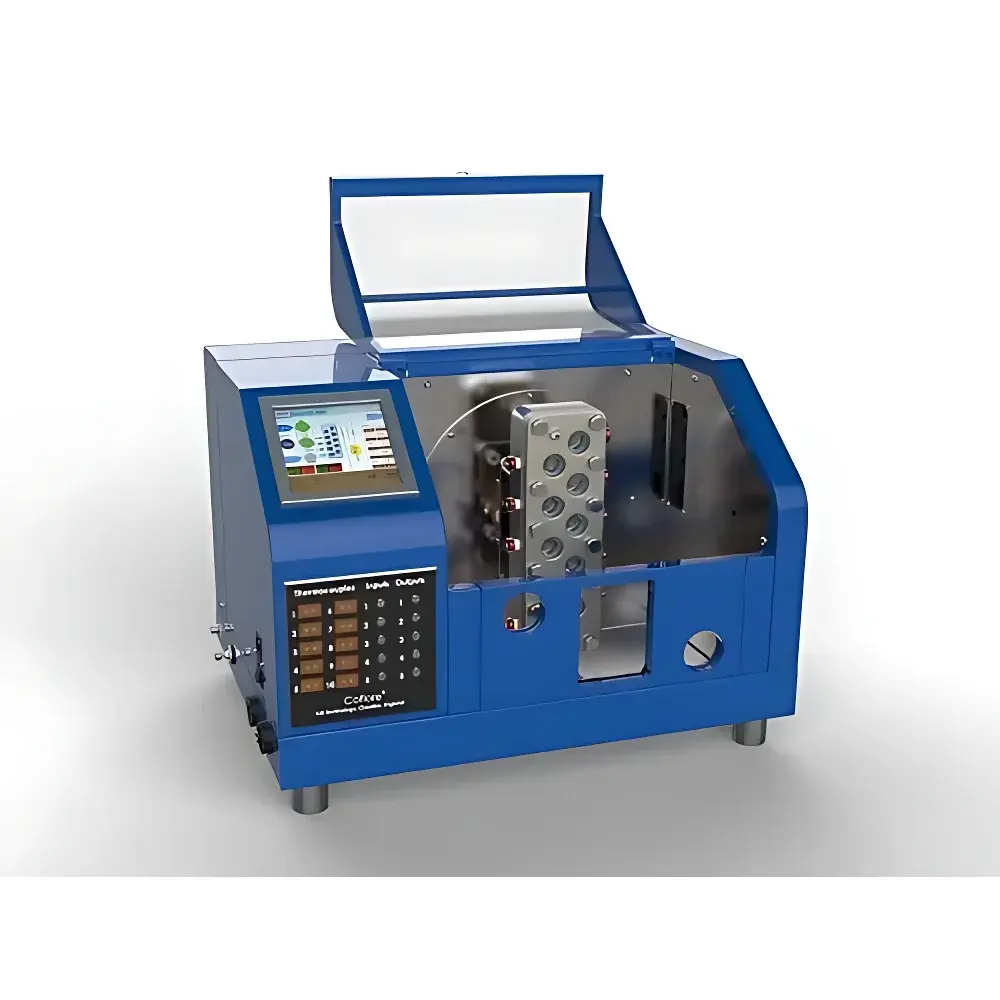
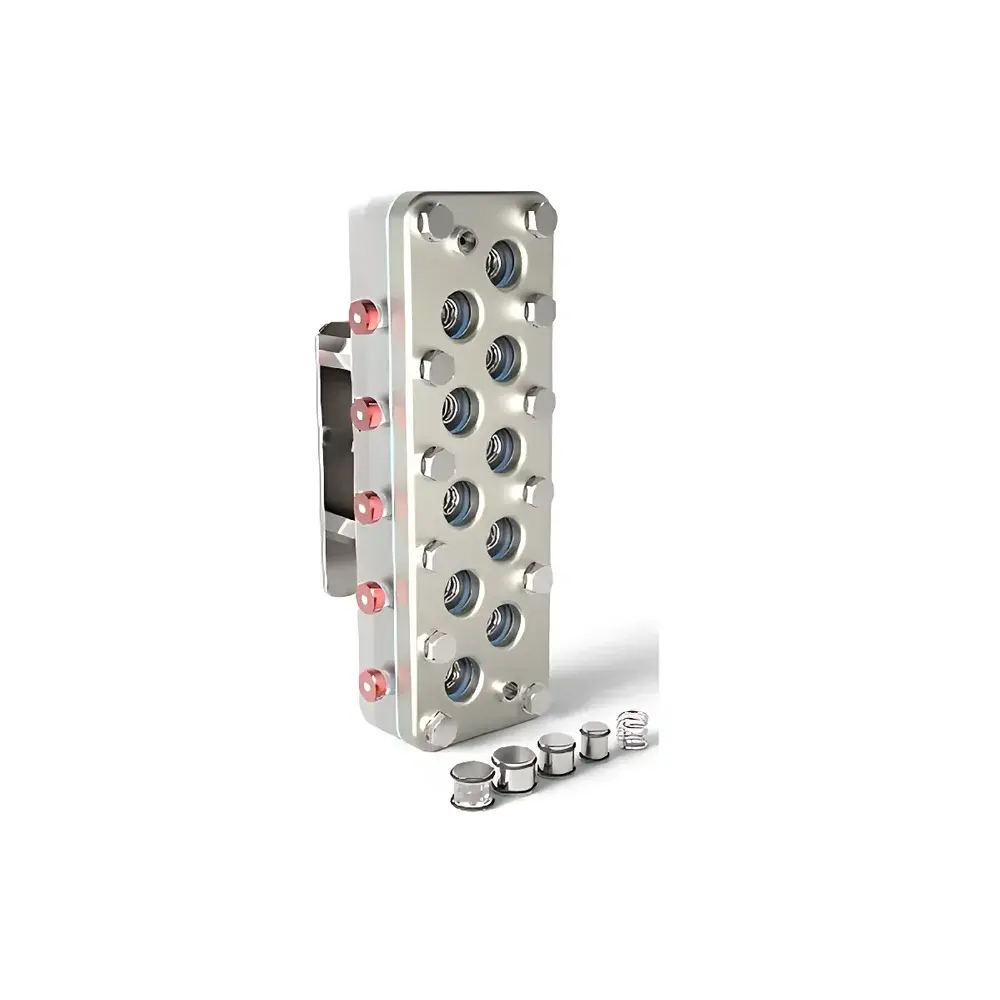
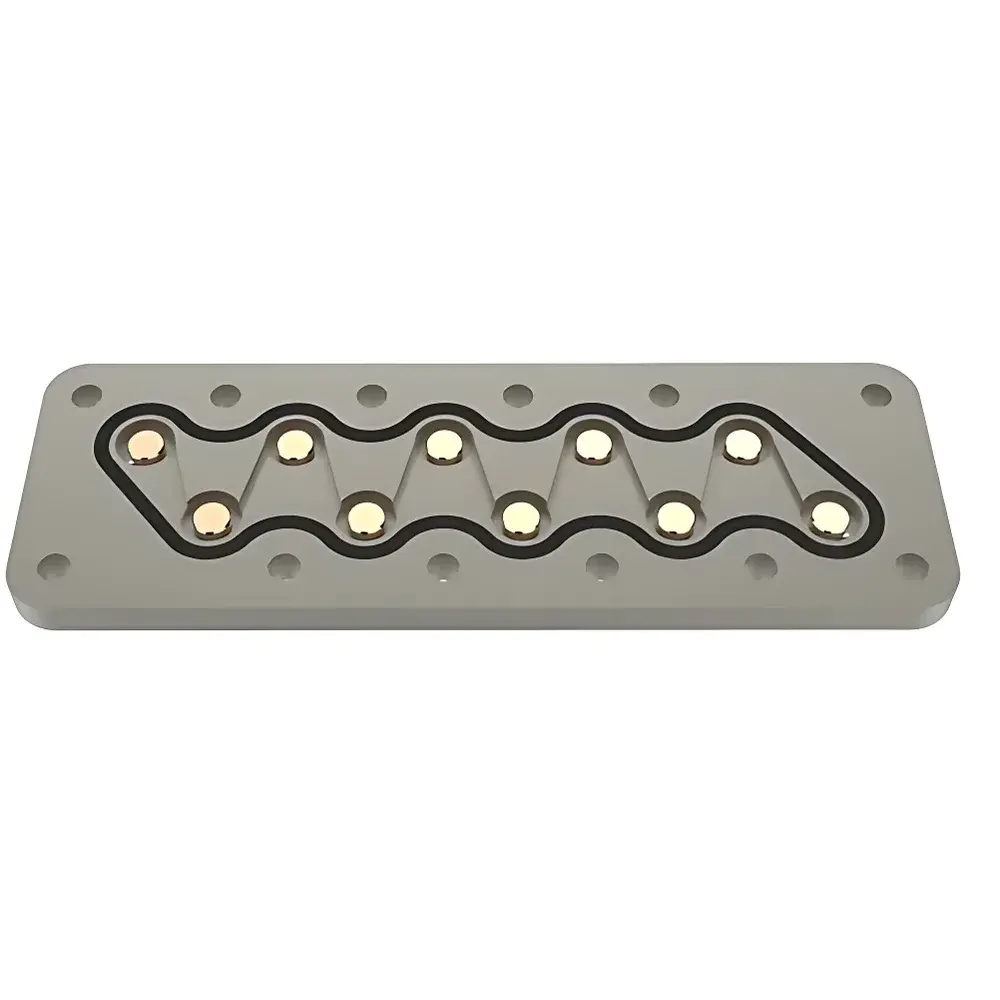
AM Technology Coflore ACR-P200 Continuous Multistage Agitated Flow Reactor
| Brand | AM Technology |
|---|---|
| Origin | United Kingdom |
| Model | ACR-P200 |
| Reactor Type | Continuous Multistage Agitated Flow Reactor |
| Number of Stages | 10 |
| Total Reaction Volume | 100 mL (10 × 10 mL per stage) |
| Flow Rate Range | 8–80 mL/min |
| Residence Time Range | 30 s to several hours |
| Temperature Range | −40 °C to +140 °C |
| Operating Pressure | 0–10 bar |
| Wetted Materials | Hastelloy, PTFE, FFKM, Ceramic |
| Agitation Mechanism | Lateral oscillation-driven magnetic stir-bar motion |
| Heat Exchange | Integrated stage-matched thermal plates with independent coolant channels |
| Control Interface | Digital PID control, real-time data logging, remote Ethernet/OPC UA connectivity |
| Compliance | Designed for GLP-compliant process development environments |
Overview
The AM Technology Coflore ACR-P200 is a benchtop-scale, continuous multistage agitated flow reactor engineered for rigorous kinetic and mass-transfer investigation in multiphase reaction systems. Unlike conventional plug-flow or single-tank continuous reactors, the ACR-P200 implements a segmented, mechanically agitated architecture—comprising ten independently addressable, vertically stacked reaction chambers—each operating under controlled residence time, temperature, and interfacial mixing intensity. Its core principle relies on lateral oscillation of the reactor plate, which induces free, chaotic motion of internal magnetic stir elements without rotating shafts, seals, or valves. This mechanism ensures high-intensity micromixing across gas–liquid, liquid–solid, and gas–liquid–solid regimes while eliminating dead zones and minimizing shear-induced degradation of sensitive catalysts or crystalline products. The system operates under low-pressure conditions (up to 10 bar), supports cryogenic to elevated temperatures (−40 °C to +140 °C), and is explicitly designed for scalable process development—from early-stage reaction screening to late-phase parameter mapping aligned with ICH Q5 and Q8 guidelines.
Key Features
- Ten-stage modular architecture enabling precise residence time distribution control and sequential reagent addition at any stage
- Lateral oscillation-driven agitation eliminates mechanical seals, rotating joints, and dynamic gaskets—reducing maintenance, leakage risk, and contamination pathways
- Integrated thermal exchange plates with one-to-one correspondence to each reaction chamber; enables rapid, uniform heating/cooling even at low coolant flow rates
- Optically transparent viewing windows on all stages for real-time visual monitoring of phase behavior, bubble dynamics, solid suspension, and crystal nucleation
- Modular plate design: standard co-current, counter-current, and multi-step configurations are field-interchangeable without tools
- Digital control system with embedded thermocouples (one per stage), programmable flow profiles, automated data timestamping, and secure remote access via Ethernet or OPC UA
- Wetted-path materials selected for chemical resilience: Hastelloy C-276 for structural integrity, PTFE/FFKM for sealing, and ceramic for abrasive solid handling
Sample Compatibility & Compliance
The ACR-P200 accommodates heterogeneous reaction media including slurries, foams, viscous emulsions, and evolving crystalline suspensions. Its gravity-directed flow logic—upward gas transport, downward solid feed, bidirectional liquid routing—ensures stable hydrodynamics during three-phase operation. The system meets essential requirements for regulated laboratory environments: data audit trails comply with FDA 21 CFR Part 11 when configured with user authentication and electronic signature modules; temperature and flow records adhere to ALCOA+ principles (Attributable, Legible, Contemporaneous, Original, Accurate, Complete, Consistent, Enduring, Available); hardware design supports IQ/OQ documentation packages for GMP-aligned technology transfer. It has been deployed in academic and industrial labs conducting USP compliant analytical method development and ASTM E2500-13–based equipment qualification.
Software & Data Management
The Coflore Control Suite provides deterministic, deterministic sequence-based operation: users define per-stage setpoints for temperature, oscillation frequency, and inlet flow rates; the software synchronizes actuator responses and logs all sensor outputs at ≥1 Hz resolution. Raw datasets—including thermocouple voltages, pressure transducer outputs, and motor current signatures—are stored in vendor-neutral CSV and HDF5 formats. Batch metadata (e.g., operator ID, protocol version, calibration timestamps) is embedded in file headers. Optional integration with LabArchives ELN or DeltaV DCS enables traceable linkage between experimental execution and downstream analytics. All firmware updates undergo SHA-256 verification; configuration backups are encrypted and exportable to network-attached storage.
Applications
- Counter-current solvent extraction and acid–base partitioning studies
- Heterogeneous catalytic hydrogenations under mild pressure with supported Pd/C or Raney Ni
- Enzymatic transformations involving immobilized lipases or oxidoreductases in aqueous–organic biphasic systems
- Controlled antisolvent crystallization of APIs—including chiral amine salts—with in situ FBRM or PVM correlation
- Kinetic profiling of slow-conversion reactions (e.g., SNAr, Ullmann couplings) where residence time extension is critical
- Gas-evolving reactions (e.g., diazotization, decarboxylation) with integrated vent management and headspace analysis readiness
- Three-phase photocatalytic oxidations using TiO₂ suspensions under LED irradiation through quartz viewing ports
FAQ
How does the ACR-P200 achieve uniform mixing without rotating impellers?
It uses precisely tuned lateral oscillation of the entire reaction plate, causing freely suspended magnetic stir elements to move chaotically within each chamber—generating turbulent kinetic energy equivalent to >100 rpm in conventional stirred tanks, without shaft penetration or seal wear.
Can the system handle abrasive solid catalysts or crystalline precipitates?
Yes—wetted components include ceramic-coated ports and Hastelloy internals; slurry-handling validation includes >500 h continuous operation with micronized silica and metal-organic framework particles.
Is it possible to integrate inline analytics such as FTIR or Raman?
Each stage features standardized 1/4″ Swagelok ports compatible with flow cells; third-party spectrometers have been successfully coupled using custom manifold adapters and synchronization triggers.
What level of temperature uniformity is maintained across the 10 stages?
Under steady-state operation at 80 °C, inter-stage deviation is ≤ ±0.4 °C (measured via calibrated PT100 probes), verified per ASTM E742-18.
Does AM Technology provide application support for process intensification studies?
Yes—application scientists offer protocol development, kinetic modeling (e.g., using gPROMS or MATLAB), and comparative benchmarking against batch and tubular reactor performance metrics.



