
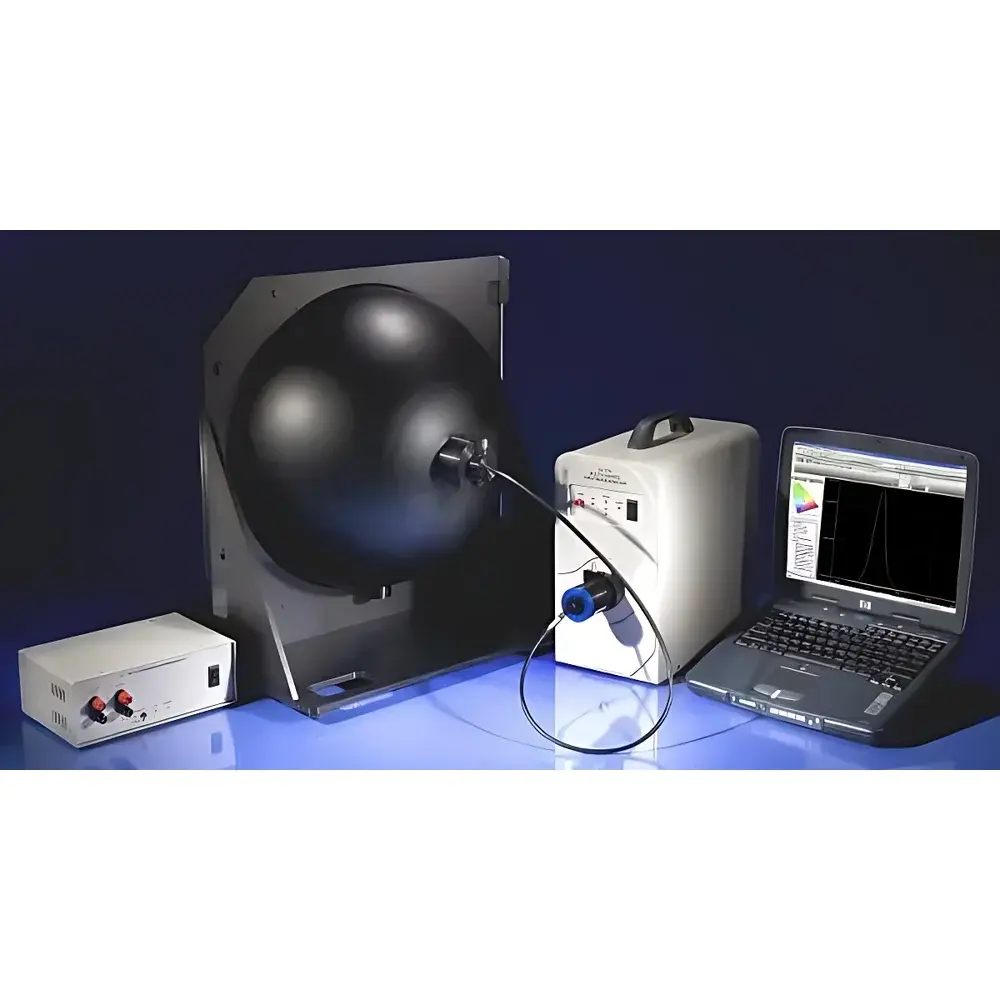
TechnoTeam OL 770/771 Research-Grade CCD-Based Spectroradiometer
| Brand | TechnoTeam |
|---|---|
| Origin | USA |
| Model | OL 770/771 |
| Spectral Range | 200–1700 nm |
| Wavelength Accuracy | ±0.25 nm |
| Sampling Rate | >25 spectra/s |
| Stray Light Suppression | <10⁻⁵ |
| Reflectance Coating | PTFE (>99% from 300–1700 nm) |
| Calibration Source | Integrated tungsten-halogen reference lamp |
| Compliance | CIE 127:2007 (Conditions A, B, and Total Flux), CIE 127.2, ISO/CIE 11664 (Colorimetry), ASTM E308, USP <857> (Photometric Testing) |
Overview
The TechnoTeam OL 770/771 is a research-grade CCD-based spectroradiometer engineered for traceable, high-fidelity optical radiation measurements across the deep ultraviolet to short-wave infrared spectrum (200–1700 nm). Developed by G&H (formerly Optronic Laboratories), a U.S.-based metrology enterprise founded in 1970 by two NIST photometric and radiometric scientists, the system embodies decades of primary-standard calibration heritage. Its core architecture leverages a thermoelectrically stabilized back-illuminated CCD detector coupled with a high-resolution Czerny-Turner monochromator, enabling simultaneous acquisition of spectral irradiance, radiance, luminance, radiant flux, transmittance, diffuse reflectance, and external quantum efficiency (EQE). The instrument operates on fundamental radiometric principles defined in CIE Publication 127:2007 — specifically supporting measurement conditions A (far-field), B (near-field), and total flux — and maintains strict adherence to SI-traceable chain-of-custody protocols required for GLP/GMP-compliant laboratories and ISO/IEC 17025-accredited testing facilities.
Key Features
- Integrated NIST-traceable tungsten-halogen calibration source enabling in-situ recalibration without shipment or third-party intervention
- Automated self-centering LED fixture with mechanical repeatability ≤±0.05 mm, ensuring consistent spatial positioning for inter-laboratory comparability
- Low-stray-light optical path (<10⁻⁵ at 600 nm relative to peak) achieved via double-pass monochromator design and precision baffling
- High dynamic range (>10⁶:1) enabled by 16-bit ADC and adaptive integration time control (1 ms to 60 s)
- Compact, field-deployable chassis (≤18 kg) with MIL-STD-810G-rated shock and thermal stability for outdoor radiometric surveys
- Dual-mode spectral acquisition: single-shot full-range capture or user-defined region-of-interest scanning for optimized SNR
Sample Compatibility & Compliance
The OL 770/771 supports heterogeneous sample geometries including discrete LEDs (SMD, through-hole, COB), OLED panels, laser diodes, phosphor-converted sources, optical filters, diffusers, and solid-state optical materials. All accessories — including the OL IS-670-LED (6″ PTFE-coated integrating sphere), OL 1272-LED (9.75″ dual-mode sphere with angular positioning rail), OL 700-30 goniophotometer (±90° horizontal scan, 0.01° resolution), and OL 700-88TC liquid-cooled thermal stage — are mechanically and optically characterized per ISO 6722 and ASTM E2309. The system complies with FDA 21 CFR Part 11 requirements for electronic records and signatures when used with validated software configurations. Measurement uncertainty budgets conform to GUM (JCGM 100:2008) and are documented in accordance with ISO/IEC 17025 Clause 7.6.2.
Software & Data Management
Acquisition and analysis are performed using OL-Spectra v5.x — a Windows-based application validated under IEC 62304 Class B medical device software guidelines. The platform provides audit-trail logging (user ID, timestamp, parameter set, raw spectrum hash), automated report generation compliant with ISO 17025 Annex A.2, and export formats including CSV, XML (CIE 15:2018 schema), and HDF5 for MATLAB/Python post-processing. Raw spectral data are stored with embedded metadata (calibration date, lamp serial number, slit width, integration time), satisfying ALCOA+ (Attributable, Legible, Contemporaneous, Original, Accurate, Complete, Consistent, Enduring, Available) data integrity criteria. Optional modules support real-time LIV (Light-Current-Voltage) curve fitting, CIE 1931 chromaticity mapping, and spectral power distribution (SPD) normalization per CIE S 026/E:2018.
Applications
- Primary and secondary calibration of LED test equipment in national metrology institutes (NMIs) and accredited labs
- Development and validation of photobiomodulation (PBM) light sources per ANSI/IES RP-27.3
- Characterization of UV-C germicidal lamps for disinfection efficacy (ISO 15858:2016)
- Material-level optical property quantification: bidirectional transmittance distribution function (BTDF), hemispherical reflectance, and spectral absorptance
- EQE mapping of perovskite and organic photovoltaic devices under calibrated AM1.5G illumination
- Defense applications: night-vision device compatibility testing per MIL-STD-3009 and STANAG 4370
FAQ
Does the OL 770/771 meet CIE 127:2007 requirements for LED total luminous flux measurement?
Yes — the system implements Conditions A and B via interchangeable apertures and collimation optics, and supports total flux measurement using NIST-traceable PTFE-coated integrating spheres with auxiliary lamp correction.
Can the instrument perform spectral measurements under controlled thermal conditions?
Yes — the OL 700-88TC liquid-cooled thermal module enables temperature stabilization from −40 °C to +125 °C with ±0.1 °C stability, fully integrated into the OL-Spectra acquisition workflow.
Is the calibration traceable to NIST?
All factory calibrations originate from NIST Standard Reference Materials (SRMs) 2030, 2032, and 2065, with certificates of calibration issued per ISO/IEC 17025 requirements.
What spectral resolution is achievable across the 200–1700 nm range?
Effective resolution is ≤0.5 nm FWHM at 500 nm, varying with grating selection and slit width; wavelength accuracy remains ±0.25 nm across the full range.
How is stray light corrected during UV-NIR measurements?
Stray light is minimized optically and corrected mathematically using a pre-characterized matrix derived from mercury-argon line spectra and applied in real time during acquisition.






