
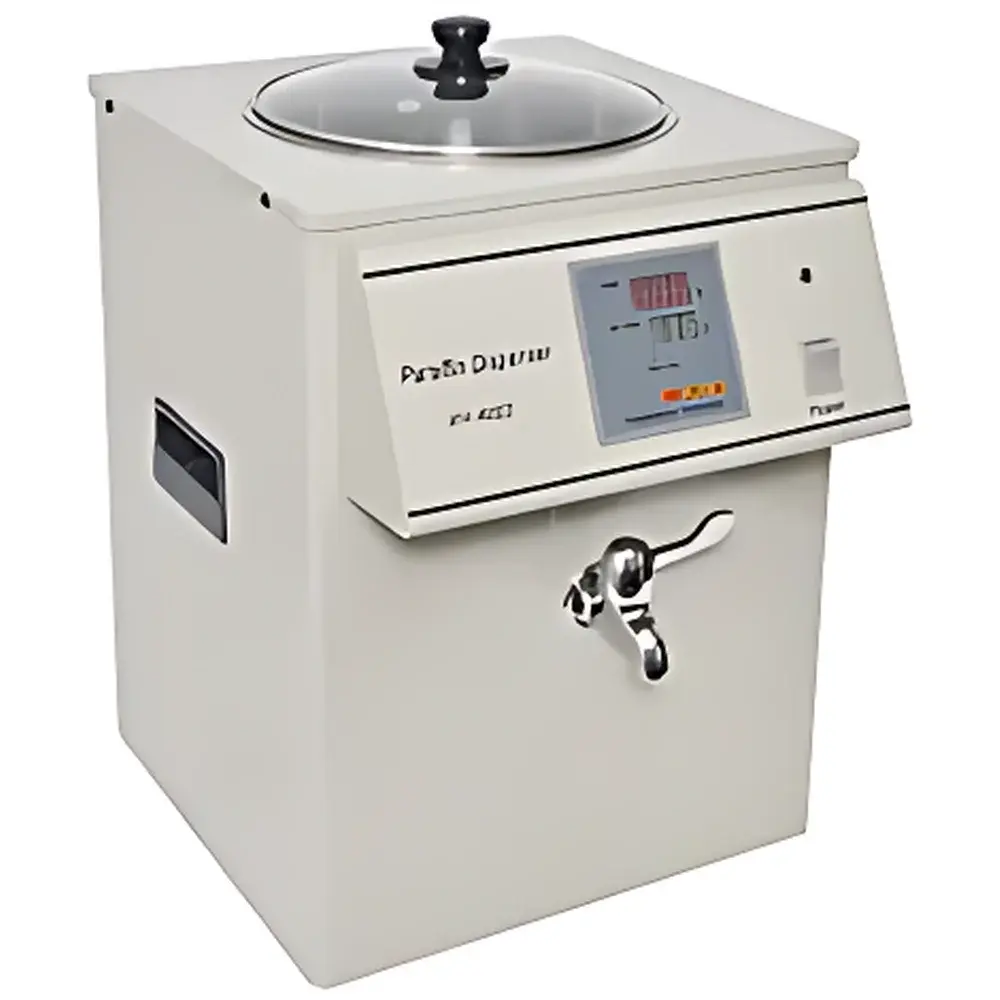
Ted Pella Paraffin Dispenser Model 28151-230
| Brand | Ted Pella |
|---|---|
| Origin | USA |
| Model | 28151-230 |
| Capacity | 2.5 gal (9.46 L) |
| Temperature Range | Ambient to 72°C (162°F) |
| Construction | Stainless steel interior with transparent polycarbonate lid |
| Dimensions | 40 W × 38.1 D × 45.7 H cm (16" × 15" × 18") |
| Weight | 21 kg (46 lbs.) |
| Spigot Type | Heated, non-drip, microprocessor-controlled |
Overview
The Ted Pella Paraffin Dispenser Model 28151-230 is a precision-engineered laboratory instrument designed for consistent, contamination-free handling of molten paraffin wax in histology and tissue processing workflows. Unlike generic wax baths or manual pouring systems, this unit integrates microprocessor-based thermal regulation with a thermally stabilized dispensing spigot to maintain wax viscosity within narrow operational limits—critical for uniform tissue infiltration and embedding block formation. Its design adheres to core principles of laboratory ergonomics and biosafety: the heated spigot eliminates dripping and stringing during dispensing, while the clear polycarbonate lid enables real-time visual monitoring without opening the chamber—minimizing airborne particulate exposure and preventing cross-contamination between batches. The stainless steel interior resists thermal degradation and chemical interaction with hydrocarbon-based paraffin formulations, ensuring long-term dimensional stability and ease of de-waxing and cleaning between uses.
Key Features
- Microprocessor-controlled temperature regulation with ±0.5°C stability across the full range (ambient to 72°C), enabling precise optimization for low-melting-point and high-melting-point paraffin blends.
- Heated, non-drip spigot with integrated thermal maintenance—prevents wax solidification at the outlet and ensures laminar, bubble-free flow during dispensing into molds or embedding centers.
- Transparent, hinged polycarbonate lid with positive-lock sealing mechanism—permits unobstructed visual verification of wax level and clarity while maintaining a closed system environment.
- Durable 304 stainless steel reservoir interior—resistant to thermal cycling fatigue and compatible with standard histological cleaning agents (e.g., xylene substitutes, enzymatic cleaners).
- Front-panel digital interface with intuitive push-button controls and LED temperature readout—supports rapid setpoint adjustment and real-time status feedback without requiring external software or calibration tools.
Sample Compatibility & Compliance
The Model 28151-230 is validated for use with standard histological paraffin waxes (melting points 56–62°C), low-temperature embedding media (e.g., Paraplast® X-TRA, Histowax), and specialty waxes containing additives such as plasticizers or polymer modifiers. It is not intended for use with water-soluble or cryo-embedding media. While the unit itself carries no CE marking or FDA 510(k) clearance—consistent with its classification as a Class I laboratory support device—it conforms to general electrical safety standards per UL 61010-1 (Edition 3) and supports GLP-compliant documentation when paired with laboratory information management systems (LIMS). Its closed-lid operation and drip-free dispensing align with OSHA Laboratory Standard 29 CFR 1910.1200 requirements for minimizing dermal and inhalation exposure to heated hydrocarbon vapors.
Software & Data Management
This dispenser operates as a standalone hardware platform with no embedded firmware connectivity (e.g., USB, Ethernet, or Bluetooth). Temperature setpoints and operational status are managed exclusively via the front-panel interface; no data logging, remote monitoring, or audit trail functionality is provided. For laboratories requiring traceability under ISO 15189 or CAP accreditation, users may integrate the unit into broader environmental monitoring networks using external calibrated temperature probes and time-stamped loggers. The absence of networked software reduces cybersecurity risk and eliminates validation overhead associated with FDA 21 CFR Part 11 compliance—making it suitable for routine histopathology labs where regulatory emphasis lies on procedural consistency rather than electronic record integrity.
Applications
- Primary tissue embedding in automated and semi-automated histology suites, particularly where batch reproducibility of block hardness and sectioning quality is essential.
- Manual embedding stations in academic pathology departments, where operator control over wax temperature and dispensing rate directly impacts artifact minimization (e.g., edge curling, knife chatter).
- Quality assurance testing of paraffin lot consistency—by holding temperature constant across multiple dispensing cycles, technicians can assess viscosity drift and crystallinity changes over time.
- Training environments for histotechnicians, where visual access through the clear lid supports demonstration of proper wax clarity assessment and bubble detection prior to embedding.
FAQ
What is the maximum recommended operating temperature for continuous use?
The unit is rated for sustained operation up to 72°C; prolonged exposure above this threshold may accelerate gasket aging and reduce spigot thermal response fidelity.
Can the dispenser be used with molten celloidin or other non-paraffin embedding media?
No—this system is engineered specifically for paraffin-based hydrocarbon waxes. Celloidin, gelatin, or resin-based media require different thermal profiles and material compatibility, and their use may damage internal seals or temperature sensors.
Is the stainless steel reservoir resistant to xylene-based cleaning solutions?
Yes—304 stainless steel exhibits excellent resistance to short-term immersion in xylene and common xylene substitutes (e.g., Limonene, d-Limonene); however, extended soak times (>30 minutes) are not recommended without post-rinse validation.
Does the non-drip spigot require periodic maintenance or recalibration?
The spigot contains no user-serviceable components; routine wiping with lint-free cloth after each shift is sufficient. No recalibration is required—the heating element and thermal sensor are factory-trimmed and sealed.
How does ambient room temperature affect temperature stability during operation?
At ambient temperatures below 18°C, the unit may require up to 45 minutes to reach and stabilize at 65°C. A stable ambient range of 20–25°C is recommended for optimal thermal recovery between dispensing cycles.



