
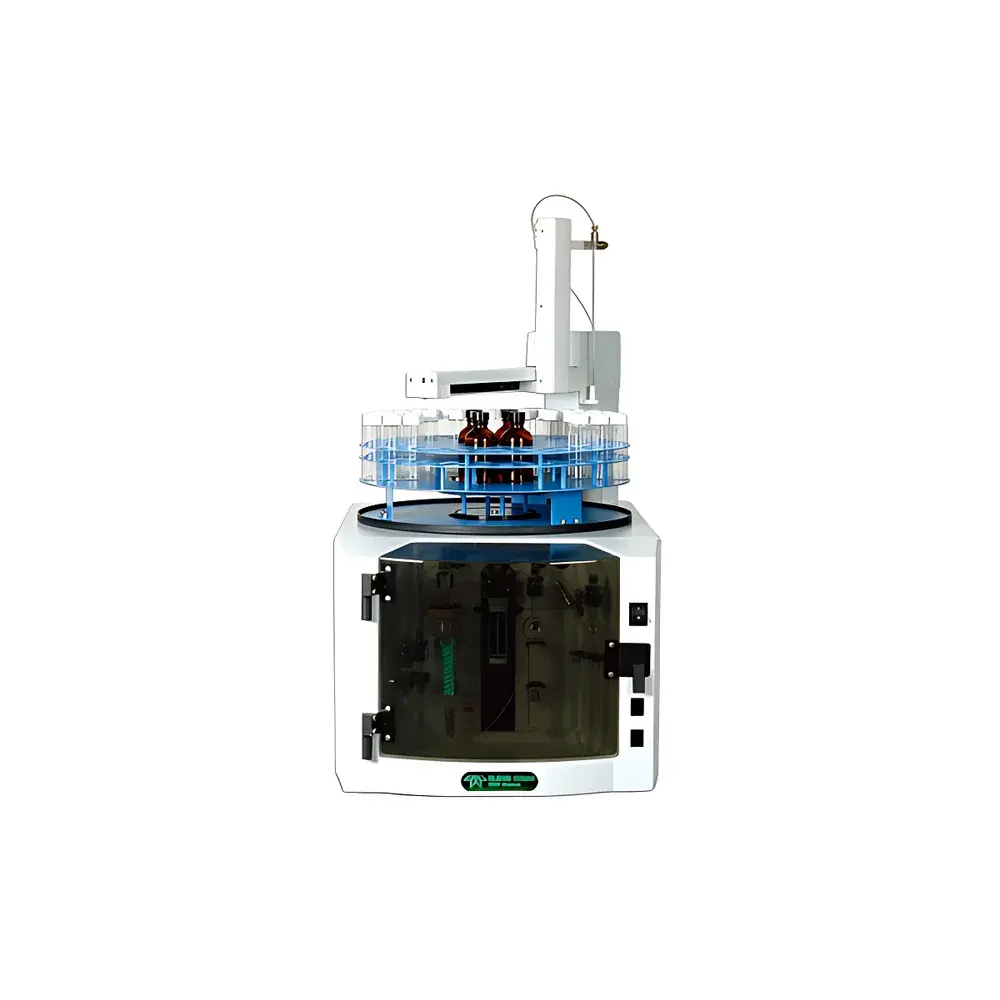
Tekmar Fusion Total Organic Carbon (TOC) Analyzer with UV/Persulfate Oxidation
| Brand | Tekmar |
|---|---|
| Origin | USA |
| Model | Fusion |
| Instrument Type | Laboratory TOC Analyzer |
| Detection Principle | Non-Dispersive Infrared (NDIR) Absorption |
| Oxidation Method | UV Light + Sodium Persulfate |
| Measurement Range | 0.2 ppb C to 4,000 ppm C |
| Accuracy | ±1% |
| Detection Limit | 0.2 ppb C |
| Precision (RSD) | ≤1% |
| Regulatory Compliance | EPA Methods 415.1–415.3, 9060A |
Overview
The Tekmar Fusion Total Organic Carbon (TOC) Analyzer is a high-performance laboratory instrument engineered for precise, trace-level quantification of organic carbon in aqueous matrices—including purified water, pharmaceutical process streams, drinking water, wastewater, and environmental samples. It employs a dual-stage oxidation strategy combining ultraviolet (UV) irradiation with sodium persulfate under acidic conditions to achieve near-complete conversion of refractory organic compounds into carbon dioxide (CO₂). The liberated CO₂ is then quantified via a highly stable, temperature-compensated Non-Dispersive Infrared (NDIR) detector—ensuring metrological traceability, long-term baseline stability, and minimal drift across extended operational cycles. Unlike catalytic combustion or high-temperature furnace-based systems, the UV/persulfate method eliminates metal catalyst deactivation risks and avoids chloride interference common in halogen-rich samples. The Fusion platform is purpose-built for regulated environments where data integrity, audit readiness, and method robustness are non-negotiable—fully supporting 21 CFR Part 11 compliance with electronic signatures, audit trails, and user-access controls.
Key Features
- Patented Static Pressure Concentration (SPC) technology enhances signal-to-noise ratio by pressurizing the entire CO₂ stream prior to NDIR detection—enabling sub-ppb sensitivity without cryogenic trapping or modulation.
- Mass Flow Controller (MFC)-driven gas management system provides real-time pressure logging, automated valve integrity verification, and adaptive purge flow optimization between injections—reducing carrier gas consumption by up to 40% while ensuring consistent system hygiene.
- Intelligent Dilution capability automatically adjusts sample volume and reagent concentration to maintain linearity across the full 0.2 ppb–4,000 ppm dynamic range—eliminating manual dilution errors and enabling unattended analysis of heterogeneous sample sets.
- Single-Stock Calibration workflow automates serial dilution from one certified standard solution—generating multi-point calibration curves per user-defined linearization requirements and reducing preparation time by >70%.
- Integrated Moisture Control System (MCS) combines a glass-frit mist trap and permeation dryer to remove water vapor prior to NDIR measurement—preventing spectral interference and condensation-induced baseline instability.
- Halogen Scrubbing Tower removes chlorine, bromide, and other volatile halogens upstream of the detector—critical for accurate TOC determination in seawater, chlorinated disinfectant residuals, and industrial effluents.
Sample Compatibility & Compliance
The Fusion analyzer accommodates a broad spectrum of sample types: ultrapure water (UPW), WFI (Water for Injection), PW (Purified Water), municipal and groundwater sources, activated sludge supernatants, and aggressive industrial wastewaters. Its UV/persulfate oxidation module demonstrates superior recovery (>98%) for recalcitrant compounds such as humic acids, EDTA, and low-molecular-weight organic acids—validated against ISO 8245 and ASTM D4779 reference materials. The system fully supports GLP/GMP workflows through built-in system suitability testing (SST), automatic leak diagnostics, and hardware-level interlock verification. All software operations comply with FDA 21 CFR Part 11 requirements—including role-based access control, immutable audit trails, electronic signatures, and secure data archiving. Preloaded method templates align with USP , EP 2.2.44, JP 2.2.44, and EPA 415.3—enabling immediate deployment in pharmaceutical QC labs and environmental monitoring agencies.
Software & Data Management
FusionControl™ software delivers a validated, intuitive interface for method development, instrument control, and report generation. Users define custom sequences—including TC, IC, TOC (TC–IC), and NPOC modes—with configurable acid addition volumes, UV exposure times, and persulfate dosing profiles. All analytical metadata—operator ID, timestamp, calibration history, system suitability results, and raw NDIR absorbance traces—are embedded in exportable PDF or CSV reports. Data export formats include ASTM E1382-compliant .csv for LIMS integration and XML-based audit packages compliant with Annex 11 requirements. Remote monitoring and diagnostic logs are accessible via secure HTTPS connection, supporting centralized fleet management across multi-site laboratories.
Applications
- Pharmaceutical manufacturing: Routine TOC monitoring of WFI, PW, and clean-in-place (CIP) rinse waters per USP and EU GMP Annex 1.
- Environmental compliance: EPA 415.3-certified analysis of surface water, groundwater, and wastewater discharge permits.
- Power generation: Monitoring condensate and boiler feedwater for organic contamination that may accelerate corrosion or deposit formation.
- Microelectronics: Verification of organic residue levels in UPW used for wafer rinsing and photolithography processes.
- Academic and regulatory research: Method validation studies requiring high reproducibility, low detection limits, and full traceability of oxidation efficiency.
FAQ
What oxidation methods does the Fusion TOC analyzer support?
The Fusion exclusively uses UV/persulfate oxidation—no high-temperature combustion or electrochemical options are available.
Can the Fusion measure both TOC and IC in the same run?
Yes—using the sequential IC/TOC mode, the instrument first acidifies and sparges IC, then transfers an aliquot to the UV reactor for organic carbon oxidation.
Is the NDIR detector field-replaceable?
No—the NDIR module is factory-calibrated and sealed; replacement requires return-to-factory service and recalibration against NIST-traceable CO₂ standards.
Does the Fusion require daily maintenance?
Routine tasks include weekly halogen scrubber replacement, monthly MCS desiccant change, and quarterly UV lamp inspection—no daily intervention is required for stable operation.
How is system suitability verified?
Automated SST includes spike recovery (e.g., 500 ppb sucrose), blank integrity checks, and MFC pressure stability validation—all documented in the audit trail.







