
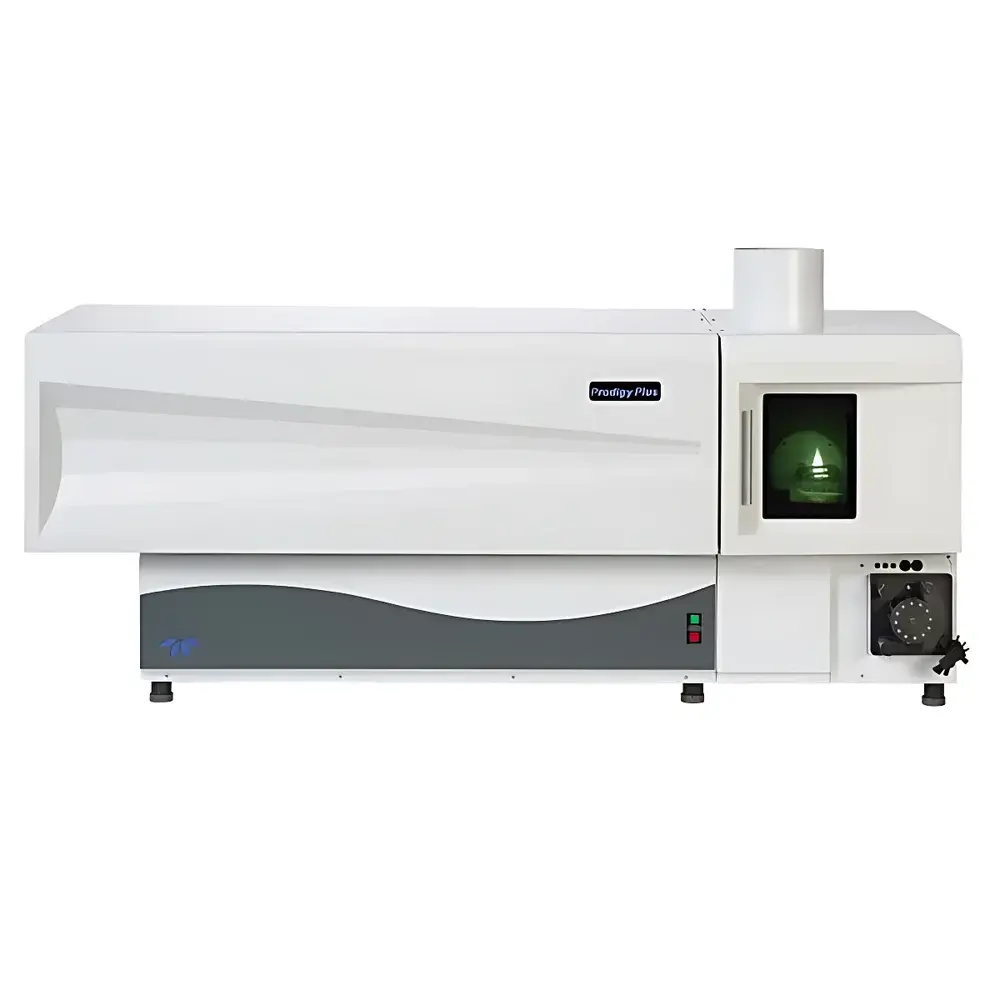
Teledyne Leeman Labs Prodigy Plus Full-Spectrum Direct-Reading ICP-OES
| Brand | Teledyne Leeman Labs |
|---|---|
| Origin | USA |
| Model | Prodigy Plus |
| Instrument Type | Full-Spectrum Direct-Reading ICP Optical Emission Spectrometer |
| Detection Limit (Zn @ 213.856 nm) | < 0.1 µg/L |
| Precision (RSD) | ≤ 0.5% |
| Long-Term Stability (RSD, 4h) | ≤ 1.0% |
| Wavelength Range | 130–1100 nm |
| Optical Resolution | 0.005 nm @ 200 nm |
| Detector | Custom 28 × 28 mm CMOS sensor with 3.38 million effective pixels |
| Readout Speed | >10× faster than conventional CID/CCD detectors |
Overview
The Teledyne Leeman Labs Prodigy Plus is a high-performance, full-spectrum direct-reading inductively coupled plasma optical emission spectrometer (ICP-OES) engineered for precision elemental analysis across research laboratories, environmental testing facilities, metallurgical QA/QC departments, and regulatory compliance centers. It operates on the fundamental principle of atomic emission spectroscopy: liquid samples are nebulized into an argon-supported 6,000–10,000 K plasma, where constituent elements are atomized and electronically excited. As atoms return to lower energy states, they emit characteristic photons across the ultraviolet–visible–near-infrared spectrum (130–1100 nm). The Prodigy Plus captures this entire emission spectrum simultaneously using a custom-designed, large-format CMOS detector—eliminating sequential wavelength scanning and enabling true multi-element quantification in a single exposure.
Key Features
- Full-spectrum acquisition architecture: Simultaneous detection across 130–1100 nm enables concurrent quantification of up to 70+ elements—including challenging halogens (Cl, Br, I) at trace levels—without method reconfiguration or dwell-time trade-offs.
- High-resolution optical system: Optimized Czerny-Turner monochromator with aberration-corrected optics delivers 0.005 nm spectral resolution at 200 nm, supporting accurate peak deconvolution for overlapping lines (e.g., V 309.310 nm / Fe 309.299 nm) and robust background correction.
- Custom 28 × 28 mm CMOS detector: Featuring 3.38 million effective pixels and enhanced quantum efficiency in the VUV region (130–190 nm), this solid-state sensor provides superior signal-to-noise ratio and dynamic range (>106) compared to legacy CID/CCD technologies.
- Real-time, non-destructive spectral processing: Onboard FPGA-accelerated CPU performs pixel-level dark-current correction, cosmic-ray rejection, and intensity normalization during acquisition—preserving raw data fidelity while enabling immediate spectral visualization and integration.
- Integrated plasma source & optical bench: Rigid, thermally stabilized monolithic optical housing minimizes mechanical drift; combined with a high-efficiency RF generator (27.12 MHz, 1.5 kW solid-state), ensures long-term photometric stability (≤1.0% RSD over 4 hours).
- Intelligent maintenance logging: Embedded diagnostics monitor torch alignment, nebulizer pressure, coolant flow, and detector temperature—triggering context-aware alerts and scheduled service reminders aligned with ISO/IEC 17025 preventive maintenance requirements.
Sample Compatibility & Compliance
The Prodigy Plus accepts aqueous solutions (0.1–5% HNO3, 0.5–2% HCl), digested geological matrices (EPA Method 6010D, 6020B), organic solvents (via microconcentric nebulization), and high-salt brines (up to 25% TDS with optional desolvation). Its hardware and software architecture support full compliance with ISO 17025:2017 clause 7.7 (data integrity), USP , ASTM D1976, and EPA 200.7/200.9 workflows. Audit trails, electronic signatures, and user-access controls meet FDA 21 CFR Part 11 requirements when deployed in regulated GLP/GMP environments.
Software & Data Management
Prodigy Plus is controlled via the Windows-based Prodigy Software Suite, which features intuitive method development wizards, automated calibration curve generation (linear, quadratic, weighted), and interference correction algorithms (internal standardization, matrix-matched standards, multivariate background modeling). All raw spectra are stored in vendor-neutral HDF5 format with embedded metadata (instrument parameters, sample ID, operator, timestamp, calibration history). Data export supports ASTM E1382-compliant CSV, XML, and LIMS-ready formats. Optional integration with Thermo Fisher SampleManager LIMS or LabVantage via ODBC/API ensures seamless chain-of-custody documentation.
Applications
- Environmental monitoring: Quantification of regulated metals (As, Cd, Cr, Pb, Hg) and nutrients (Ca, Mg, Na, K) in drinking water per EPA 200.7 and ISO 11885.
- Geochemical exploration: Multi-element analysis of rock digests (Li–U) with sub-ppq detection for rare earth elements (REEs) using high-sensitivity VUV lines.
- Pharmaceutical excipient testing: Verification of catalyst residues (Pd, Pt, Ni) in APIs at ≤10 ng/g per ICH Q2(R2) guidelines.
- Metallurgical process control: Rapid alloy fingerprinting (Al, Cu, Fe, Mn, Si, Zn) and inclusion analysis in molten metal streams.
- Nuclear fuel cycle labs: Uranium isotopic ratio estimation via U II line intensity ratios (e.g., 367.007 nm / 424.167 nm) with internal standard correction.
FAQ
Does the Prodigy Plus require external cooling water or chiller units?
No—it integrates a closed-loop, thermostatically controlled recirculating cooler optimized for ambient operation (15–30 °C), eliminating dependency on facility chillers and reducing total cost of ownership.
Can it analyze halogens without vacuum purging?
Yes—the optical path is sealed and continuously purged with argon, enabling stable detection of Cl (134.724 nm), Br (148.504 nm), and I (178.279 nm) without requiring costly vacuum pumps or extended pump-down cycles.
Is method transfer supported from older Leeman Labs instruments?
Yes—Prodigy Software includes backward-compatible import tools for legacy Prodigy, Profile, and Integra methods, preserving historical calibration data and QC records during instrument upgrades.
What maintenance intervals are recommended under ISO/IEC 17025?
Torch inspection every 500 hours; nebulizer cleaning every 100 samples; detector dark-current calibration monthly; full optical alignment verification annually—automatically tracked and reported by the onboard maintenance scheduler.





