
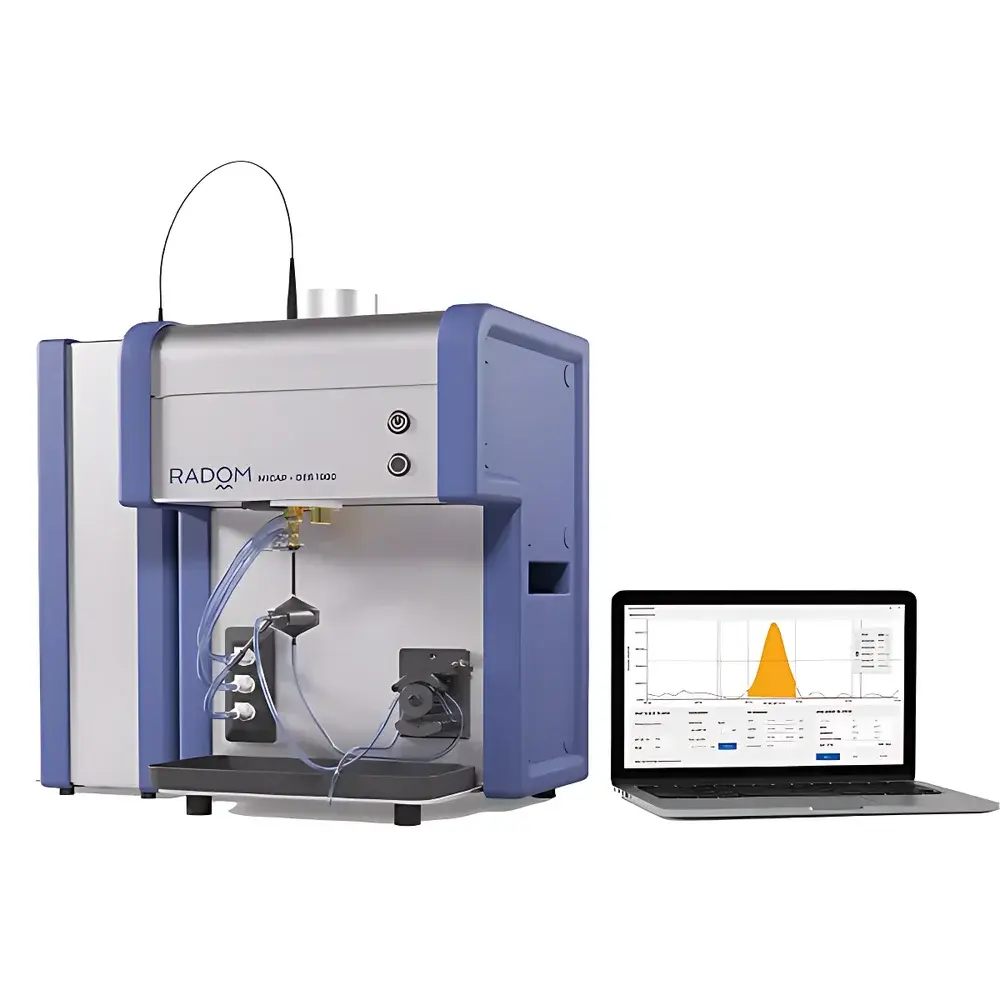
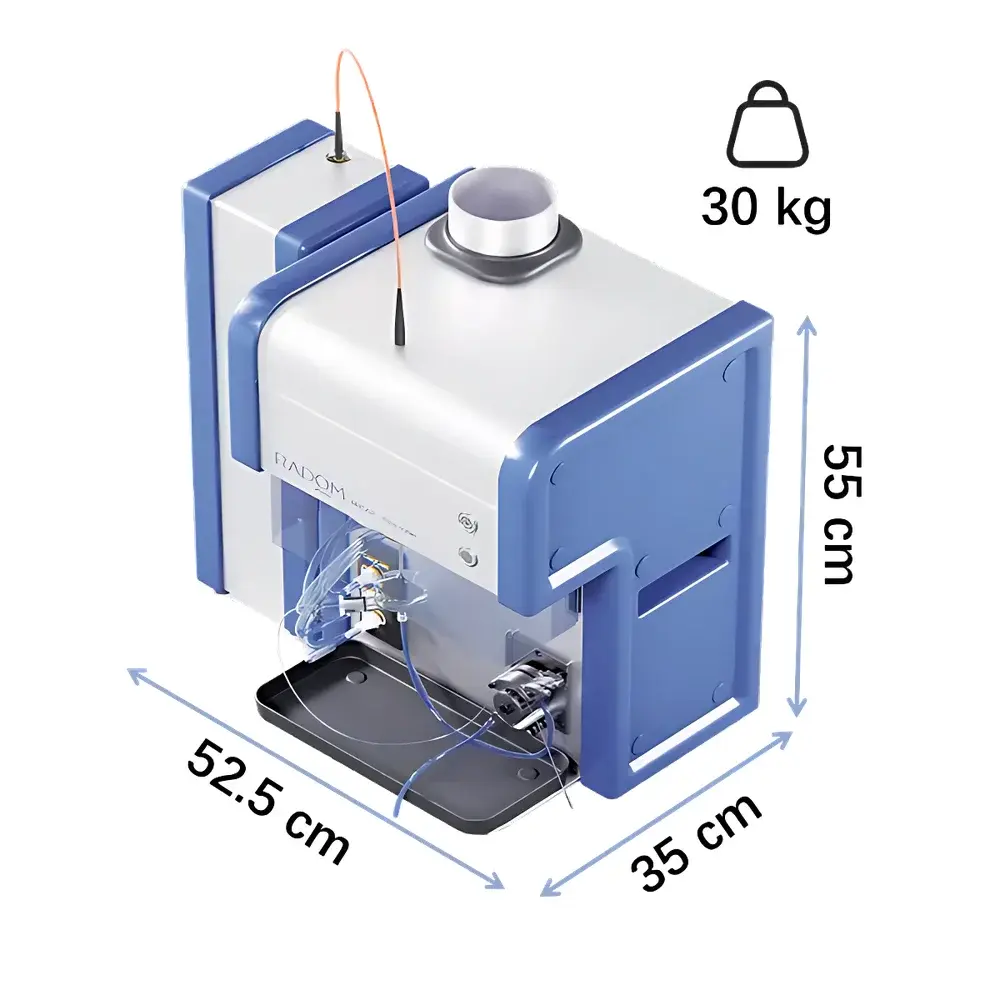
Teledyne Leeman Labs RADOM Inductively Coupled Plasma Optical Emission Spectrometer
| Brand | Teledyne Leeman Labs |
|---|---|
| Origin | Imported |
| Manufacturer Type | Authorized Distributor |
| Instrument Type | Full-Spectrum Simultaneous Readout |
| Detection Limit (Ca at 396.847 nm) | 0.155 ppb |
| Precision (RSD) | ≤0.5% |
| Long-Term Stability (2-hr drift) | ≤1.0% |
| Optical Resolution | 0.005 nm |
| RF Generator Cooling | Air-Cooled |
| Plasma Torch Assembly | Ceramic RF Load Coil |
| Optical System | Echelle Grating with ICCD Detector |
| Compliance | ASTM D1976, ISO 11885, USP <233>, EPA Methods 200.7 & 6010E |
Overview
The Teledyne Leeman Labs RADOM Inductively Coupled Plasma Optical Emission Spectrometer (ICP-OES) is an engineered solution for high-throughput, multi-element trace metal analysis in environmental, geological, pharmaceutical, and industrial quality control laboratories. It operates on the fundamental principle of inductively coupled plasma atomic emission spectroscopy: liquid samples are nebulized into fine aerosols, transported into a high-temperature (~6,000–10,000 K) argon plasma sustained by radiofrequency (RF) energy, where atoms and ions are excited and emit element-specific photons upon relaxation. These emissions are dispersed via a high-fidelity echelle optical system and captured simultaneously across the ultraviolet–visible–near-infrared spectrum (165–900 nm) using an intensified charge-coupled device (ICCD) detector. Unlike conventional ICP-OES systems relying on copper induction coils and water-cooled RF generators, the RADOM platform integrates a proprietary ceramic RF load coil and air-cooled solid-state RF generator—delivering enhanced plasma stability, reduced thermal load, and improved matrix tolerance for complex, high-dissolved-solid or organic-rich samples.
Key Features
- Ceramic RF load coil architecture: Eliminates copper coil oxidation and thermal fatigue, ensuring consistent plasma impedance and long-term power coupling efficiency.
- Air-cooled RF generator (27.12 MHz, 1.0–1.5 kW range): Removes dependency on deionized water circulation, reducing infrastructure requirements, maintenance intervals, and total cost of ownership.
- Simultaneous full-spectrum acquisition: Echelle grating + cross-disperser optics enable single-exposure spectral capture across all analyte wavelengths—minimizing integration time and maximizing sample throughput.
- Compact benchtop footprint (≤75 cm W × 65 cm D × 70 cm H): Designed for space-constrained labs without compromising optical path length or signal-to-noise ratio.
- Modular hardware design: Torch assembly, nebulizer, spray chamber, and peristaltic pump are tool-free swappable—reducing mean time to repair (MTTR) and enabling rapid method reconfiguration.
- Intuitive software interface with embedded QC workflows: Supports automated calibration verification, drift correction, and real-time spectral interference assessment per ASTM D1976 Annex A3.
Sample Compatibility & Compliance
The RADOM ICP-OES accommodates aqueous solutions, digested environmental solids (e.g., soils, sludges per EPA 3050B/3051A), acid-leached geological matrices, biological digests (USP compliant), and diluted hydrocarbon-based extracts—provided dissolved solids remain ≤0.2% w/v. Its robust plasma and optimized gas flow dynamics mitigate polyatomic interferences (e.g., ArO⁺ on 56Fe, ArCl⁺ on 35Cl) through kinetic energy discrimination and optional helium collision cell integration. The system meets analytical performance criteria outlined in ISO 11885 (water quality), EPA Method 200.7 (drinking water), and Method 6010E (waste analysis), and supports 21 CFR Part 11-compliant audit trails when deployed with validated software configurations under GLP/GMP environments.
Software & Data Management
Control and data processing are managed via Leeman Labs’ SpectraPro Suite v5.x—a Windows-based application supporting method development, spectral library management, background correction (polynomial and peak-fit), internal standard normalization, and multi-point calibration with outlier rejection. Raw spectral data (.spc binary format) and processed reports (.pdf/.xlsx) are stored in a relational database with configurable retention policies. Audit trail functionality logs all user actions—including method edits, calibration changes, and result approvals—with timestamps, operator IDs, and IP addresses. Export modules comply with LIMS interoperability standards (ASTM E1482, HL7) and support direct integration with enterprise laboratory information systems.
Applications
- Environmental monitoring: Quantification of regulated metals (As, Cd, Cr, Pb, Hg, Se) in surface water, groundwater, wastewater, and sediment extracts.
- Geochemical exploration: Multi-element profiling (Li, Be, Sc, Y, REEs, U, Th) in rock powders and leachates for provenance and mineral potential assessment.
- Pharmaceutical raw material testing: Verification of elemental impurities per ICH Q3D guidelines (Class 1–3 elements) in APIs and excipients.
- Food safety and agriculture: Screening for toxic elements (Pb, Cd, As) in crops, animal feed, and fortified foods; nutrient analysis (Ca, Mg, Fe, Zn, Mn).
- Industrial process control: Monitoring catalyst poisons (Na, K, V, Ni) in petrochemical feedstocks and coolant fluids.
FAQ
Does the RADOM ICP-OES support hydride generation or laser ablation interfaces?
Yes—optional HG-300 hydride generation module and LS-300 laser ablation system are available as factory-integrated accessories, enabling sub-ppt detection for As, Se, Sb, Bi and direct solid sampling for glasses, metals, and ceramics.
What plasma gas consumption rates are typical during routine operation?
Argon consumption averages 12–14 L/min during plasma ignition and stabilizes at 10–11 L/min in analytical mode, compatible with standard high-pressure cylinder or on-site argon generators rated ≥30 L/min continuous flow.
Is remote diagnostics and firmware update capability supported?
Yes—the instrument includes embedded Ethernet connectivity with TLS 1.2-secured remote access; firmware updates and configuration backups can be performed via Leeman Labs’ SecureConnect portal with role-based authentication.
How is spectral calibration maintained over time?
Wavelength calibration is performed automatically at startup using internal Hg/Ar hollow cathode lamp references; daily verification against NIST-traceable multi-element standards is recommended per ISO/IEC 17025 clause 7.7.
Can the system operate unattended overnight?
Yes—integrated autosampler compatibility (up to 240 positions), auto-dilution, and intelligent rinse logic enable fully automated batch analysis with real-time fault detection and email alerting via SMTP protocol.





