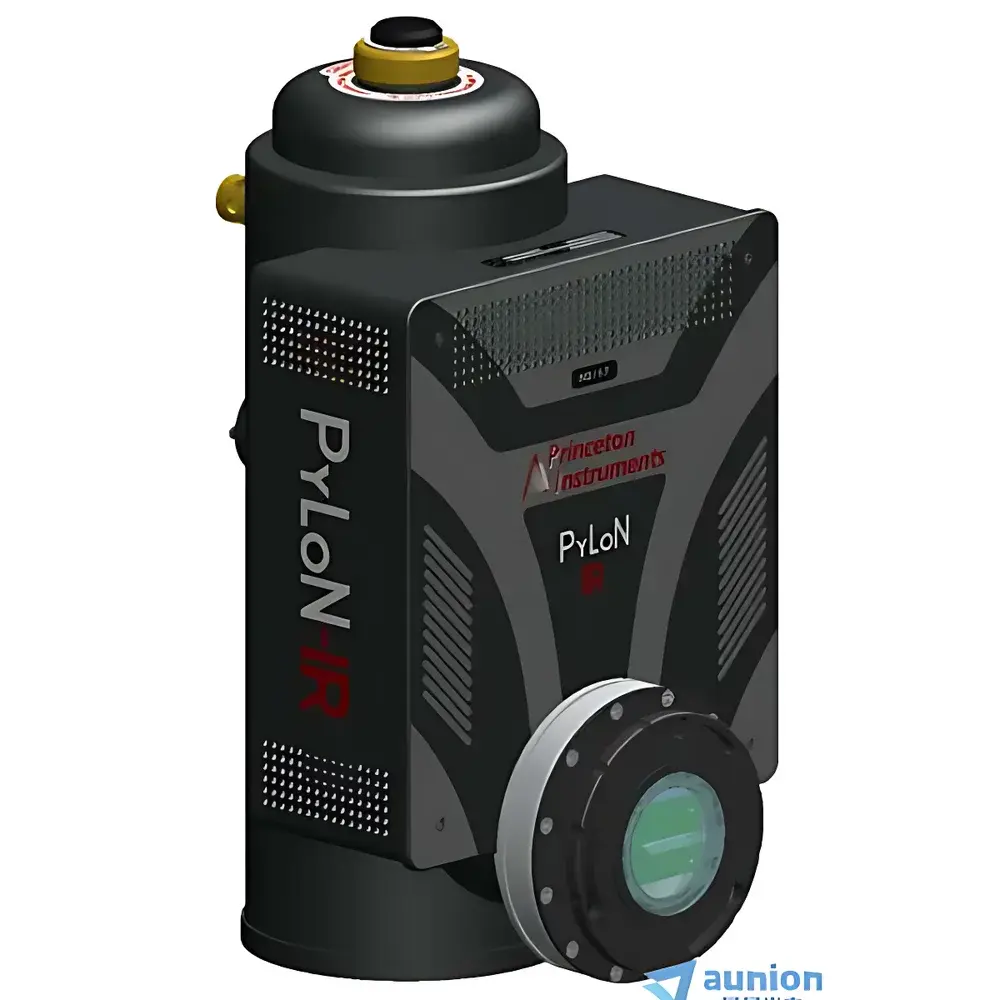
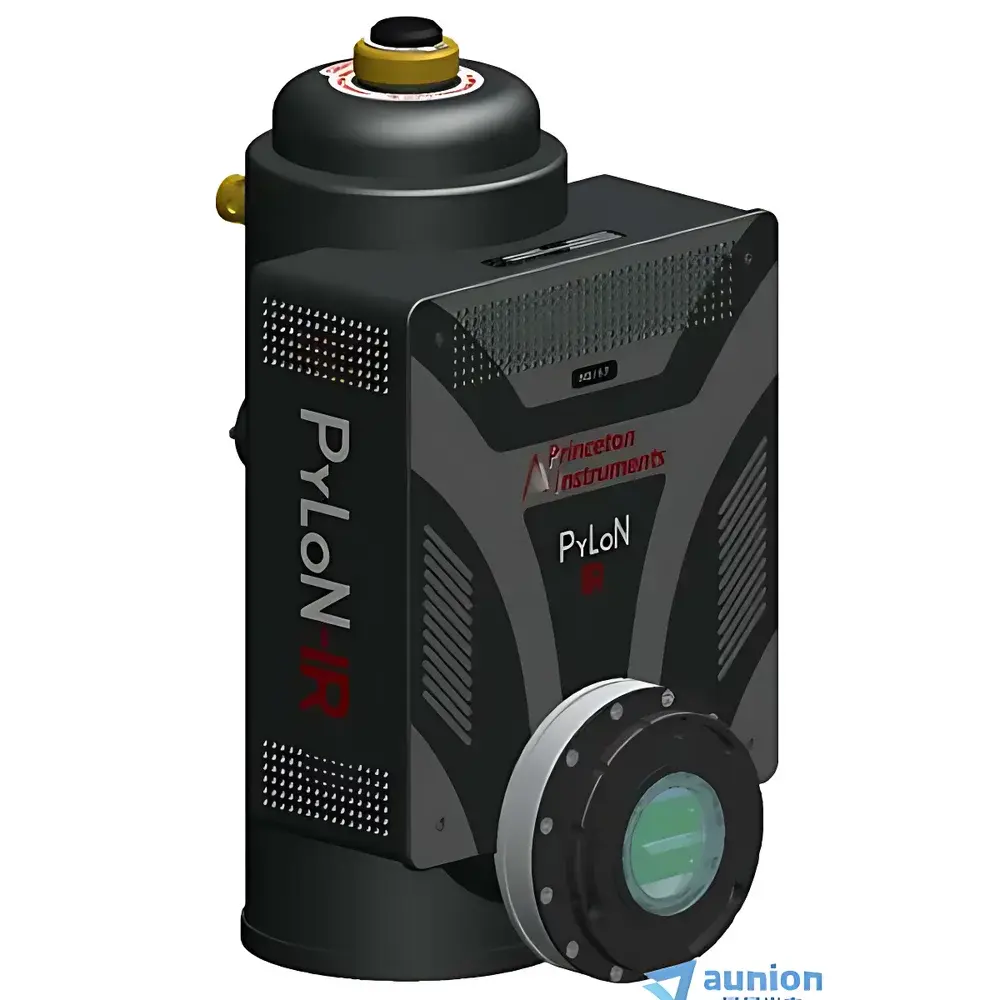
Teledyne Princeton Instruments PyLoN-IR Liquid Nitrogen-Cooled InGaAs Line Scan Camera
| Brand | Teledyne Princeton Instruments |
|---|---|
| Model | PyLoN-IR |
| Sensor Type | Linear InGaAs Photodiode Array |
| Spectral Range | 800–1700 nm (PyLoN-IR:1024-1.7) / 1000–2200 nm (PyLoN-IR:1024-2.2) |
| Pixel Format | 1024 × 1 |
| Pixel Size | 25 µm × 500 µm (1.7) / 25 µm × 250 µm (2.2) |
| Readout Noise | ≤400 e⁻ (high-gain mode) |
| Full Well Capacity | up to 120 Me⁻ (low-gain) |
| QE | >85% (800–1700 nm), ≥70% (1000–2200 nm) |
| Max Spectral Rate | 6600 spectra/s |
| Cooling | Liquid nitrogen to –100 °C |
| Digitization | 16-bit |
| Software Support | LightField 64-bit, PICAM SDK, IntelliCal Wavelength & Intensity Calibration |
| Compliance | Fully compatible with ASTM E131, ISO/IEC 17025 workflows, and FDA 21 CFR Part 11–enabled data acquisition environments |
Overview
The Teledyne Princeton Instruments PyLoN-IR is a high-performance, liquid nitrogen-cooled linear InGaAs photodiode array camera engineered for quantitative scientific spectroscopy in the near-infrared (NIR) and short-wave infrared (SWIR) spectral regions. Unlike conventional thermoelectrically cooled detectors, the PyLoN-IR leverages cryogenic cooling to achieve sub-0.1 e⁻/pixel/s dark current levels—enabling integration times of several minutes without thermal signal contamination. Its measurement principle is based on photon-to-electron conversion within an optimized InGaAs epitaxial layer, followed by low-noise charge amplification and 16-bit digitization. This architecture ensures exceptional signal fidelity for applications demanding high dynamic range, ultra-low noise floors, and precise radiometric stability—particularly where weak emission or scattering signals must be resolved against background-limited conditions.
Key Features
- Cryogenic Performance: Operates at –100 °C via liquid nitrogen cooling, reducing dark current by over three orders of magnitude compared to TE-cooled alternatives—critical for long-exposure NIR photoluminescence and Raman measurements.
- Dual-Gain Amplifier Architecture: Integrates parallel high-sensitivity and high-capacity readout paths. High-gain mode delivers ≤400 e⁻ read noise for faint-signal detection; low-gain mode supports >100 Me⁻ full-well capacity for high-intensity spectral lines.
- Optimized Optical Interface: Single-input fused silica window with anti-reflection coating across 800–2200 nm; redesigned cold shield minimizes stray thermal radiation, enhancing signal-to-noise ratio in ambient laboratory environments.
- High-Speed Spectral Acquisition: Sustains up to 6600 spectra per second at full 1024-pixel resolution, with 500 kHz line rate—enabling real-time kinetic studies and rapid spectral mapping.
- Vacuum Integrity & Longevity: Indium-metal sealed vacuum dewar provides >10-year operational lifetime under standard lab conditions, with typical LN₂ refill interval of once per 24 hours.
Sample Compatibility & Compliance
The PyLoN-IR is compatible with standard C-mount and F-mount spectrograph interfaces, and integrates seamlessly with modular optical benches used in FT-NIR, dispersive Raman, and time-resolved photoluminescence systems. Its detector geometry (1024 × 1 format) aligns with industry-standard spectrometer slit projections, minimizing optical aberration and calibration drift. The system meets requirements for GLP/GMP-compliant laboratories through hardware-enforced audit trails in LightField software, including timestamped metadata logging, user-access controls, and electronic signature support aligned with FDA 21 CFR Part 11. It also conforms to measurement traceability standards referenced in ASTM E131 (Standard Terminology Relating to Molecular Spectroscopy) and ISO/IEC 17025 (General Requirements for the Competence of Testing and Calibration Laboratories).
Software & Data Management
The PyLoN-IR is fully supported by LightField 64-bit—a vendor-developed, platform-agnostic application that unifies hardware control, real-time image processing, and spectral analysis in a single interface. LightField embeds a native mathematical engine supporting pixel-wise background subtraction, spectral deconvolution, peak fitting (Gaussian/Lorentzian), and multi-channel ratio imaging. It natively exports calibrated data in HDF5, CSV, and FITS formats, ensuring interoperability with Python (NumPy, SciPy), MATLAB, and LabVIEW via direct API calls. The included IntelliCal system enables automated wavelength and intensity calibration using NIST-traceable light sources, eliminating manual polynomial fitting. For custom integration, the PICAM Software Development Kit provides low-level access to all camera registers and timing parameters—bypassing abstraction layers to minimize latency in OEM or synchronized multi-instrument setups.
Applications
- NIR Raman Spectroscopy: Detection of low-frequency vibrational modes in carbon nanotubes, graphene, and pharmaceutical crystalline forms—where high SNR and minimal dark current are essential for resolving subtle Stokes/anti-Stokes asymmetries.
- Photoluminescence Quantum Yield (PLQY) Mapping: Quantitative spatial profiling of quantum dot and perovskite thin films under pulsed excitation, leveraging the camera’s linearity over 5 decades and shot-noise-limited performance.
- Gas Phase Absorption Spectroscopy: High-resolution monitoring of CH₄, CO, NH₃, and H₂O absorption features between 1.0–2.2 µm in environmental sensing and combustion diagnostics.
- OEM Spectrometer Integration: Drop-in replacement for legacy OMA V InGaAs arrays in portable and benchtop analyzers requiring extended spectral coverage, regulatory-grade data integrity, and field-replaceable cooling modules.
FAQ
What cooling method does the PyLoN-IR use, and why is it preferred over thermoelectric cooling?
It employs liquid nitrogen cooling to –100 °C, which suppresses dark current to <0.1 e⁻/pixel/s—enabling minute-scale integrations without thermal saturation. TE cooling cannot achieve comparable dark current suppression in the SWIR band.
Is the PyLoN-IR compatible with third-party spectrographs?
Yes—it accepts standard C-mount and F-mount mechanical interfaces and supports pixel pitch matching via software-defined binning and ROI selection.
Does the system support automated wavelength calibration?
Yes, via the IntelliCal module, which uses NIST-traceable emission lamps and built-in motorized filter wheels to perform fully automated, multi-point wavelength and intensity calibration.
Can the PyLoN-IR be controlled programmatically from MATLAB or LabVIEW?
Yes, through LightField’s native instrument drivers and the PICAM SDK, both of which provide documented APIs for synchronous triggering, exposure control, and raw frame streaming.
What vacuum maintenance is required?
The indium-sealed dewar requires no periodic pump-down; vacuum integrity is verified during factory certification and maintained for >10 years under normal operation—only routine LN₂ refills are needed.