
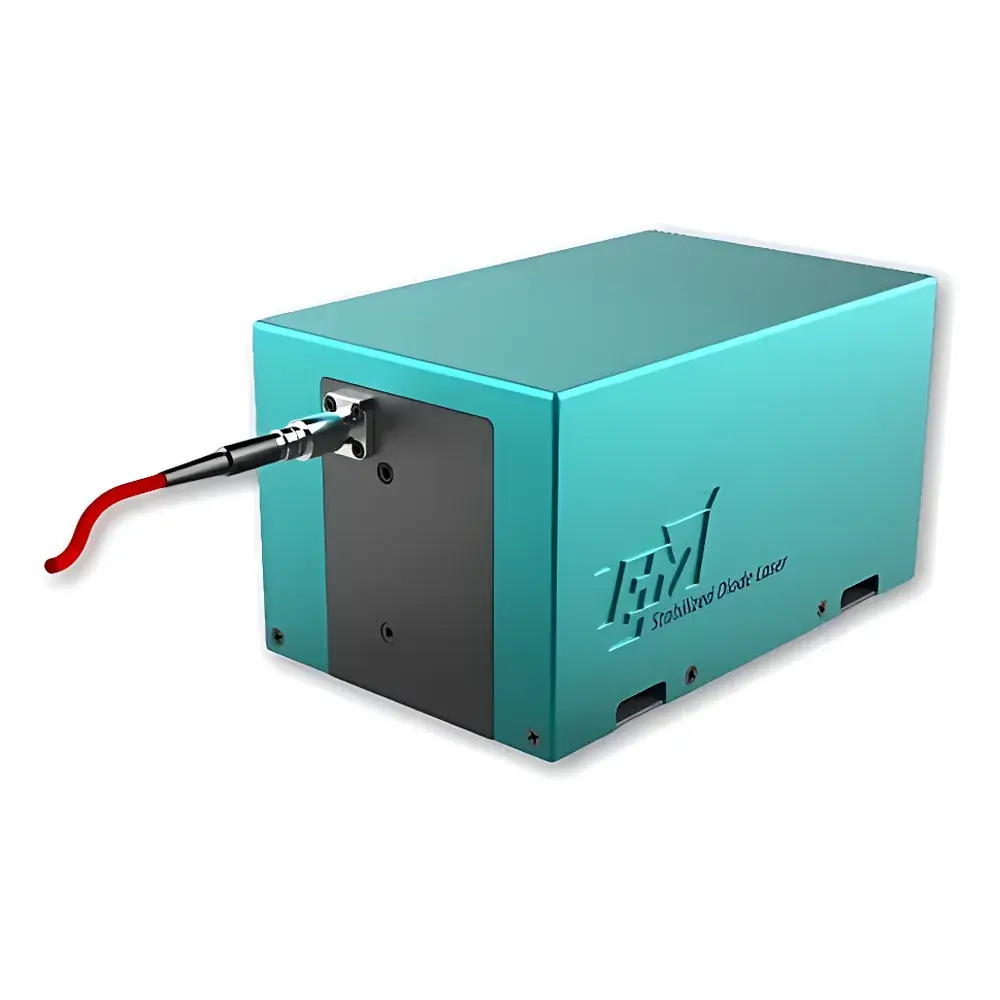
TEM Messtechnik GmbH Lasy633-633nm Iodine-Stabilized Tunable Diode Laser
| Origin | Germany |
|---|---|
| Manufacturer Type | Authorized Distributor |
| Origin Category | Imported |
| Model | Lasy633 |
| Key Components | Semiconductor Laser System with Integrated Iodine Absorption Cell and Active Stabilization Electronics |
| Output Power | >2 mW (fiber-coupled), >10 mW (free-space) |
| Tuning Range | ≥300 GHz (≈0.4 nm at 633 nm) |
| Frequency Stability | <5 MHz RMS over 10 min |
| Coherence Length | >50 m |
| Spectral Linewidth | <5 MHz |
| Tuning Resolution | 1 MHz |
| Wavelength Accuracy | ±1 nm (standard) |
Overview
The TEM Messtechnik GmbH Lasy633 is a high-stability, iodine-saturated-absorption-referenced tunable diode laser operating at the metrologically significant 633 nm wavelength. Engineered for precision optical metrology, it implements a dual-reference stabilization architecture: primary locking to the hyperfine transition of molecular iodine (¹²⁷I₂) at 633 nm provides absolute frequency traceability to the SI second, while optional secondary locking to a high-finesse interferometer enables ultra-low drift operation in demanding long-duration measurements. Unlike conventional He–Ne lasers, the Lasy633 delivers semiconductor-based reliability and compactness without sacrificing metrological performance—achieving coherence lengths exceeding 50 m and intrinsic linewidths below 5 MHz. Its design targets direct replacement of gas lasers in interferometric applications where long-term frequency stability, sub-MHz tuning resolution, and mechanical phase-shifter elimination are critical.
Key Features
- Iodine-saturated absorption cell integrated into the laser head for primary absolute frequency reference—traceable to international atomic standards
- Active electronic stabilization circuitry maintaining frequency deviation <5 MHz (RMS) over 10-minute intervals and <50 MHz absolute over device lifetime under ambient lab conditions
- Continuous, hysteresis-free wavelength tuning across ≥300 GHz (≈0.4 nm), enabling precise cavity-length scanning and synthetic-wavelength interferometry
- Dual output configuration: free-space beam (>10 mW) and polarization-maintaining single-mode fiber coupling (>2 mW) with FC/APC interface
- USB 2.0 interface supporting remote control via TEM’s proprietary LabControl software—enabling automated sweep sequences, lock-point adjustment, and real-time frequency monitoring
- Compact OEM-ready housing (142 × 94 × 45 mm) with TE cooling and low-noise current drivers ensuring thermal and current stability essential for sub-kHz noise floor operation
Sample Compatibility & Compliance
The Lasy633 is designed for integration into ISO/IEC 17025-accredited calibration laboratories and industrial metrology platforms requiring traceable 633 nm sources. It complies with the spectral requirements defined in ISO 10110-2 for laser wavelength specification and meets the frequency stability criteria referenced in EURAMET cg-19 (Guidelines on Interferometric Length Measurements). The iodine reference line (R(127) 11-5 transition) is recognized by BIPM as a secondary frequency standard, enabling direct traceability for national metrology institutes. The system supports GLP-compliant audit trails when operated with TEM’s validated software suite and satisfies electromagnetic compatibility per EN 61326-1 for laboratory use. No hazardous materials or regulated substances are employed in its construction.
Software & Data Management
TEM’s LabControl v3.x software provides full instrument orchestration under Windows 10/11 (64-bit) and Linux (via API). The application supports scripting (Python SDK included), synchronized multi-channel data acquisition, and timestamped frequency logging compliant with FDA 21 CFR Part 11 requirements—including electronic signatures, user access levels, and immutable audit logs. All tuning parameters—including setpoint frequency, lock gain, error signal offset, and piezo drive voltage—are exportable in CSV and HDF5 formats. Remote operation via TCP/IP is supported for integration into larger automation frameworks (e.g., LabVIEW, MATLAB, or Python-based control systems). Firmware updates are delivered through secure signed packages with SHA-256 verification.
Applications
- Phase-shifting interferometry (PSI) and Fourier-transform interferometry (FTI), where wavelength tuning replaces mechanical translation stages—reducing vibration sensitivity and enabling sub-nanometer displacement resolution
- Calibration of Fabry–Pérot cavities, optical frequency combs, and wavemeters requiring a stable, tunable 633 nm source with known iodine-line anchoring
- High-resolution spectroscopy of iodine isotopes and calibration of Doppler-free saturated absorption setups
- Gravitational wave detector prototype testing, where long-coherence-length lasers are used to characterize mirror thermal noise and coating Brownian motion
- Traceable refractometry and index-of-refraction mapping in transparent media using dual-wavelength synthetic interferometry
- Education and research labs performing fundamental tests of laser stabilization theory, including Pound–Drever–Hall and modulation transfer spectroscopy techniques
FAQ
Is the Lasy633 fully compatible with existing He–Ne interferometer optics?
Yes—the free-space output is collimated (1.2 mm diameter, M² < 1.1), TEM₀₀ polarized, and spatially coherent, matching the beam parameters of standard 632.8 nm He–Ne lasers within optical alignment tolerances.
Can the iodine reference cell be recalibrated or replaced in the field?
No—the iodine absorption cell is hermetically sealed and factory-aligned. Recalibration is not required during normal operation; lifetime stability is guaranteed for ≥10,000 hours of continuous use.
What environmental conditions are required for optimal frequency stability?
Operation is specified for 15–30 °C ambient temperature with <±0.5 °C/h drift; active temperature control of the iodine cell is embedded. Humidity should remain <70 % RH non-condensing.
Does the system support external modulation inputs for Pound–Drever–Hall locking?
Yes—BNC connectors provide access to the error signal output, piezo drive input, and RF modulation port (up to 10 MHz), enabling custom lock-in or digital PID implementations.
Is fiber-coupled output polarization-maintaining and mode-matched to standard SM630 fiber?
Yes—the PM fiber output uses Panda-type SM630 fiber with extinction ratio >20 dB and is factory aligned for optimal coupling into interferometric fiber networks.





