
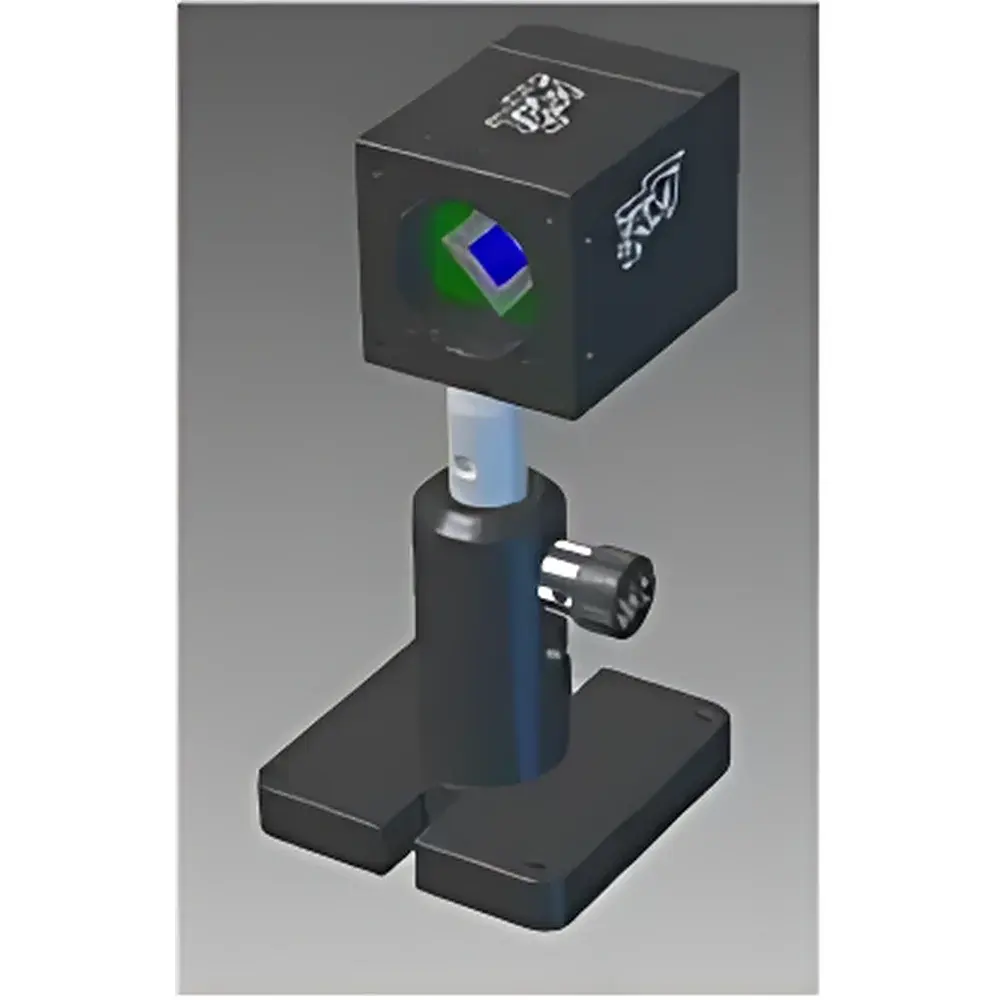
TEM Messtechnik GmbH PSD_Position_Sensitive_Detector
| Brand | TEM Messtechnik GmbH |
|---|---|
| Origin | Germany |
| Model | PSD_Position_Sensitive_Detector |
| Category | Optical Component |
| Wavelength Range (Standard) | 380–1100 nm |
| Wavelength Range (Custom) | 180–2600 nm |
| Detector Type | Dual-2D PSD-based 4D position & angle sensor |
| Position Resolution | < 10 nm (PSD 4D e), < 1 µm (PSD 4D i) |
| Angular Resolution | < 10 nrad (PSD 4D e), < 1 µrad (PSD 4D i) |
| Power Handling (CW) | 100 µW – 10 mW |
| Pulse Energy Sensitivity | > 10 nJ |
| Active Area Options | Ø4 mm, Ø10 mm |
Overview
The TEM Messtechnik GmbH PSD_Position_Sensitive_Detector is a high-precision optical sensing platform engineered for real-time, non-contact measurement of both lateral beam displacement and angular deviation in laser-based optical systems. Unlike conventional quadrant photodiodes or single-axis PSDs, this system implements a dual-2D position-sensitive detector architecture—two orthogonally aligned 2D PSD chips integrated with precision collimating and beam-splitting optics—to decouple and simultaneously quantify four independent degrees of freedom: X-position, Y-position, X-angle (pitch), and Y-angle (yaw). This 4D metrology principle enables unambiguous separation of translational drift from rotational instability—a critical capability in interferometric alignment, adaptive optics feedback loops, cavity mirror stabilization, and ultra-stable laser pointing applications. The detector operates on the lateral photoeffect principle, where incident photon flux distribution across a continuous resistive semiconductor layer generates proportional current differentials at electrode terminals; signal processing algorithms then reconstruct centroid coordinates and beam tilt with sub-microradian and sub-micrometer fidelity.
Key Features
- Dual-2D PSD architecture enabling true 4D (X, Y, θX, θY) beam characterization without mechanical scanning or computational ambiguity
- Two performance variants: PSD 4D i (industrial grade, < 1 µm / < 1 µrad resolution) and PSD 4D e (experimental grade, < 10 nm / < 10 nrad resolution)
- Broad spectral compatibility: standard silicon-based detection from 380 nm to 1100 nm; optional UV-enhanced chipsets extend response down to 180 nm and up to 2600 nm
- Flexible active area options: Ø4 mm and Ø10 mm PSD elements, optimized for beam size matching and signal-to-noise ratio scaling
- Compatible with both continuous-wave (100 µW–10 mW) and pulsed (≥10 nJ per pulse) laser sources across common laboratory and industrial wavelengths
- Modular mechanical design supports integration into OEM optical benches, vacuum-compatible mounts, and closed-loop stabilization subsystems
Sample Compatibility & Compliance
The PSD_Position_Sensitive_Detector is designed for use with free-space collimated or weakly focused laser beams. It requires no beam attenuation under nominal power conditions and maintains linearity over its full dynamic range. Calibration traceability follows ISO/IEC 17025-compliant procedures performed by TEM Messtechnik’s accredited metrology lab. Device firmware and analog output interfaces comply with industrial EMC standards (EN 61326-1) and safety requirements (IEC 61010-1). For regulated environments—including GLP laboratories and medical laser development facilities—the system supports external timestamping and raw analog voltage outputs suitable for integration with validated data acquisition platforms compliant with FDA 21 CFR Part 11 when paired with appropriate audit-trail software.
Software & Data Management
TEM provides a vendor-neutral SDK (C/C++, Python, LabVIEW, MATLAB APIs) enabling direct access to all four output channels: X/Y position voltages and θX/θY angular signals. Real-time streaming at up to 50 kHz (depending on interface and host configuration) allows for closed-loop control loop implementation. Optional TEM BeamTrack™ software offers real-time visualization, statistical analysis (drift, jitter, Allan deviation), automated calibration routines, and export to CSV, HDF5, or TDMS formats. All digital outputs include hardware timestamps synchronized to an internal 10 MHz reference clock, ensuring temporal coherence across multi-sensor experiments.
Applications
- Laser cavity alignment and long-term pointing stability monitoring in gravitational wave interferometers
- Feedback control for piezoelectric tip/tilt mirror systems in adaptive optics and laser communication terminals
- Beam walk and angular jitter quantification in ultrafast amplifier chains and OPCPA setups
- Non-contact vibration analysis of optical mounts and kinematic stages via differential PSD interrogation
- Calibration reference for autocollimators, electronic levels, and high-resolution goniometers
- UV/EUV beam diagnostics in synchrotron beamlines and laser-plasma interaction experiments (with UV-enhanced variant)
FAQ
What distinguishes a 4D PSD from a standard 2D PSD?
A 4D PSD integrates two spatially registered 2D PSDs with fixed optical geometry to resolve not only beam centroid (X,Y) but also divergence-induced angular shifts (θX, θY)—enabling full decoupling of translation and rotation effects.
Can the PSD_Position_Sensitive_Detector operate in vacuum?
Yes—the core detector module is vacuum-compatible (UHV-rated upon request); optical housing materials and feedthroughs can be specified for pressures down to 10−9 mbar.
Is custom wavelength optimization available beyond the standard 380–1100 nm range?
Yes—TEM offers application-specific PSD chipsets with antireflection coatings and substrate doping tailored for deep-UV (180–200 nm), VUV (100–200 nm), and SWIR (1100–2600 nm) operation.
How is linearity error characterized and corrected?
Linearity is verified across the full active area using NIST-traceable stage-based beam scanning; correction coefficients are provided in polynomial form and embedded in firmware or applied in post-processing.
Does the system support analog and digital output simultaneously?
Yes—standard configuration includes four low-noise analog outputs (±5 V, 16-bit effective resolution) and USB 2.0 digital interface with configurable sampling rate and trigger modes.



