
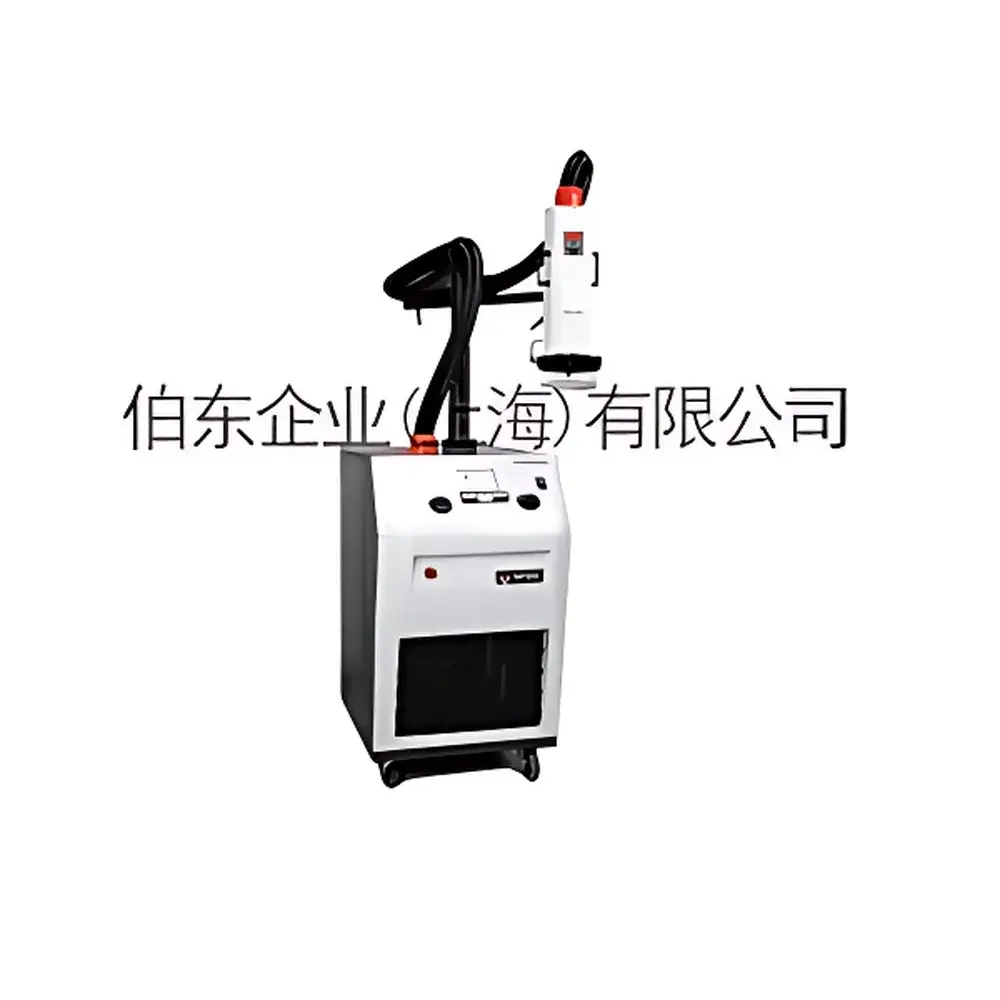
Temptronic TP04310 Thermal Shock Test System
| Brand | inTEST–Temptronic |
|---|---|
| Origin | USA |
| Model | TP04310 |
| Temperature Range | −80 °C to +225 °C |
| Airflow Output | 4–18 scfm (1.8–8.5 L/s) |
| Transition Rate | <10 s from −55 °C to +125 °C and vice versa |
| Temperature Accuracy | ±1 °C (NIST-traceable calibration) |
| Temperature Resolution | 0.1 °C |
| Sensor Type | T-type or K-type thermocouple |
| Remote Interface | IEEE-488 (GPIB), RS-232 |
| Dimensions (W×D×H) | 61 × 72.4 × 108 cm |
| Weight | 236 kg |
| Operating Height Range | 69.1–130.3 cm (extendable to 81.3–188 cm) |
| Sound Pressure Level | <65 dBA |
Overview
The Temptronic TP04310 Thermal Shock Test System is a high-performance, nitrogen-free thermal transient testing platform engineered for precision temperature cycling and rapid thermal shock evaluation of semiconductor devices, IC packages, PCB assemblies, and microelectronic components. Unlike conventional environmental chambers that rely on bulk air volume and slow convection-based heating/cooling, the TP04310 employs directed, high-velocity conditioned airflow—delivered via a proprietary ThermoStream® nozzle architecture—to achieve localized, dynamic thermal loading directly onto the device under test (DUT). Its operational principle is rooted in convective heat transfer control: by modulating refrigerant flow through an environmentally compliant, non-ozone-depleting chiller system and integrating resistive heating elements with real-time thermocouple feedback, the system delivers repeatable, NIST-traceable thermal transients across a certified range of −80 °C to +225 °C. Designed for integration into automated test environments—including ATE platforms and probe stations—the TP04310 supports both Air Mode (ambient-constrained airflow) and DUT Mode (shroud-isolated, targeted thermal jetting), enabling true single-component stress without cross-thermal influence on adjacent circuitry.
Key Features
- Fluorocarbon-free chiller architecture compliant with EPA SNAP and EU F-Gas Regulation—eliminates reliance on liquid nitrogen (LN₂) or liquid CO₂ (LCO₂)
- Patented moisture suppression system prevents condensation formation on DUT surfaces during low-temperature transitions
- Real-time closed-loop temperature control with dual-point thermocouple monitoring (T-type or K-type) at nozzle exit and DUT interface
- High-fidelity thermal ramping: <10 seconds for full transition between −55 °C and +125 °C, verified per ASTM E1545-21 Annex A2
- Operator-configurable thermal limits with hardware-enforced over-temperature cutoff (factory default: +230 °C)
- Energy-efficient idle mode: chiller enters standby during heater-only operation to reduce power consumption
- Modular mechanical integration options—including robotic arm mounting (ATS-545-M variant) and enclosed test chamber configuration (ATS-545-T variant)
Sample Compatibility & Compliance
The TP04310 accommodates a broad spectrum of microelectronic test configurations, including bare die, wire-bonded and flip-chip ICs, QFN, BGA, and LGA packages mounted on load boards or probe cards. Its localized thermal delivery eliminates thermal mass limitations inherent in chamber-based systems, permitting validation of JEDEC JESD22-A104F (Temperature Cycling) and JESD22-A106B (Thermal Shock) protocols at component level—not board level. The system meets ISO/IEC 17025 requirements for calibration traceability (NIST-certified sensor chain), supports GLP/GMP audit trails via optional software logging, and conforms to IEC 61000-4-27 for electromagnetic compatibility in lab-grade instrumentation environments. All firmware and controller logic are designed to support FDA 21 CFR Part 11-compliant electronic records when paired with validated data acquisition modules.
Software & Data Management
The TP04310 operates via embedded real-time controller firmware with dual communication pathways: IEEE-488 (GPIB) for legacy ATE synchronization and RS-232 for serial command scripting (SCPI-compliant syntax). No proprietary GUI is required; integration is achieved using standard SCPI commands (e.g., :TEMP:SET -40, :RAMP:RATE 5) or LabVIEW/VISA drivers. Temperature profiles, dwell times, cycle counts, and thermocouple readings are timestamped and exportable as CSV or ASCII log files. Optional PC-based software provides waveform visualization, pass/fail thresholding per JEDEC criteria, and automated report generation compatible with internal quality management systems (QMS). Audit logs record all parameter changes, operator IDs (via optional LDAP integration), and calibration event timestamps—fully supporting ISO 9001:2015 Clause 7.1.5 and IATF 16949 Section 8.5.1.2.
Applications
- Qualification testing of automotive-grade ICs per AEC-Q100 Rev H (including Grade 0 and Grade 1 thermal profiles)
- Failure analysis root cause isolation via accelerated thermal stress of solder joints, underfill interfaces, and die attach layers
- Reliability screening of advanced packaging technologies: 2.5D/3D IC stacks, fan-out wafer-level packages (FOWLP), and heterogeneous integration modules
- Validation of thermal interface materials (TIMs) under dynamic load conditions
- Pre-conditioning of MEMS sensors and RF front-end modules prior to parametric characterization
- Support for IPC-9701A and IPC-TR-579 accelerated life modeling inputs
FAQ
Does the TP04310 require external LN₂ or CO₂ supply?
No. It uses an integrated, self-contained chiller system with R-513A refrigerant—a low-GWP, non-toxic, non-flammable alternative compliant with ASHRAE Standard 34 and EPA SNAP Subpart G.
Can the system validate JEDEC JESD22-A104F temperature cycling profiles?
Yes. With its programmable dwell time, ramp rate, and endpoint accuracy (±1 °C), it fully satisfies the thermal profile fidelity requirements specified in JESD22-A104F Annex B.
Is remote scripting supported for automated test sequences?
Yes. Full SCPI command set enables seamless integration into Python, MATLAB, or C++-based test executive frameworks without middleware dependencies.
What safety certifications does the TP04310 carry?
It is CE-marked per EN 61010-1:2010+A1:2019 (Safety Requirements for Electrical Equipment for Measurement, Control, and Laboratory Use) and UL 61010-1 certified.
How is temperature uniformity ensured across the DUT surface?
Uniformity is maintained via calibrated nozzle alignment, laminar airflow design, and optional thermal shroud accessories that define a controlled 25–50 mm diameter thermal envelope—verified per ASTM E2202-18 Annex A3.



