
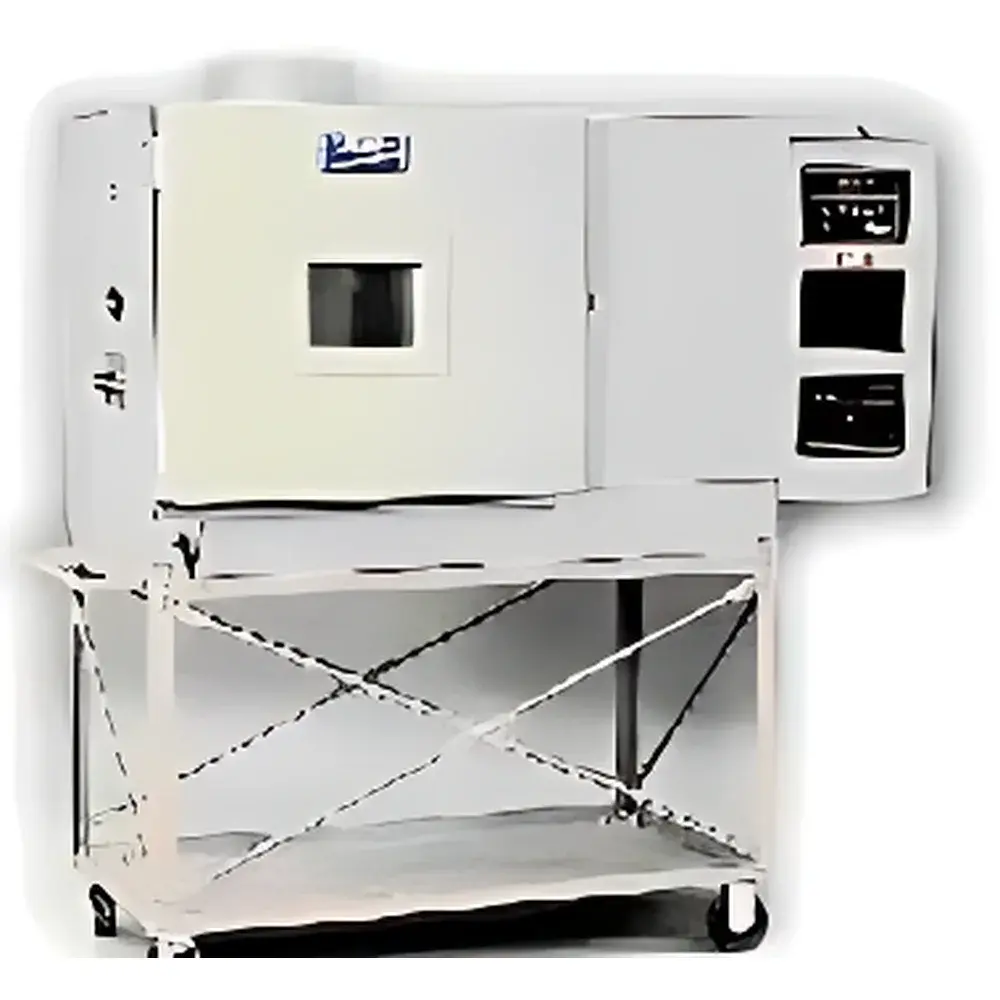
Tenney Benchmaster Environmental Test Chamber
| Origin | USA |
|---|---|
| Manufacturer Type | Authorized Distributor |
| Origin Category | Imported |
| Model | Tenney Benchmaster |
| Pricing | Upon Request |
Overview
The Tenney Benchmaster Environmental Test Chamber is a precision-engineered benchtop environmental simulation system designed for rigorous thermal and humidity conditioning in controlled laboratory and industrial settings. Built upon decades of Tenney Engineering heritage, the Benchmaster employs a closed-loop, vertically oriented recirculating airflow architecture—known as VaporFlo—to ensure exceptional spatial uniformity and temporal stability across temperature and relative humidity (RH) profiles. Its measurement principle relies on high-fidelity feedback control of conditioned air mass via PID-regulated heating, hermetic refrigeration, and saturated steam injection or desiccant-assisted dehumidification. This architecture meets the physical requirements of accelerated aging, qualification testing, and process validation per ASTM E145, ISO 16750-4, IEC 60068-2-30, and MIL-STD-810G methodologies. The chamber is not a generic incubator but a calibrated test instrument engineered for reproducible environmental stress application—particularly where traceable thermal gradients (< ±0.3 °C control tolerance) and RH fidelity (±2 % RH typical after stabilization) are mandated by quality systems.
Key Features
- Proprietary VersaTenn™ control system integrated with Watlow 942 digital controller for deterministic setpoint tracking and alarm logging
- Hermetically sealed refrigeration circuit using environmentally compliant R-404A or R-507 refrigerant
- Tenney VaporFlo™ humidity generation system delivering stable RH from 20 % to 98 % within +20 °C to +85 °C dry-bulb range (dewpoint-limited)
- Vapor-tight interior liner fabricated from 100 % continuously welded 316 stainless steel with electropolished finish
- Low-mass open-wire nichrome heating elements enabling rapid thermal response and reduced thermal inertia
- Vertical-down recirculating conditioning stream ensuring ≤ ±0.5 °C spatial uniformity (per ASTM E145 Class II specifications)
- Dual silicone door gaskets and NEC-compliant internal wiring for safety and long-term seal integrity
- 2-inch diameter access port with hermetic plug for sensor feedthroughs, power cables, or data lines
- Thermally insulated, heated viewing window (6″ × 8″) with anti-fog coating for real-time visual monitoring without thermal leakage
- Adjustable, removable stainless steel shelving supporting up to 25 kg per shelf (load-rated per ANSI Z535.4)
Sample Compatibility & Compliance
The Benchmaster accommodates a broad spectrum of test specimens—including PCB assemblies, pharmaceutical packaging, polymer components, medical device housings, and active electronic modules—without compromising environmental fidelity. Its non-corroding construction, low-outgassing interior, and absence of organic adhesives or painted surfaces comply with USP , ISO 10993-12, and FDA 21 CFR Part 11–ready audit trail configurations (when paired with LinkTenn software). All electrical subsystems meet NEC Article 422 and UL 3101-1 safety standards. Humidity control adheres to ISO 17025 traceability requirements when operated with NIST-traceable hygrometers and calibrated dewpoint sensors. The system supports GLP/GMP documentation workflows through optional redundant thermal protection alarms and event-triggered data capture.
Software & Data Management
LinkTenn™ software for Windows provides centralized, multi-chamber orchestration—enabling simultaneous control and monitoring of up to ten Benchmaster units via RS-232, RS-422, RS-485, or IEEE-488 (GPIB) interfaces. The software logs timestamped temperature/RH values at user-defined intervals (1 s to 60 min), generates ASTM-compliant test reports (including ramp/soak profiles and deviation histograms), and exports CSV/Excel-compatible datasets. When configured with optional recording instruments or third-party DAQ hardware, it satisfies FDA 21 CFR Part 11 requirements for electronic records and signatures—including role-based access control, operator audit trails, and immutable data archiving. Optional GN₂ purge and CO₂/LN₂ boost cooling modules are fully scriptable within LinkTenn’s sequence editor for complex thermal shock protocols.
Applications
- Accelerated life testing of automotive ECUs under combined thermal-humidity stress (ISO 16750-4)
- Stability studies for sterile barrier systems per ISO 11607-1
- Reliability screening of avionics hardware per MIL-STD-810G Method 507.6
- Process validation of lyophilization cycle parameters in pharmaceutical manufacturing
- Material compatibility assessment of adhesives, coatings, and encapsulants under cyclic humidity exposure
- Calibration verification of handheld hygrometers and thermometers against NIST-traceable references
- Environmental stress screening (ESS) of printed circuit board assemblies prior to burn-in
FAQ
What is the lowest achievable humidity level, and under what conditions?
With the optional external desiccant dryer, the Benchmaster achieves ≤5 % RH at temperatures up to +20 °C—verified per ISO 4677-2 dewpoint measurement methodology.
Is the chamber suitable for continuous unattended operation?
Yes—equipped with redundant thermal protection, low-water cutoff, and configurable email/SMS alerts via optional network interface modules.
Can the system be validated for GxP environments?
Absolutely—the VersaTenn controller supports IQ/OQ/PQ documentation templates, and LinkTenn software includes 21 CFR Part 11 compliance packages with electronic signature workflows.
What maintenance intervals are recommended for the VaporFlo humidity system?
Demineralizer cartridges require replacement every 6 months under typical usage; stainless steel humidifier sump cleaning is advised quarterly per Tenney PM-07 service bulletin.
Does the chamber support custom thermal shock profiles?
Yes—LinkTenn’s sequence editor enables multi-step ramp/soak/dwell cycles with programmable transition rates, dwell durations, and conditional branching based on sensor feedback.



