
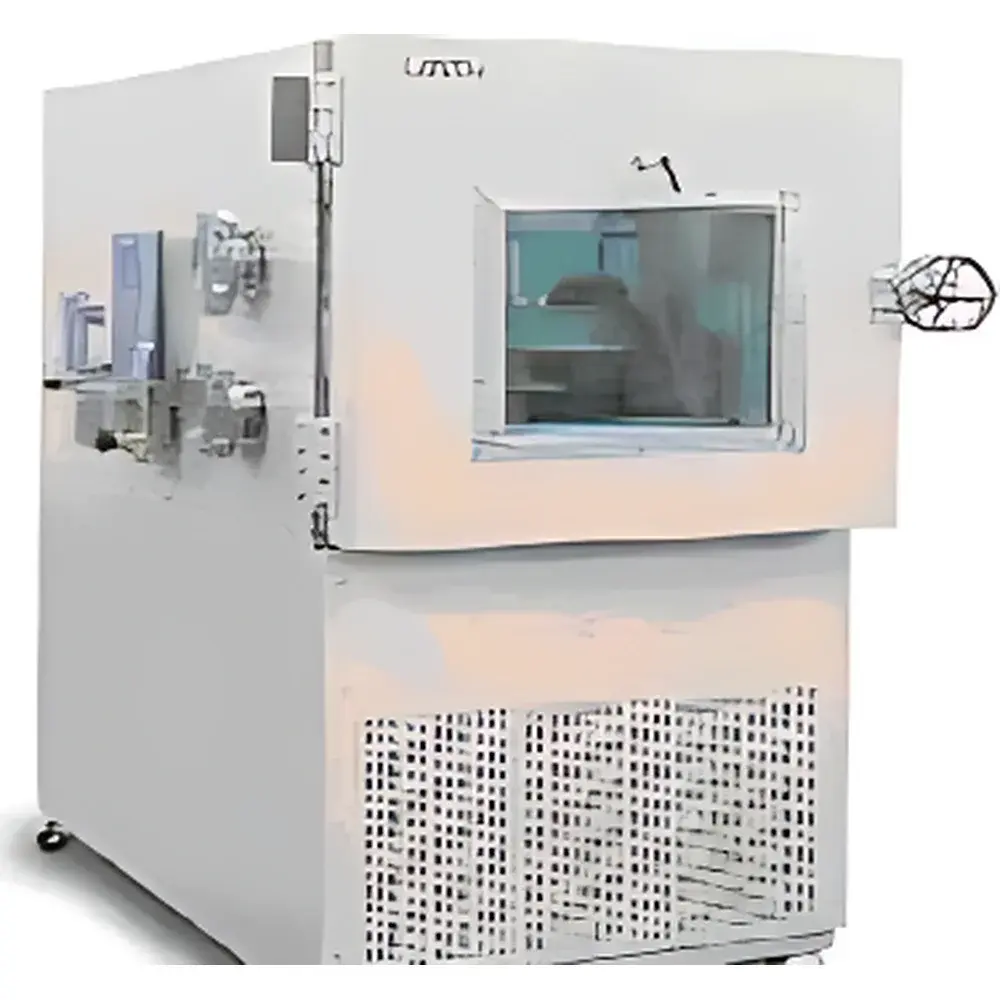
Tenneystrat Altitude Chamber
| Origin | USA |
|---|---|
| Manufacturer Type | Authorized Distributor |
| Origin Category | Imported |
| Model | Tenneystrat |
| Pricing | Upon Request |
Overview
The Tenneystrat Altitude Chamber is a high-performance environmental simulation system engineered for rigorous aerospace, defense, and electronics reliability testing. It replicates atmospheric conditions at altitudes up to 200,000 feet (≈61 km) by precisely controlling chamber pressure—corresponding to absolute pressures as low as 0.17 mm Hg—while simultaneously maintaining temperature from –70 °C to +177 °C and relative humidity from 20 % to 98 % RH (within the +20 °C to +85 °C temperature band). Its core measurement principle relies on high-accuracy linear pressure transducers calibrated to NIST-traceable standards, enabling direct altitude simulation via barometric equivalence rather than indirect vacuum estimation. Unlike conventional thermal chambers, the Tenneystrat integrates a fully sealed, all-welded stainless-steel construction with dual-compartment integrity—separating the humidity generation system from the main test volume to prevent corrosion and ensure long-term stability under cyclic low-pressure operation. The system is designed for compliance with MIL-STD-810H Method 500.7 (Altitude), RTCA DO-160G Section 4 (Altitude), and ASTM F1980 (Accelerated Aging of Sterile Barrier Systems), supporting qualification testing in regulated development workflows.
Key Features
- Fully welded 304 stainless-steel chamber body with integral gasketed door seal and helium-leak-tested integrity (≤1 × 10⁻⁶ atm·cc/s)
- Temperature control stability: ±0.3 °C after stabilization; humidity control accuracy: ±2 % RH (within operational envelope)
- Pt100 platinum resistance thermometers (PRTs) mounted per IEC 60751 Class A tolerance, with redundant sensor placement
- High-linearity piezoresistive pressure transducers for altitude measurement, traceable to NIST Standard Reference Material (SRM) 2466
- Corrosion-resistant humidity system featuring titanium-housed steam generator, PTFE-lined water reservoir, and integrated low-water-level shutdown circuitry
- Vertical downward airflow recirculation design ensuring uniform thermal and humidity distribution (±1.0 °C / ±3 % RH spatial uniformity per ASTM E145 Annex A3)
- Dual-mode vacuum architecture: standard configuration achieves 100,000 ft (8.2 mm Hg) in ≤35 minutes; optional upgrades support 150,000 ft (1.0 mm Hg) and 200,000 ft (0.17 mm Hg) performance tiers
Sample Compatibility & Compliance
The Tenneystrat accommodates test volumes from 5 ft³ (0.14 m³) to 64 ft³ (1.81 m³), supporting full-system validation of avionics enclosures, UAV components, pressure-sensitive packaging, and hermetically sealed medical devices. Humidity and altitude parameters are not concurrently attainable across the full range: maximum altitude capability under humidified conditions is limited to 60,000 ft due to condensation and vapor pressure constraints. The “R” suffix denotes humidity-capable variants (e.g., Tenneystrat-32R). All configurations comply with UL 61010-1 and CE marking requirements for laboratory equipment. System architecture supports audit-ready GLP/GMP data integrity per FDA 21 CFR Part 11 when paired with validated software (see Software & Data Management section). Calibration documentation includes as-found/as-left reports aligned with ISO/IEC 17025-accredited practices.
Software & Data Management
Control and monitoring are executed via the Tenneystrat Control Suite—a Windows-based application offering real-time multivariable trending, programmable ramp/soak profiles, and automated test sequencing. The software provides full electronic audit trail functionality—including user login tracking, parameter change logging, and timestamped event records—meeting FDA 21 CFR Part 11 requirements for signature verification and data immutability. Raw sensor data (temperature, pressure, RH, vacuum pump status) is logged at user-selectable intervals (1 s to 60 min) and exported in CSV or XML formats compatible with LIMS and statistical process control platforms. Optional IQ/OQ/PQ documentation packages are available, including protocol templates, acceptance criteria matrices, and calibration certificate cross-referencing.
Applications
- Aerospace component validation: outgassing assessment, seal integrity testing, and pressure differential survivability per MIL-STD-810H
- Electronics reliability: detection of latent defects in PCBAs induced by rapid decompression (popcorning), solder joint fatigue, and conformal coating delamination
- Medical device packaging: accelerated aging and leak testing of sterile barrier systems under simulated transport altitudes
- Automotive ADAS sensor qualification: functional testing of radar/LiDAR modules under combined low-pressure and thermal stress
- Research applications: atmospheric physics modeling, material permeability studies, and cryogenic vacuum compatibility screening
FAQ
What is the maximum simultaneous altitude and temperature combination?
The system supports up to 60,000 ft altitude when operating within the temperature range of –40 °C to +85 °C. Higher altitudes (up to 200,000 ft) require dry, non-humidified conditions and are limited to temperatures between –70 °C and +177 °C.
Does the chamber meet MIL-STD-810H altitude testing requirements?
Yes—the Tenneystrat satisfies Method 500.7 for both functional and survival testing, including rate-of-change specifications and dwell time tolerances, with documented traceability to DoD-approved test laboratories.
How is humidity controlled at low pressures?
Humidity is generated only within the specified temperature band (+20 °C to +85 °C) and is disabled below 100,000 ft to prevent condensation and maintain system integrity. The dew point is stabilized at 3 °C during humidification cycles.
Is 50 Hz power operation supported?
Yes, but with minor derating: vacuum pump speed and thermal recovery rates decrease by approximately 8–12 % compared to 60 Hz operation. Full specification compliance is guaranteed only at 60 Hz, 24 °C ambient, sea-level conditions.
Can the system be integrated into an existing facility SCADA network?
Standard Modbus TCP and optional Ethernet/IP interfaces enable seamless integration with industrial control systems. OPC UA support is available upon request for enterprise-level interoperability.



