
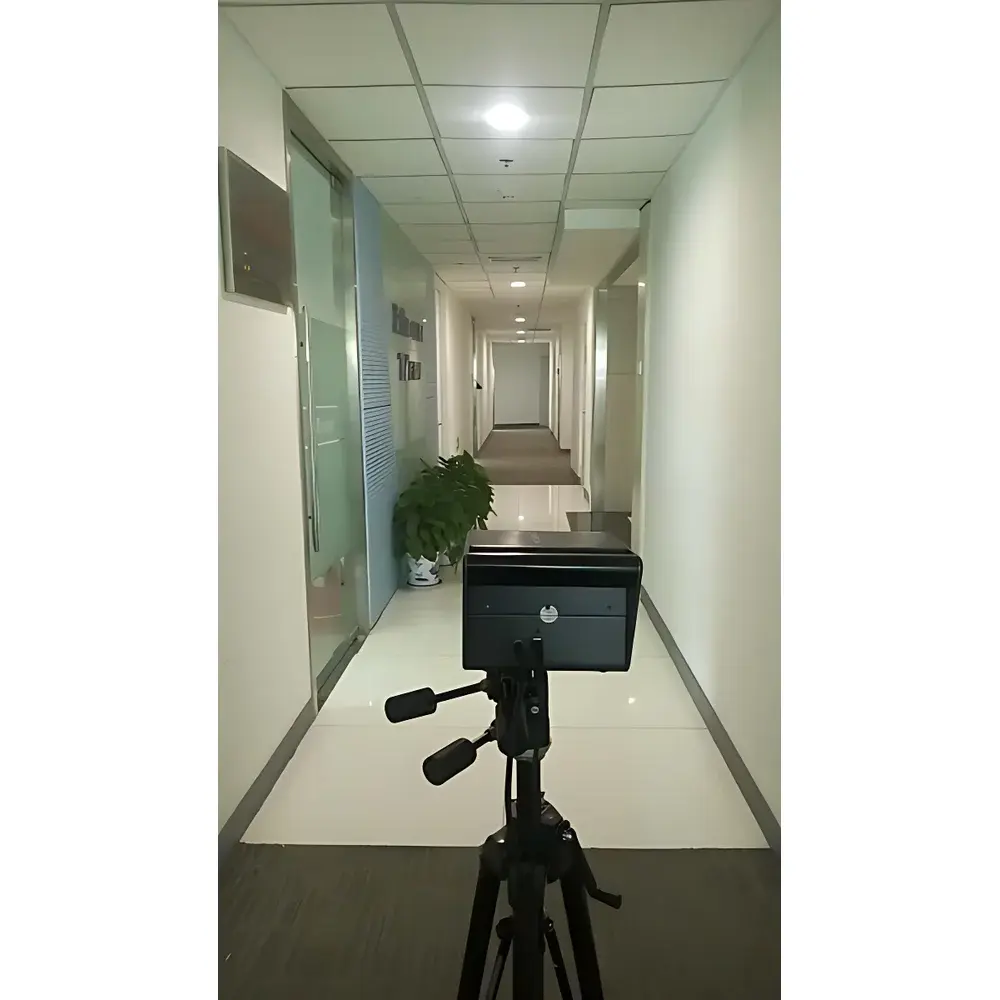
TEO Online Glare Measurement System
| Brand | TEO |
|---|---|
| Origin | Beijing, China |
| Manufacturer Type | Authorized Distributor |
| Product Origin | Domestic (China) |
| Model | Ture8-based Integrated Glare Measurement System |
| Price | USD 27,500 (approx. ¥200,000) |
| Imaging Luminance Meter | Ture8 (PR-930 equivalent) |
| Sensor | Instrument-grade monochrome CCD |
| Resolution | 3296 × 2472 (≥8.1 MP) |
| FOV (8 mm lens) | 150° × 120° |
| FOV (14 mm lens) | 60° × 50° |
| Luminance Range | 0.005–5×10⁶ cd/m² (with ND filters) |
| Luminance Accuracy | ±5% (8 mm lens, CIE 1931-weighted) |
| Calibration Suite | Uniform-field, lens distortion, gradient, stray-light, illuminance, luminance/chrominance, and geometric scaling calibration |
| Compliant Standards | CIE 117:1995 (UGR), CIE 112:1994 (GR), CIE 140:2000 & CIE 150:2003 (TI), ISO/CIE joint guidance on glare assessment in lighting design |
Overview
The TEO Online Glare Measurement System is a calibrated, standards-compliant imaging photometry platform engineered for real-time, in-situ evaluation of visual discomfort and disability glare in architectural, roadway, and industrial lighting environments. It implements the three internationally recognized glare metrics—Unified Glare Rating (UGR), Glare Rating (GR), and Threshold Increment (TI)—in full accordance with CIE Technical Reports 117:1995, 112:1994, 140:2000, and 150:2003. The system’s core measurement principle relies on high-dynamic-range (HDR) imaging luminance capture using a CIE 1931 photopic spectral response–matched monochrome CCD sensor, coupled with ultra-wide-angle optics (8 mm f/1.4 lens) to satisfy the minimum solid angle requirement (0.0003 sr) and field-of-view constraint (≥143.14° diagonal) mandated by CIE 117:1995 for UGR computation. Unlike conventional spot photometers or low-resolution imaging systems, this platform delivers spatially resolved luminance maps at ≥8.1 megapixels, enabling pixel-level radiometric analysis across complex luminous scenes—including LED arrays, streetlight clusters, and façade-integrated lighting installations.
Key Features
- Integrated imaging luminance meter (Ture8 series) with instrument-grade monochrome CCD sensor, delivering ≥8.1 MP resolution (3296 × 2472) and luminance dynamic range from 0.005 cd/m² to 5×10⁶ cd/m² (extendable via calibrated neutral density filters)
- Dual-lens configuration: 8 mm lens (150° × 120° FOV) for UGR-compliant wide-field capture; 14 mm lens (60° × 50° FOV) for higher spatial resolution in GR/TI applications requiring focused scene analysis
- Comprehensive optical calibration suite including uniform-field luminance calibration, lens distortion mapping, gradient correction, stray-light compensation, illuminance-to-luminance traceability, and geometric scaling verification—each traceable to NIM (National Institute of Metrology, China) reference standards
- Real-time acquisition and automated glare metric computation: UGR, GR, and TI values are derived directly from raw luminance images without manual region-of-interest selection or post-hoc interpolation
- Glare 2.0 software platform supporting automated fixture detection, adaptive exposure control, HDR merging, CIE-compliant V(λ) weighting, and configurable reporting templates compliant with ISO/IEC 17025 documentation requirements
Sample Compatibility & Compliance
The system is validated for use in indoor lighting validation (e.g., office, classroom, hospital settings per EN 12464-1), outdoor roadway lighting assessment (per CIE 115, EN 13201, and IES RP-8), and façade lighting compliance checks. It accommodates static and quasi-static light sources—including continuous-wave LEDs, fluorescent tubes, HID lamps, and hybrid luminaires—with no moving parts required during measurement. All glare calculations strictly follow the mathematical definitions and weighting functions specified in CIE 117:1995 (UGR), CIE 112:1994 (GR), and CIE 140:2000 (TI). The system’s luminance accuracy (±5% at 8 mm lens configuration) meets the tolerance limits defined in CIE 224:2017 for imaging luminance meters used in glare evaluation. It supports audit-ready data export with embedded metadata (exposure time, lens ID, calibration timestamp, operator ID) required under GLP and ISO/IEC 17025 quality management frameworks.
Software & Data Management
Glare 2.0 is a Windows-based, FDA 21 CFR Part 11–ready application offering role-based user access, electronic signature capability, and full audit trail logging for all measurement sessions, parameter changes, and report generation events. Raw image files are stored in lossless TIFF format with embedded EXIF and custom XML metadata tags containing calibration coefficients, lens distortion maps, and CIE standard observer parameters. The software enables batch processing of time-series measurements for longitudinal glare monitoring (e.g., seasonal daylight impact studies), and exports results in CSV, PDF, and XML formats compatible with LCA (Lighting Calculation Archive) schema. Optional API integration supports direct data ingestion into BIM platforms (Revit, ArchiCAD) and lighting simulation tools (DIALux evo, AGi32) for closed-loop design validation workflows.
Applications
- Architectural lighting design validation against UGR ≤ 19 (offices), ≤ 16 (classrooms), and ≤ 22 (industrial spaces) per EN 12464-1
- Roadway lighting compliance testing for GR < 55 (motorways) and TI < 10% (tunnels) per CIE 115 and national highway standards
- LED retrofit project evaluation—quantifying glare increase due to higher luminance and smaller source size
- Daylight harvesting system commissioning—assessing glare risk under varying solar azimuth/elevation conditions
- Quality assurance in luminaire manufacturing—verifying angular luminance distribution and hotspot suppression efficacy
FAQ
Does the system support automated UGR calculation per CIE 117:1995?
Yes. Glare 2.0 implements the exact UGR formula, including the Guth position index table, background luminance averaging over 0.1 sr solid angle, and source luminance weighting—all computed directly from calibrated luminance images.
Is lens distortion correction applied in real time during acquisition?
Yes. A pre-characterized distortion map is applied during image acquisition and HDR merging, ensuring geometric fidelity for accurate solid angle and position indexing per CIE 117 Annex A.
Can the system be used for photometric testing beyond glare metrics?
Yes. With optional calibration kits, it supports luminous intensity distribution (LID) reconstruction, zonal lumen reporting, and chromaticity mapping per CIE 13.3 and IES LM-79–2015 protocols.
What is the traceability basis for the ±5% luminance accuracy claim?
Calibration is performed against NIM-certified standard luminance sources (Class A, 0.5% uncertainty) across the full dynamic range, with full uncertainty budgeting per GUM (JCGM 100:2008) reported in the Certificate of Calibration.
Is remote operation supported for unattended long-term monitoring?
Yes. The system supports scheduled measurements via Windows Task Scheduler, network-triggered acquisition, and secure FTP/SFTP upload of processed reports to centralized servers.




